 Add to Chrome
 Add to Firefox
 Add to Edge
Temporally Consistent Label Interpolation for Robust Surgical Multi-Task Learning under Challenging Conditions
Jun 25, 2026
Effective multi-task learning for surgical scene understanding is fundamentally hindered by annotation granularity mismatch; temporal workflow tasks such as phase recognition, step recognition and anticipation benefit from dense frame-level supervision, whereas pixel-level spatial tasks including instrument segmentation and action recognition are only sparsely annotated on selected keyframes due to prohibitive labeling costs. This supervision imbalance undermines shared representation learning and limits joint optimization across heterogeneous surgical tasks. To address this, we propose Flow-guided Annotation for Robust Operating Scenes (FAROS), a flow-guided label interpolation framework, that combines zero-shot segmentation-based mask propagation with optical flow estimation to overcome the limitations of appearance-based propagation under challenging surgical conditions such as occlusion, smoke, and motion blur, generating temporally consistent dense pseudo labels from sparse keyframe annotations. The densified instrument masks and action labels are integrated into a unified Transformer-based multi-task framework that jointly learns surgical phase recognition, step recognition, anticipation, instrument segmentation, and action recognition, enabling balanced optimization between dense temporal supervision and sparse spatial supervision. The label interpolation quality of FAROS is first validated on the DAVIS 2017 benchmark under a sparse ground-truth protocol, confirming robust propagation beyond the surgical domain. Extensive experiments on GraSP, MISAW, and AutoLaparo benchmarks further demonstrate that FAROS significantly improves cross-task representation learning and enhances holistic surgical scene understanding performance across spatio-temporal tasks.

IMPACT: Industrial Machine Perception via Acoustic Cognitive Transformer
Jul 09, 2025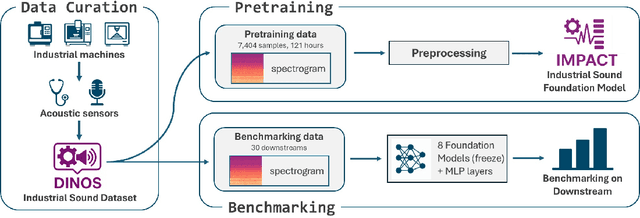
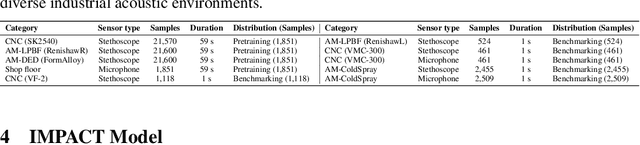
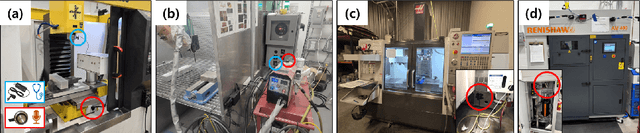
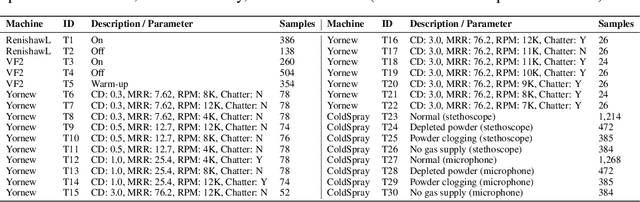
Acoustic signals from industrial machines offer valuable insights for anomaly detection, predictive maintenance, and operational efficiency enhancement. However, existing task-specific, supervised learning methods often scale poorly and fail to generalize across diverse industrial scenarios, whose acoustic characteristics are distinct from general audio. Furthermore, the scarcity of accessible, large-scale datasets and pretrained models tailored for industrial audio impedes community-driven research and benchmarking. To address these challenges, we introduce DINOS (Diverse INdustrial Operation Sounds), a large-scale open-access dataset. DINOS comprises over 74,149 audio samples (exceeding 1,093 hours) collected from various industrial acoustic scenarios. We also present IMPACT (Industrial Machine Perception via Acoustic Cognitive Transformer), a novel foundation model for industrial machine sound analysis. IMPACT is pretrained on DINOS in a self-supervised manner. By jointly optimizing utterance and frame-level losses, it captures both global semantics and fine-grained temporal structures. This makes its representations suitable for efficient fine-tuning on various industrial downstream tasks with minimal labeled data. Comprehensive benchmarking across 30 distinct downstream tasks (spanning four machine types) demonstrates that IMPACT outperforms existing models on 24 tasks, establishing its superior effectiveness and robustness, while providing a new performance benchmark for future research.