 Add to Chrome
 Add to Firefox
 Add to Edge
EdgeXpert: An Edge Device for Memory-Efficient LLM Inference with Mixture-of-Experts and Speculative Decoding
Aug 05, 2026
On-device deployment of Large Language Models (LLMs) has become essential for personalized edge applications. A primary bottleneck is external memory access (EMA) in feed-forward network (FFN) layers. Speculative decoding and mixture-of-experts (MoE) are promising solutions. Speculative decoding reduces the number of decoding stages by generating multiple tokens per stage, and MoE minimizes per-stage cost through sparse expert activation. However, there is an incompatibility when combining these two techniques. We propose EdgeXpert, a software-hardware co-designed LLM accelerator that resolves this incompatibility. In the prefill stage, the prompt-wise expert reuse reformulates routing as prompt-level expert reuse rather than independent per-token expert selection. It identifies important tokens using a lightweight encoder, constructs a shared expert set from them, and routes less important tokens with a reduced expert budget to lower expert EMA. In the decode stage, depth-aware expert coalescing exploits the contextual similarity and mutual exclusivity of same-depth candidate tokens. Rather than loading the union of all required channels, EdgeXpert loads only salient channels and applies computational calibration to recover accuracy without additional memory access. Synthesized in Samsung 28nm technology at 800 MHz, EdgeXpert achieves up to 56.3% latency reduction and 44.1% energy reduction compared to prior works, while maintaining near-baseline accuracy.

LightRot: A Light-Weighted Rotation Scheme and Architecture for Accurate Low-Bit Large Language Model Inference
Jul 30, 2026As large language models (LLMs) continue to demonstrate exceptional capabilities across various domains, the challenge of achieving energy-efficient and accurate inference becomes increasingly critical. This work presents LightRot, a lightweight rotation scheme and dedicated hardware accelerator designed for low-bit LLM inference. The proposed architecture integrates Grouped Local Rotation (GLR) and Outlier Direction Aligning (ODA) algorithms with a hierarchical Fast Hadamard Transform (FHT)-based rotation unit to address key challenges in low-bit quantization, including the energy overhead of rotation operations. The proposed accelerator, implemented in a 28nm CMOS process, achieves a peak energy efficiency of 27.4 TOPS/W for 4-bit inference, surpassing prior state-of-the-art designs. Unlike conventional approaches that rely on higher-precision inference or evaluate on basic language modeling tasks like GPT-2, LightRot is optimized for advanced models such as LLaMA2-13B and LLaMA3-8B. Its performance is further validated on MT-Bench, demonstrating robust applicability to real-world conversational scenarios and redefining benchmarks for chat-based AI systems. By synergizing algorithmic innovations and hardware efficiency, this work sets a new paradigm for scalable, low-bit LLM inference, paving the way for sustainable AI advancements.
* 13 pages, journal version. Published in IEEE Journal on Emerging and Selected Topics in Circuits and Systems (JETCAS), vol. 15, no. 2, pp. 231-243, 2025, DOI: 10.1109/JETCAS.2025.3558300
ELMoE-3D: Leveraging Intrinsic Elasticity of MoE for Hybrid-Bonding-Enabled Self-Speculative Decoding in On-Premises Serving
Apr 16, 2026Mixture-of-Experts (MoE) models have become the dominant architecture for large-scale language models, yet on-premises serving remains fundamentally memory-bound as batching turns sparse per-token compute into dense memory activation. Memory-centric architectures (PIM, NMP) improve bandwidth but leave compute underutilized under MoE's low arithmetic intensity at high batch sizes. Speculative decoding (SD) trades idle compute for fewer target invocations, yet verification must load experts even for rejected tokens, severely limiting its benefit in MoE especially at low batch sizes. We propose ELMoE-3D, a hybrid-bonding (HB)-based HW-SW co-designed framework that unifies cache-based acceleration and speculative decoding to offer overall speedup across batch sizes. We identify two intrinsic elasticity axes of MoE-expert and bit-and jointly scale them to construct Elastic Self-Speculative Decoding (Elastic-SD), which serves as both an expert cache and a strongly aligned self-draft model accelerated by high HB bandwidth. Our LSB-augmented bit-sliced architecture exploits inherent redundancy in bit-slice representations to natively support bit-nested execution. On our 3D-stacked hardware, ELMoE-3D achieves an average $6.6\times$ speedup and $4.4\times$ energy efficiency gain over naive MoE serving on xPU across batch sizes 1-16, and delivers $2.2\times$ speedup and $1.4\times$ energy efficiency gain over the best-performing prior accelerator baseline.
FlashMoE: Reducing SSD I/O Bottlenecks via ML-Based Cache Replacement for Mixture-of-Experts Inference on Edge Devices
Jan 22, 2026Recently, Mixture-of-Experts (MoE) models have gained attention for efficiently scaling large language models. Although these models are extremely large, their sparse activation enables inference to be performed by accessing only a fraction of the model at a time. This property opens the possibility of on-device inference of MoE, which was previously considered infeasible for such large models. Consequently, various systems have been proposed to leverage this sparsity and enable efficient MoE inference for edge devices. However, previous MoE inference systems like Fiddler[8] or DAOP[13] rely on DRAM-based offloading and are not suitable for memory constrained on-device environments. As recent MoE models grow to hundreds of gigabytes, RAM-offloading solutions become impractical. To address this, we propose FlashMoE, a system that offloads inactive experts to SSD, enabling efficient MoE inference under limited RAM. FlashMoE incorporates a lightweight ML-based caching strategy that adaptively combines recency and frequency signals to maximize expert reuse, significantly reducing storage I/O. In addition, we built a user-grade desktop platform to demonstrate the practicality of FlashMoE. On this real hardware setup, FlashMoE improves cache hit rate by up to 51% over well-known offloading policies such as LRU and LFU, and achieves up to 2.6x speedup compared to existing MoE inference systems.
SeVeDo: A Heterogeneous Transformer Accelerator for Low-Bit Inference via Hierarchical Group Quantization and SVD-Guided Mixed Precision
Dec 15, 2025Low-bit quantization is a promising technique for efficient transformer inference by reducing computational and memory overhead. However, aggressive bitwidth reduction remains challenging due to activation outliers, leading to accuracy degradation. Existing methods, such as outlier-handling and group quantization, achieve high accuracy but incur substantial energy consumption. To address this, we propose SeVeDo, an energy-efficient SVD-based heterogeneous accelerator that structurally separates outlier-sensitive components into a high-precision low-rank path, while the remaining computations are executed in a low-bit residual datapath with group quantization. To further enhance efficiency, Hierarchical Group Quantization (HGQ) combines coarse-grained floating-point scaling with fine-grained shifting, effectively reducing dequantization cost. Also, SVD-guided mixed precision (SVD-MP) statically allocates higher bitwidths to precision-sensitive components identified through low-rank decomposition, thereby minimizing floating-point operation cost. Experimental results show that SeVeDo achieves a peak energy efficiency of 13.8TOPS/W, surpassing conventional designs, with 12.7TOPS/W on ViT-Base and 13.4TOPS/W on Llama2-7B benchmarks.
A 23 $μ$W Keyword Spotting IC with Ring-Oscillator-Based Time-Domain Feature Extraction
Aug 01, 2022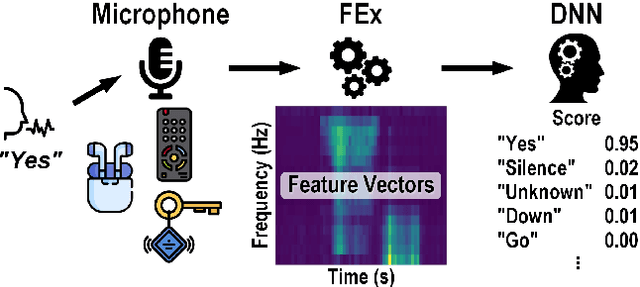
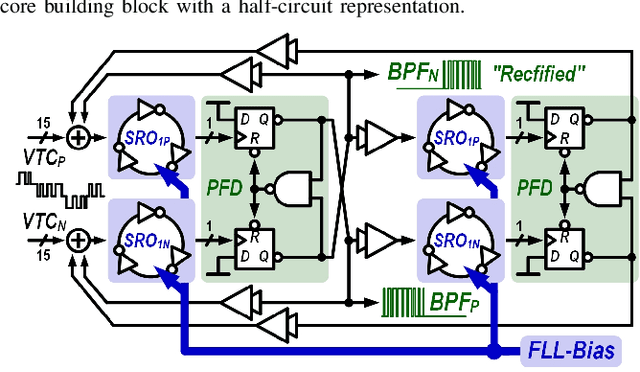
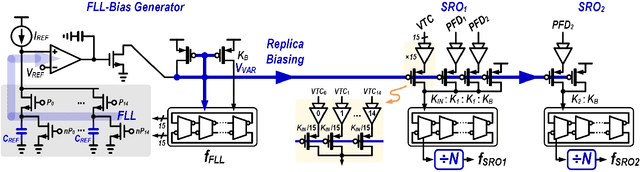
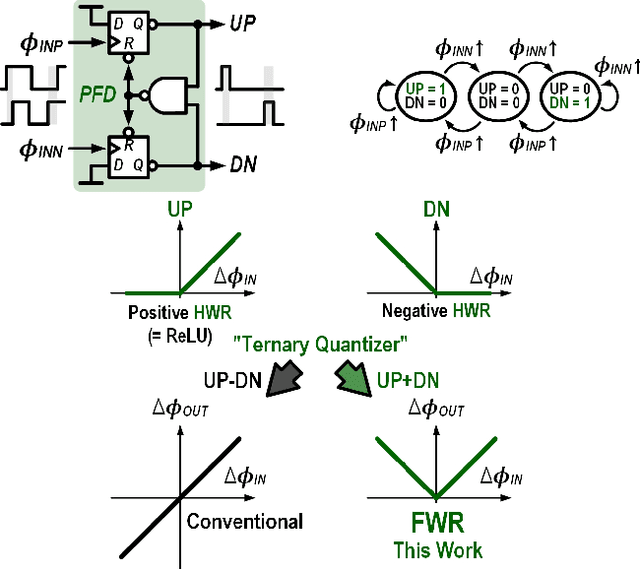
This article presents the first keyword spotting (KWS) IC which uses a ring-oscillator-based time-domain processing technique for its analog feature extractor (FEx). Its extensive usage of time-encoding schemes allows the analog audio signal to be processed in a fully time-domain manner except for the voltage-to-time conversion stage of the analog front-end. Benefiting from fundamental building blocks based on digital logic gates, it offers a better technology scalability compared to conventional voltage-domain designs. Fabricated in a 65 nm CMOS process, the prototyped KWS IC occupies 2.03mm$^{2}$ and dissipates 23 $\mu$W power consumption including analog FEx and digital neural network classifier. The 16-channel time-domain FEx achieves 54.89 dB dynamic range for 16 ms frame shift size while consuming 9.3 $\mu$W. The measurement result verifies that the proposed IC performs a 12-class KWS task on the Google Speech Command Dataset (GSCD) with >86% accuracy and 12.4 ms latency.
Energy-efficient Dense DNN Acceleration with Signed Bit-slice Architecture
Mar 15, 2022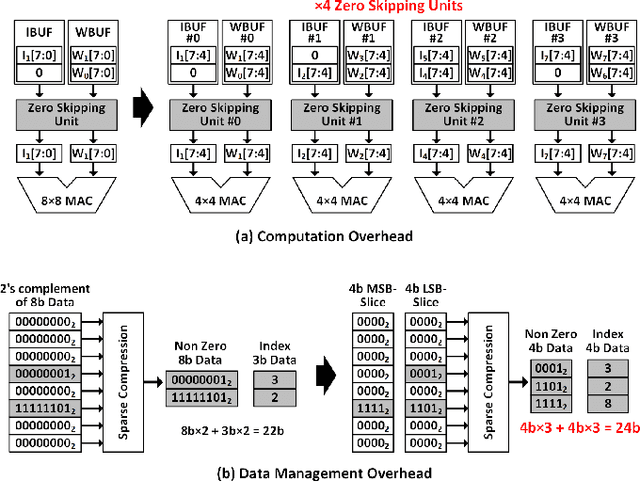
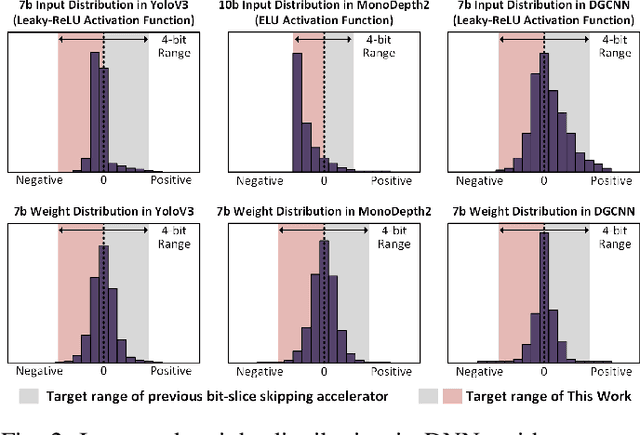
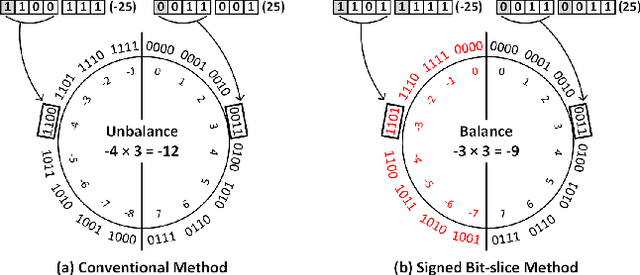
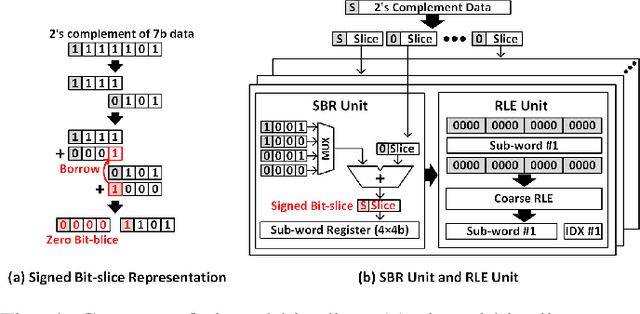
As the number of deep neural networks (DNNs) to be executed on a mobile system-on-chip (SoC) increases, the mobile SoC suffers from the real-time DNN acceleration within its limited hardware resources and power budget. Although the previous mobile neural processing units (NPUs) take advantage of low-bit computing and exploitation of the sparsity, it is incapable of accelerating high-precision and dense DNNs. This paper proposes energy-efficient signed bit-slice architecture which accelerates both high-precision and dense DNNs by exploiting a large number of zero values of signed bit-slices. Proposed signed bit-slice representation (SBR) changes signed $1111_{2}$ bit-slice to $0000_{2}$ by borrowing a $1$ value from its lower order of bit-slice. As a result, it generates a large number of zero bit-slices even in dense DNNs. Moreover, it balances the positive and negative values of 2's complement data, allowing bit-slice based output speculation which pre-computes high order of bit-slices and skips the remaining dense low order of bit-slices. The signed bit-slice architecture compresses and skips the zero input signed bit-slices, and the zero skipping unit also supports the output skipping by masking the speculated inputs as zero. Additionally, the heterogeneous network-on-chip (NoC) benefits the exploitation of data reusability and reduction of transmission bandwidth. The paper introduces a specialized instruction set architecture (ISA) and a hierarchical instruction decoder for the control of the signed bit-slice architecture. Finally, the signed bit-slice architecture outperforms the previous bit-slice accelerator, Bit-fusion, over $\times3.65$ higher area-efficiency, $\times3.88$ higher energy-efficiency, and $\times5.35$ higher throughput.
GST: Group-Sparse Training for Accelerating Deep Reinforcement Learning
Jan 24, 2021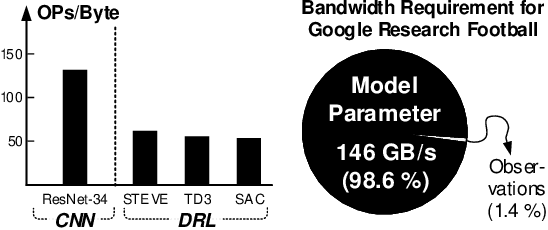
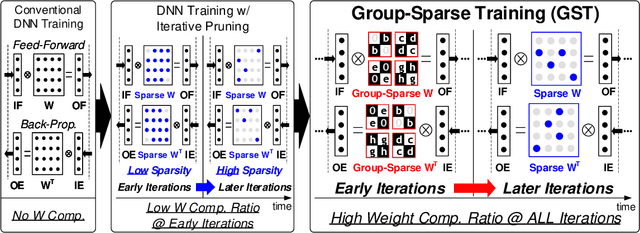
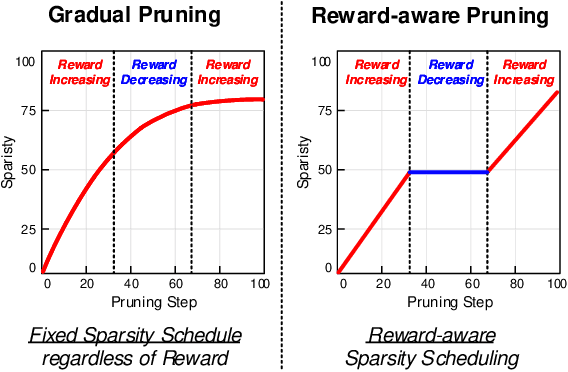
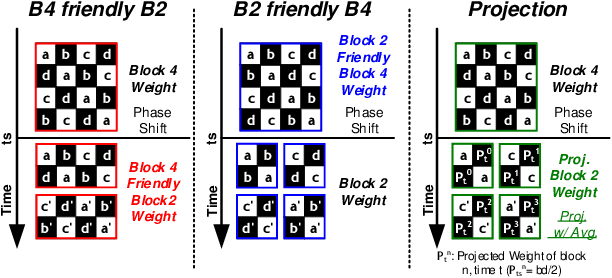
Deep reinforcement learning (DRL) has shown remarkable success in sequential decision-making problems but suffers from a long training time to obtain such good performance. Many parallel and distributed DRL training approaches have been proposed to solve this problem, but it is difficult to utilize them on resource-limited devices. In order to accelerate DRL in real-world edge devices, memory bandwidth bottlenecks due to large weight transactions have to be resolved. However, previous iterative pruning not only shows a low compression ratio at the beginning of training but also makes DRL training unstable. To overcome these shortcomings, we propose a novel weight compression method for DRL training acceleration, named group-sparse training (GST). GST selectively utilizes block-circulant compression to maintain a high weight compression ratio during all iterations of DRL training and dynamically adapt target sparsity through reward-aware pruning for stable training. Thanks to the features, GST achieves a 25 \%p $\sim$ 41.5 \%p higher average compression ratio than the iterative pruning method without reward drop in Mujoco Halfcheetah-v2 and Mujoco humanoid-v2 environment with TD3 training.