 Add to Chrome
 Add to Firefox
 Add to Edge
EdgeXpert: An Edge Device for Memory-Efficient LLM Inference with Mixture-of-Experts and Speculative Decoding
Aug 05, 2026
On-device deployment of Large Language Models (LLMs) has become essential for personalized edge applications. A primary bottleneck is external memory access (EMA) in feed-forward network (FFN) layers. Speculative decoding and mixture-of-experts (MoE) are promising solutions. Speculative decoding reduces the number of decoding stages by generating multiple tokens per stage, and MoE minimizes per-stage cost through sparse expert activation. However, there is an incompatibility when combining these two techniques. We propose EdgeXpert, a software-hardware co-designed LLM accelerator that resolves this incompatibility. In the prefill stage, the prompt-wise expert reuse reformulates routing as prompt-level expert reuse rather than independent per-token expert selection. It identifies important tokens using a lightweight encoder, constructs a shared expert set from them, and routes less important tokens with a reduced expert budget to lower expert EMA. In the decode stage, depth-aware expert coalescing exploits the contextual similarity and mutual exclusivity of same-depth candidate tokens. Rather than loading the union of all required channels, EdgeXpert loads only salient channels and applies computational calibration to recover accuracy without additional memory access. Synthesized in Samsung 28nm technology at 800 MHz, EdgeXpert achieves up to 56.3% latency reduction and 44.1% energy reduction compared to prior works, while maintaining near-baseline accuracy.

Quasi-Static Analysis on Transoral Surgical Tendon-Driven Articulated Robot Units
Nov 07, 2022Wire actuation in tendon-driven continuum robots enables the transmission of force from a distance, but it is understood that tension control problems can arise when a pulley is used to actuate two cables in a push-pull mode. This paper analyzes the relationship between angle of rotation, pressure, as well as variables of a single continuum unit in a quasi-static equilibrium. The primary objective of the quasi-static analysis was to output pressure and the analysis, given the tensions applied. Static equilibrium condition was established, and the bisection method was carried out for the angle of rotation. The function for the bisection method considered pressure-induced forces, friction forces, and weight. {\theta} was 17.14{\deg}, and p was 405.6 Pa when Tl and Ts were given the values of 1 N and 2 N, respectively. The results seemed to be consistent with the preliminary design specification, calling for further simulations and experiments.
Deep reinforcement learning for guidewire navigation in coronary artery phantom
Oct 05, 2021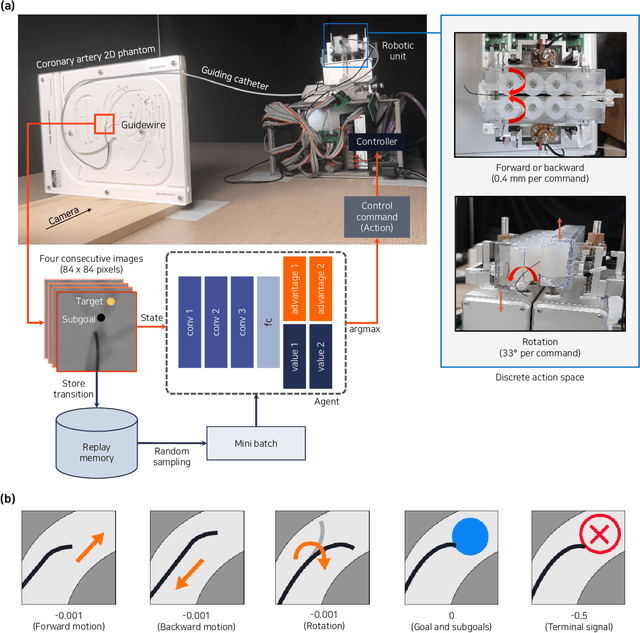
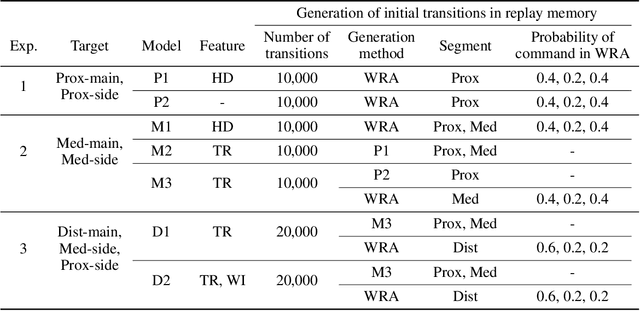
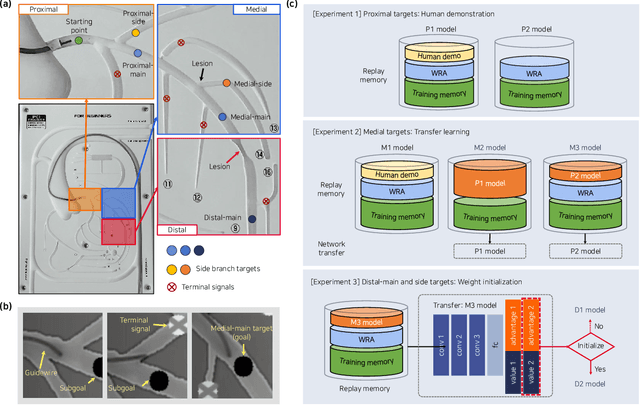
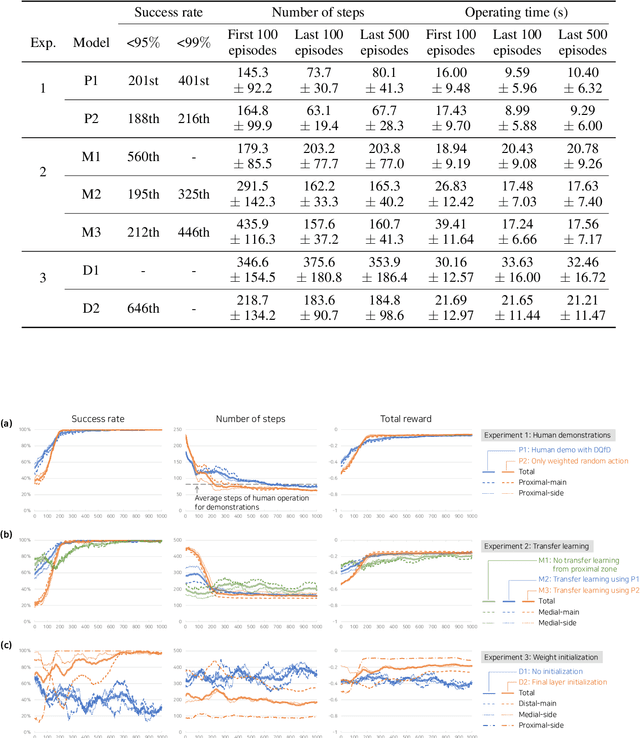
In percutaneous intervention for treatment of coronary plaques, guidewire navigation is a primary procedure for stent delivery. Steering a flexible guidewire within coronary arteries requires considerable training, and the non-linearity between the control operation and the movement of the guidewire makes precise manipulation difficult. Here, we introduce a deep reinforcement learning(RL) framework for autonomous guidewire navigation in a robot-assisted coronary intervention. Using Rainbow, a segment-wise learning approach is applied to determine how best to accelerate training using human demonstrations with deep Q-learning from demonstrations (DQfD), transfer learning, and weight initialization. `State' for RL is customized as a focus window near the guidewire tip, and subgoals are placed to mitigate a sparse reward problem. The RL agent improves performance, eventually enabling the guidewire to reach all valid targets in `stable' phase. Our framework opens anew direction in the automation of robot-assisted intervention, providing guidance on RL in physical spaces involving mechanical fatigue.