 Add to Chrome
 Add to Firefox
 Add to Edge
EdgeXpert: An Edge Device for Memory-Efficient LLM Inference with Mixture-of-Experts and Speculative Decoding
Aug 05, 2026
On-device deployment of Large Language Models (LLMs) has become essential for personalized edge applications. A primary bottleneck is external memory access (EMA) in feed-forward network (FFN) layers. Speculative decoding and mixture-of-experts (MoE) are promising solutions. Speculative decoding reduces the number of decoding stages by generating multiple tokens per stage, and MoE minimizes per-stage cost through sparse expert activation. However, there is an incompatibility when combining these two techniques. We propose EdgeXpert, a software-hardware co-designed LLM accelerator that resolves this incompatibility. In the prefill stage, the prompt-wise expert reuse reformulates routing as prompt-level expert reuse rather than independent per-token expert selection. It identifies important tokens using a lightweight encoder, constructs a shared expert set from them, and routes less important tokens with a reduced expert budget to lower expert EMA. In the decode stage, depth-aware expert coalescing exploits the contextual similarity and mutual exclusivity of same-depth candidate tokens. Rather than loading the union of all required channels, EdgeXpert loads only salient channels and applies computational calibration to recover accuracy without additional memory access. Synthesized in Samsung 28nm technology at 800 MHz, EdgeXpert achieves up to 56.3% latency reduction and 44.1% energy reduction compared to prior works, while maintaining near-baseline accuracy.

Optimizing Retrieval Strategies for Financial Question Answering Documents in Retrieval-Augmented Generation Systems
Mar 19, 2025Retrieval-Augmented Generation (RAG) has emerged as a promising framework to mitigate hallucinations in Large Language Models (LLMs), yet its overall performance is dependent on the underlying retrieval system. In the finance domain, documents such as 10-K reports pose distinct challenges due to domain-specific vocabulary and multi-hierarchical tabular data. In this work, we introduce an efficient, end-to-end RAG pipeline that enhances retrieval for financial documents through a three-phase approach: pre-retrieval, retrieval, and post-retrieval. In the pre-retrieval phase, various query and corpus preprocessing techniques are employed to enrich input data. During the retrieval phase, we fine-tuned state-of-the-art (SOTA) embedding models with domain-specific knowledge and implemented a hybrid retrieval strategy that combines dense and sparse representations. Finally, the post-retrieval phase leverages Direct Preference Optimization (DPO) training and document selection methods to further refine the results. Evaluations on seven financial question answering datasets-FinDER, FinQABench, FinanceBench, TATQA, FinQA, ConvFinQA, and MultiHiertt-demonstrate substantial improvements in retrieval performance, leading to more accurate and contextually appropriate generation. These findings highlight the critical role of tailored retrieval techniques in advancing the effectiveness of RAG systems for financial applications. A fully replicable pipeline is available on GitHub: https://github.com/seohyunwoo-0407/GAR.
Sequential Recommendation on Temporal Proximities with Contrastive Learning and Self-Attention
Feb 18, 2024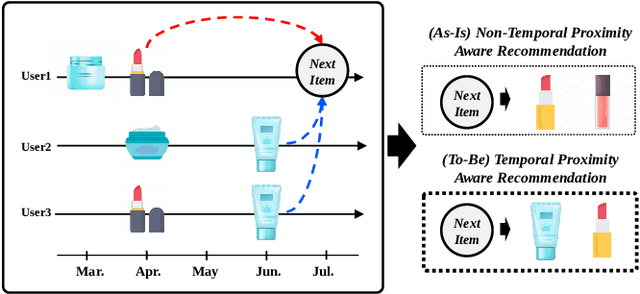
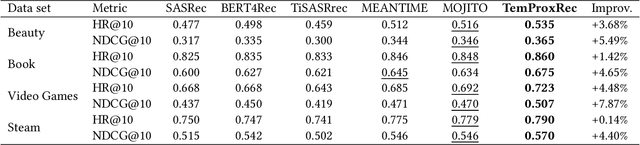
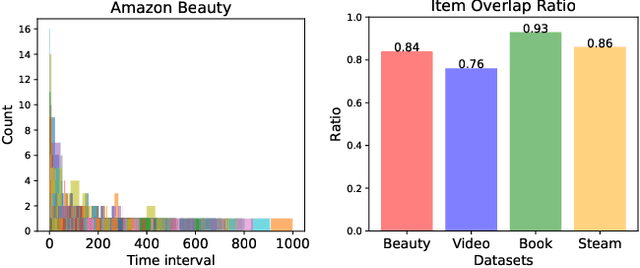
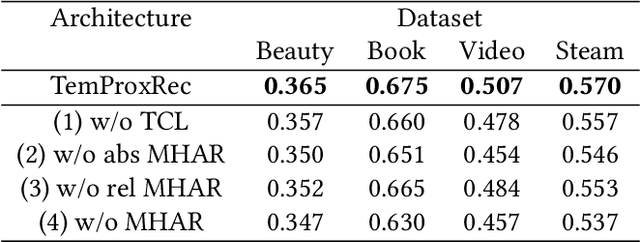
Sequential recommender systems identify user preferences from their past interactions to predict subsequent items optimally. Although traditional deep-learning-based models and modern transformer-based models in previous studies capture unidirectional and bidirectional patterns within user-item interactions, the importance of temporal contexts, such as individual behavioral and societal trend patterns, remains underexplored. Notably, recent models often neglect similarities in users' actions that occur implicitly among users during analogous timeframes-a concept we term vertical temporal proximity. These models primarily adapt the self-attention mechanisms of the transformer to consider the temporal context in individual user actions. Meanwhile, this adaptation still remains limited in considering the horizontal temporal proximity within item interactions, like distinguishing between subsequent item purchases within a week versus a month. To address these gaps, we propose a sequential recommendation model called TemProxRec, which includes contrastive learning and self-attention methods to consider temporal proximities both across and within user-item interactions. The proposed contrastive learning method learns representations of items selected in close temporal periods across different users to be close. Simultaneously, the proposed self-attention mechanism encodes temporal and positional contexts in a user sequence using both absolute and relative embeddings. This way, our TemProxRec accurately predicts the relevant items based on the user-item interactions within a specific timeframe. We validate this work through comprehensive experiments on TemProxRec, consistently outperforming existing models on benchmark datasets as well as showing the significance of considering the vertical and horizontal temporal proximities into sequential recommendation.