 Add to Chrome
 Add to Firefox
 Add to Edge
Music-Source-Separation-Training (MSST): A Unified Framework for Training and Evaluating Music Demixing Models
Jul 25, 2026
Music Source Separation (MSS), the task of recovering individual sound components (stems) from a polyphonic mixture, is central to applications ranging from karaoke and remixing to audio restoration and content production. The separation quality depends on engineering decisions across the entire pipeline: model choice, training data preparation and augmentation, loss function and metrics choice, training configuration, validation, and post-processing. This paper presents MSST (Music-Source-Separation-Training) - a universal open-source framework for MSS tasks, which unifies training, validation, and inference for a broad range of modern demixing model families under a single, configuration-driven interface. The framework supports various model architectures, data preprocessing and augmentations, multiple loss functions and evaluation metrics, which helps with fast iterations and ablation studies. Additionally, the framework supports a range of practical techniques that improve separation quality, such as sliding-window inference with cross-fading, test-time augmentation, model ensembling, and fine-tuning via Low-Rank Adaptation (LORA). Our ablation studies demonstrate improvements of MSS using the above techniques. By consolidating these components into a reproducible, YAML-configurable framework, MSST lowers the barrier to systematic experimentation and enables rapid iteration from idea to verifiable result.

A 23 $μ$W Keyword Spotting IC with Ring-Oscillator-Based Time-Domain Feature Extraction
Aug 01, 2022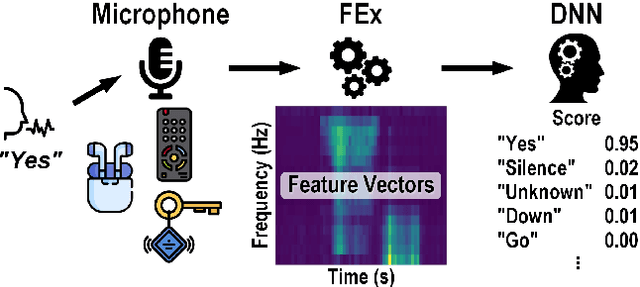
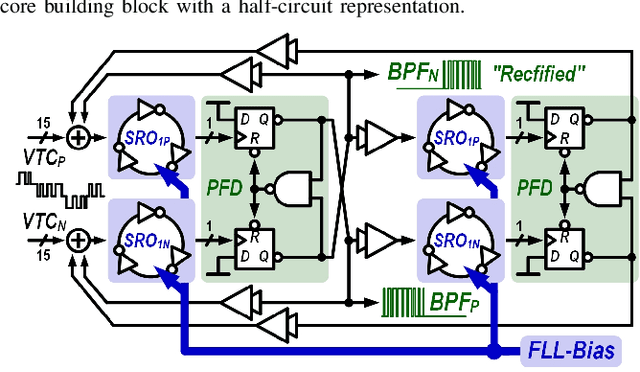
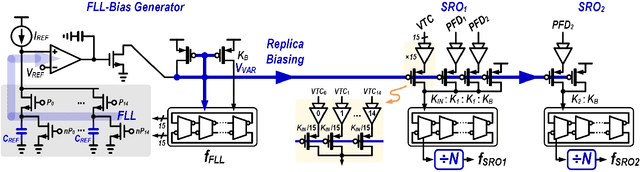
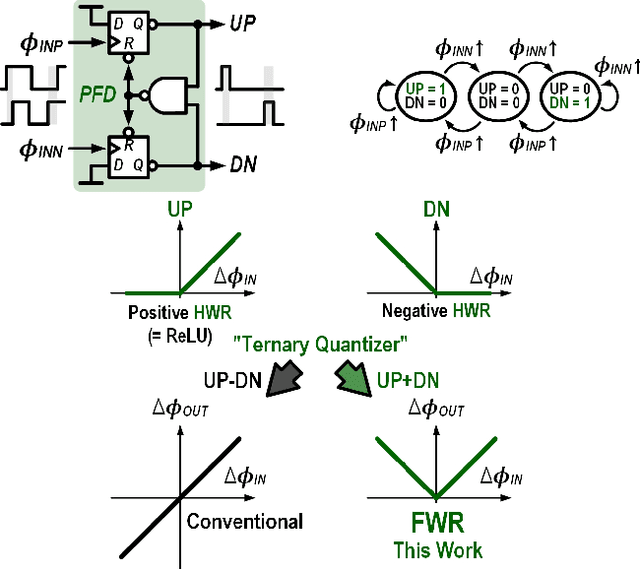
This article presents the first keyword spotting (KWS) IC which uses a ring-oscillator-based time-domain processing technique for its analog feature extractor (FEx). Its extensive usage of time-encoding schemes allows the analog audio signal to be processed in a fully time-domain manner except for the voltage-to-time conversion stage of the analog front-end. Benefiting from fundamental building blocks based on digital logic gates, it offers a better technology scalability compared to conventional voltage-domain designs. Fabricated in a 65 nm CMOS process, the prototyped KWS IC occupies 2.03mm$^{2}$ and dissipates 23 $\mu$W power consumption including analog FEx and digital neural network classifier. The 16-channel time-domain FEx achieves 54.89 dB dynamic range for 16 ms frame shift size while consuming 9.3 $\mu$W. The measurement result verifies that the proposed IC performs a 12-class KWS task on the Google Speech Command Dataset (GSCD) with >86% accuracy and 12.4 ms latency.
Spiking Cochlea with System-level Local Automatic Gain Control
Feb 14, 2022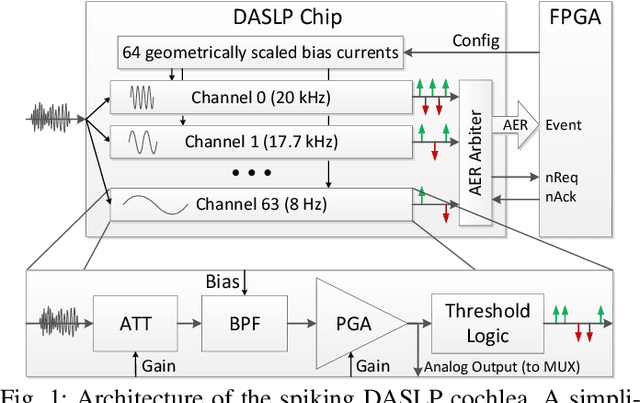
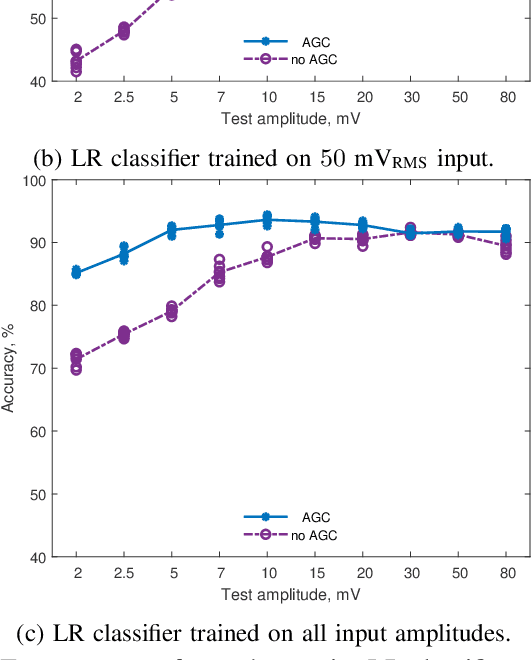
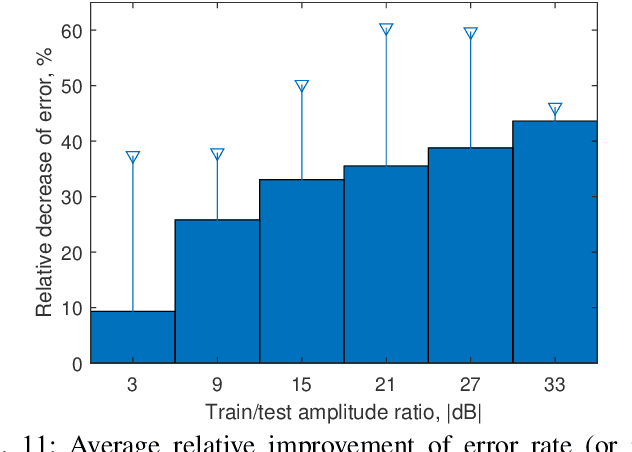
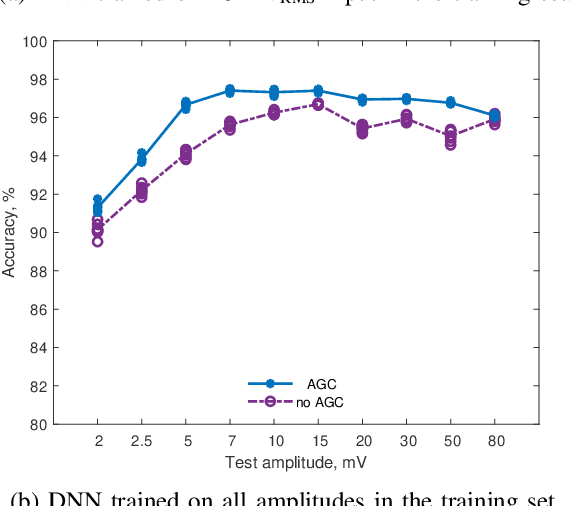
Including local automatic gain control (AGC) circuitry into a silicon cochlea design has been challenging because of transistor mismatch and model complexity. To address this, we present an alternative system-level algorithm that implements channel-specific AGC in a silicon spiking cochlea by measuring the output spike activity of individual channels. The bandpass filter gain of a channel is adapted dynamically to the input amplitude so that the average output spike rate stays within a defined range. Because this AGC mechanism only needs counting and adding operations, it can be implemented at low hardware cost in a future design. We evaluate the impact of the local AGC algorithm on a classification task where the input signal varies over 32 dB input range. Two classifier types receiving cochlea spike features were tested on a speech versus noise classification task. The logistic regression classifier achieves an average of 6% improvement and 40.8% relative improvement in accuracy when the AGC is enabled. The deep neural network classifier shows a similar improvement for the AGC case and achieves a higher mean accuracy of 96% compared to the best accuracy of 91% from the logistic regression classifier.