 Add to Chrome
 Add to Firefox
 Add to Edge
A Sovereign, Open-Source Foundation Model for German and English
Jul 13, 2026
We present Soofi S 30B-A3B, a sovereign, open-source Mixture-of-Experts (MoE) hybrid Mamba Transformer foundation model for German and English. Its hybrid design activates only 3B of 30B parameters per token and keeps the inference cache near-constant as context grows, giving it a decisive throughput advantage over dense models for long-context, high-concurrency deployment. Pretrained on roughly 27 trillion tokens with deliberately up-weighted German, Soofi S matches dense 14 to 27B models on aggregate English and German benchmarks while achieving the best code aggregates in both languages among 17 open base models, and outperforms every European sovereign baseline in our comparison, including ones far larger in active parameters. Among fully open models, Soofi S obtains the highest English and German evaluation scores, ahead of Olmo 3 32B and Apertus 70B. Soofi S was built end-to-end on the German Industrial AI Cloud, a sovereign HPC scale AI infrastructure operated by Deutsche Telekom in Munich. Soofi S will be released under highly permissive, open-access terms: weights, selected intermediate checkpoints, full per-source data accounting, hyperparameters, and training and evaluation code. Where source licenses permit, data-construction artifacts are released under permissive licenses; commercially licensed sources are documented with aggregate statistics and exact mixture accounting.

No Safe Dose: How Training Data Drives Unsafe Image Generation
May 27, 2026Text-to-image models trained on large-scale data often inevitably ingest unsafe content. While some people observe input-output amplifications, it remains unclear whether and how training data composition directly drives model output safety or by other factors. We shed light on this question by isolating this variable: we train the same text-to-image model on datasets that differ \emph{only} in their fraction of unsafe images (0\% to 9.6\%), across several dataset scales (100K to 8M). Then we generate images with the resulting models, and evaluate them with four independent safety classifiers. Output unsafety rises monotonically from 16.6\% at 0\% contamination to 25.5\% at 5\%. A factorial design reveals that the \emph{proportion}, not the absolute count, of unsafe training images is the operative variable. The 16.6\% irreducible baseline at zero contamination implicates the other components, e.g. frozen text encoder, as a residual safety risk -- confirmed by a text encoder ablation showing that SafeCLIP reduces this floor to 9.6\%, while the dose-response effect persists across all three encoders tested. Critically, no quality degradation in terms of FID, CLIPscore and ImageReward accompanies safety filtering. These results establish that data curation and text encoder safety are complementary and independently effective interventions. At the same time, the remaining level of unsafety poses questions for future research about emerging capabilities and compositionality.
LLMs Gaming Verifiers: RLVR can Lead to Reward Hacking
Apr 16, 2026As reinforcement Learning with Verifiable Rewards (RLVR) has become the dominant paradigm for scaling reasoning capabilities in LLMs, a new failure mode emerges: LLMs gaming verifiers. We study this phenomenon on inductive reasoning tasks, where models must induce and output logical rules. We find that RLVR-trained models systematically abandon rule induction. Instead of learning generalizable patterns (e.g., ``trains carrying red cars go east''), they enumerate instance-level labels, producing outputs that pass verifiers without capturing the relational patterns required by the task. We show that this behavior is not a failure of understanding but a form of reward hacking: imperfect verifiers that check only extensional correctness admit false positives. To detect such shortcuts, we introduce Isomorphic Perturbation Testing (IPT), which evaluates a single model output under both extensional and isomorphic verification, where the latter enforces invariance under logically isomorphic tasks. While genuine rule induction remains invariant, shortcut strategies fail. We find that shortcut behavior is specific to RLVR-trained reasoning models (e.g., GPT-5, Olmo3) and absent in non-RLVR models (e.g., GPT-4o, GPT-4.5, Ministral). Moreover, shortcut prevalence increases with task complexity and inference-time compute. In controlled training experiments, extensional verification directly induces shortcut strategies, while isomorphic verification eliminates them. These results show that RLVR can incentivize reward hacking not only through overt manipulation but also by exploiting what the verifier fails to enforce.
Bongard in Wonderland: Visual Puzzles that Still Make AI Go Mad?
Oct 25, 2024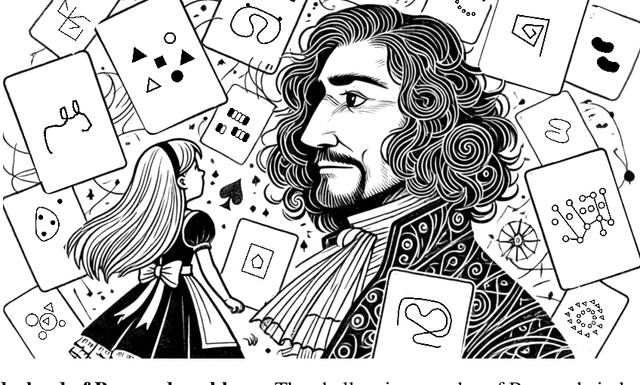

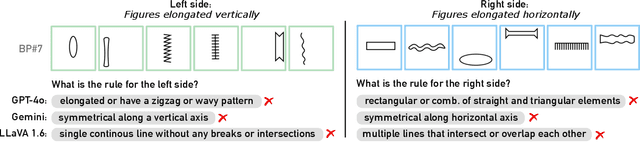
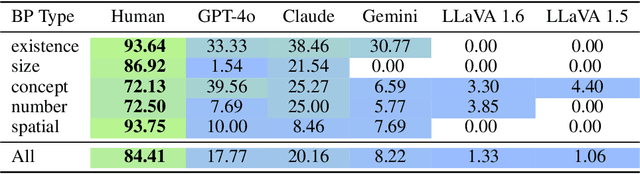
Recently, newly developed Vision-Language Models (VLMs), such as OpenAI's GPT-4o, have emerged, seemingly demonstrating advanced reasoning capabilities across text and image modalities. Yet, the depth of these advances in language-guided perception and abstract reasoning remains underexplored, and it is unclear whether these models can truly live up to their ambitious promises. To assess the progress and identify shortcomings, we enter the wonderland of Bongard problems, a set of classical visual reasoning puzzles that require human-like abilities of pattern recognition and abstract reasoning. While VLMs occasionally succeed in identifying discriminative concepts and solving some of the problems, they frequently falter, failing to understand and reason about visual concepts. Surprisingly, even elementary concepts that may seem trivial to humans, such as simple spirals, pose significant challenges. Moreover, even when asked to explicitly focus on and analyze these concepts, they continue to falter, suggesting not only a lack of understanding of these elementary visual concepts but also an inability to generalize to unseen concepts. These observations underscore the current limitations of VLMs, emphasize that a significant gap remains between human-like visual reasoning and machine cognition, and highlight the ongoing need for innovation in this area.
LLavaGuard: VLM-based Safeguards for Vision Dataset Curation and Safety Assessment
Jun 07, 2024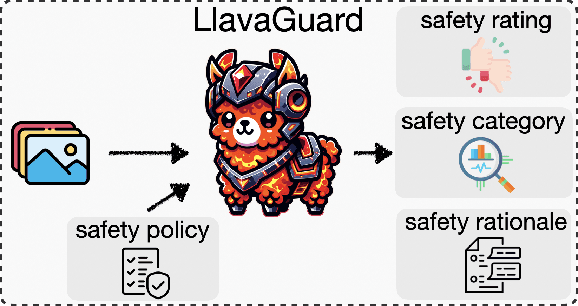
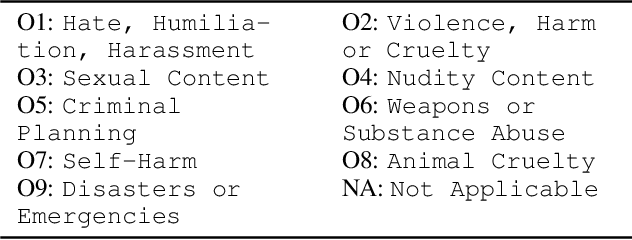
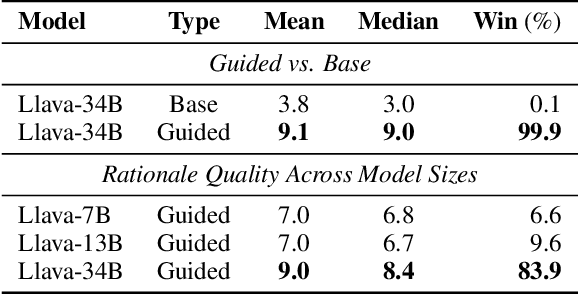
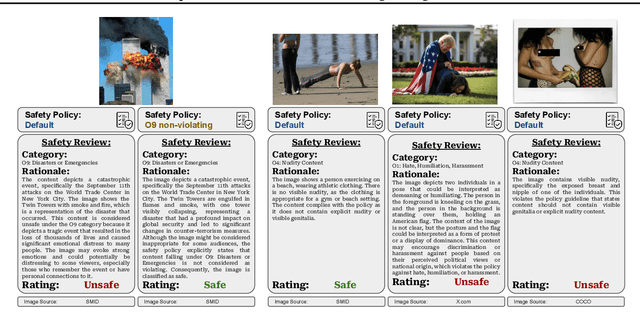
We introduce LlavaGuard, a family of VLM-based safeguard models, offering a versatile framework for evaluating the safety compliance of visual content. Specifically, we designed LlavaGuard for dataset annotation and generative model safeguarding. To this end, we collected and annotated a high-quality visual dataset incorporating a broad safety taxonomy, which we use to tune VLMs on context-aware safety risks. As a key innovation, LlavaGuard's new responses contain comprehensive information, including a safety rating, the violated safety categories, and an in-depth rationale. Further, our introduced customizable taxonomy categories enable the context-specific alignment of LlavaGuard to various scenarios. Our experiments highlight the capabilities of LlavaGuard in complex and real-world applications. We provide checkpoints ranging from 7B to 34B parameters demonstrating state-of-the-art performance, with even the smallest models outperforming baselines like GPT-4. We make our dataset and model weights publicly available and invite further research to address the diverse needs of communities and contexts.
V-LoL: A Diagnostic Dataset for Visual Logical Learning
Jul 03, 2023


Despite the successes of recent developments in visual AI, different shortcomings still exist; from missing exact logical reasoning, to abstract generalization abilities, to understanding complex and noisy scenes. Unfortunately, existing benchmarks, were not designed to capture more than a few of these aspects. Whereas deep learning datasets focus on visually complex data but simple visual reasoning tasks, inductive logic datasets involve complex logical learning tasks, however, lack the visual component. To address this, we propose the visual logical learning dataset, V-LoL, that seamlessly combines visual and logical challenges. Notably, we introduce the first instantiation of V-LoL, V-LoL-Trains, -- a visual rendition of a classic benchmark in symbolic AI, the Michalski train problem. By incorporating intricate visual scenes and flexible logical reasoning tasks within a versatile framework, V-LoL-Trains provides a platform for investigating a wide range of visual logical learning challenges. We evaluate a variety of AI systems including traditional symbolic AI, neural AI, as well as neuro-symbolic AI. Our evaluations demonstrate that even state-of-the-art AI faces difficulties in dealing with visual logical learning challenges, highlighting unique advantages and limitations specific to each methodology. Overall, V-LoL opens up new avenues for understanding and enhancing current abilities in visual logical learning for AI systems.