 Add to Chrome
 Add to Firefox
 Add to Edge
ORCAID: Oblique Rule-Based Continuous-Action Interpretation for Deep RL Policies
Jul 08, 2026
Explainability remains a key issue in reinforcement learning (RL). Distilling an interpretable policy from an agent trained in a complex environment is particularly challenging when the action space is continuous. We introduce ORCAID, a novel method for extracting interpretable rule-based policies from RL agents operating in mixed continuous-discrete environments with continuous action spaces. Our main contribution is an efficient oblique decision tree training algorithm that partitions the state space by hyperplanes and fits local linear models. The key idea lies in a three-stage split search: efficient random initialization, local refinement, and backward elimination. Finally, adjacent leaves are merged to yield a concise set of interpretable rules describing a given deep RL policy. We evaluate ORCAID across multiple RL environments, demonstrating that the extracted rule-based policies maintain strong performance with a low number of parameters and can even be used to improve the performance of the original deep RL policy.

Distilling Answer-Set Programming Rules from LLMs for Neurosymbolic Visual Question Answering
Jun 02, 2026Visual Question Answering (VQA) is the task of answering questions about images, requiring the integration of multimodal input and reasoning. Modular approaches that incorporate logic-based representations into the reasoning component offer clear advantages over end-to-end trained systems, particularly in terms of interpretability. However, adapting or extending these representations when task requirements change can place a significant burden on developers. To address this challenge, we present an approach for distilling rules from Large Language Models (LLMs). Our method prompts an LLM to extend an initial VQA reasoning theory, expressed as an answer-set program, to meet new requirements of the task. Examples from VQA datasets guide the LLM, validate the results, and help correct erroneous rules by leveraging feedback from the ASP solver. We demonstrate that our approach is effective across diverse VQA datasets. Notably, only a few examples are needed to elicit correct rules from LLMs. Our experiments suggest that rule distillation from LLMs is a promising alternative to traditional data-driven rule learning approaches. Under consideration in Theory and Practice of Logic Programming (TPLP).
Answer-Set-Programming-based Abstractions for Reinforcement Learning
May 29, 2026Reinforcement Learning (RL) enables autonomous agents to learn policies from experience, but realistic problems often involve enormous state spaces, making learning and generalisation challenging. Abstraction and approximation are therefore essential. Relational Reinforcement Learning (RRL) offers a way to reason about objects and their relations, and the CARCASS framework by Martijn van Otterlo demonstrates how logical representations can model Markov Decision Processes (MDPs) in first-order domains. Originally implemented in Prolog, CARCASS leverages domain knowledge to create powerful abstractions. We explore Answer-Set Programming (ASP), which is a rich and, contrary to Prolog, fully declarative modelling language, to realise CARCASS abstractions. We evaluate our ASP-based implementation in case studies of two domains, viz. Blocks World and Minigrid. Our results indicate that CARCASS with ASP provides a promising approach to constructing abstractions for RL, especially when domain knowledge is available.
Neural Decision-Propagation for Answer Set Programming
May 03, 2026Integration of Answer Set Programming (ASP) with neural networks has emerged as a promising tool in Neuro-symbolic AI. While existing approaches extend the capabilities of ASP to real world domains, their reasoning pipelines depend on classical solvers, which is a bottleneck for scalability. To tackle this problem, we propose a new method to compute stable models, called decision-propagation (DProp), which alternates falsity decisions and truth propagations. Successful DProp computations are shown to capture the stable model semantics. We then develop Neural DProp (NDProp), a differentiable extension of DProp with neural computation for decisions and fuzzy evaluation for propagations. We evaluate the capabilities of NDProp for learning decision heuristics as well as neuro-symbolic integration, and compare it with existing neuro-symbolic approaches. The results show that NDProp can learn to efficiently compute stable models, and it improves accuracy and scalability on neuro-symbolic benchmarks.
Visual Perceptual to Conceptual First-Order Rule Learning Networks
Apr 09, 2026Learning rules plays a crucial role in deep learning, particularly in explainable artificial intelligence and enhancing the reasoning capabilities of large language models. While existing rule learning methods are primarily designed for symbolic data, learning rules from image data without supporting image labels and automatically inventing predicates remains a challenge. In this paper, we tackle these inductive rule learning problems from images with a framework called γILP, which provides a fully differentiable pipeline from image constant substitution to rule structure induction. Extensive experiments demonstrate that γILP achieves strong performance not only on classical symbolic relational datasets but also on relational image data and pure image datasets, such as Kandinsky patterns.
An XAI View on Explainable ASP: Methods, Systems, and Perspectives
Jan 21, 2026Answer Set Programming (ASP) is a popular declarative reasoning and problem solving approach in symbolic AI. Its rule-based formalism makes it inherently attractive for explainable and interpretive reasoning, which is gaining importance with the surge of Explainable AI (XAI). A number of explanation approaches and tools for ASP have been developed, which often tackle specific explanatory settings and may not cover all scenarios that ASP users encounter. In this survey, we provide, guided by an XAI perspective, an overview of types of ASP explanations in connection with user questions for explanation, and describe how their coverage by current theory and tools. Furthermore, we pinpoint gaps in existing ASP explanations approaches and identify research directions for future work.
ASP-FZN: A Translation-based Constraint Answer Set Solver
Jul 30, 2025We present the solver asp-fzn for Constraint Answer Set Programming (CASP), which extends ASP with linear constraints. Our approach is based on translating CASP programs into the solver-independent FlatZinc language that supports several Constraint Programming and Integer Programming backend solvers. Our solver supports a rich language of linear constraints, including some common global constraints. As for evaluation, we show that asp-fzn is competitive with state-of-the-art ASP solvers on benchmarks taken from past ASP competitions. Furthermore, we evaluate it on several CASP problems from the literature and compare its performance with clingcon, which is a prominent CASP solver that supports most of the asp-fzn language. The performance of asp-fzn is very promising as it is already competitive on plain ASP and even outperforms clingcon on some CASP benchmarks.
Refining Gelfond Rationality Principle Towards More Comprehensive Foundational Principles for Answer Set Semantics
Jul 02, 2025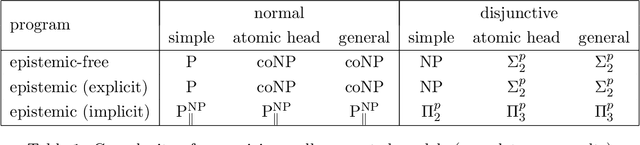

Non-monotonic logic programming is the basis for a declarative problem solving paradigm known as answer set programming (ASP). Departing from the seminal definition by Gelfond and Lifschitz in 1988 for simple normal logic programs, various answer set semantics have been proposed for extensions. We consider two important questions: (1) Should the minimal model property, constraint monotonicity and foundedness as defined in the literature be mandatory conditions for an answer set semantics in general? (2) If not, what other properties could be considered as general principles for answer set semantics? We address the two questions. First, it seems that the three aforementioned conditions may sometimes be too strong, and we illustrate with examples that enforcing them may exclude expected answer sets. Second, we evolve the Gelfond answer set (GAS) principles for answer set construction by refining the Gelfond's rationality principle to well-supportedness, minimality w.r.t. negation by default and minimality w.r.t. epistemic negation. The principle of well-supportedness guarantees that every answer set is constructible from if-then rules obeying a level mapping and is thus free of circular justification, while the two minimality principles ensure that the formalism minimizes knowledge both at the level of answer sets and of world views. Third, to embody the refined GAS principles, we extend the notion of well-supportedness substantially to answer sets and world views, respectively. Fourth, we define new answer set semantics in terms of the refined GAS principles. Fifth, we use the refined GAS principles as an alternative baseline to intuitively assess the existing answer set semantics. Finally, we analyze the computational complexity.
Visual Graph Question Answering with ASP and LLMs for Language Parsing
Feb 13, 2025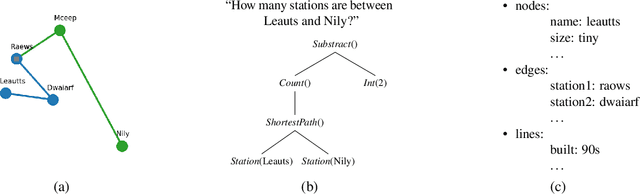
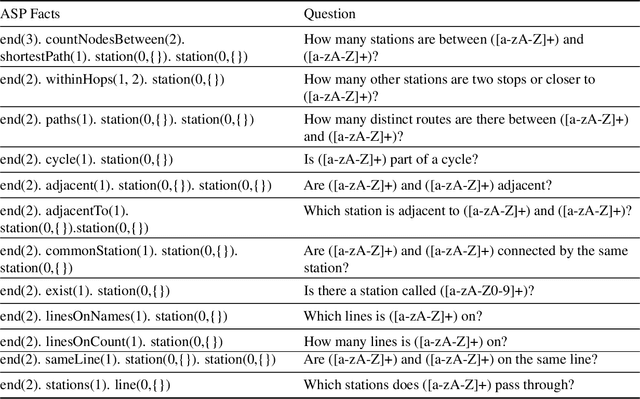
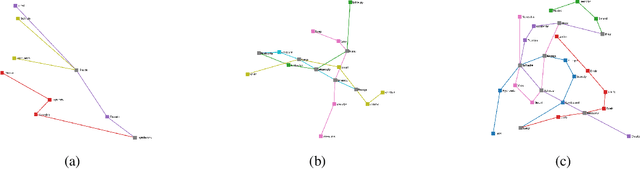
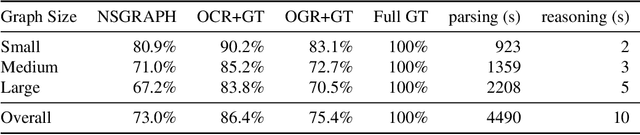
Visual Question Answering (VQA) is a challenging problem that requires to process multimodal input. Answer-Set Programming (ASP) has shown great potential in this regard to add interpretability and explainability to modular VQA architectures. In this work, we address the problem of how to integrate ASP with modules for vision and natural language processing to solve a new and demanding VQA variant that is concerned with images of graphs (not graphs in symbolic form). Images containing graph-based structures are an ubiquitous and popular form of visualisation. Here, we deal with the particular problem of graphs inspired by transit networks, and we introduce a novel dataset that amends an existing one by adding images of graphs that resemble metro lines. Our modular neuro-symbolic approach combines optical graph recognition for graph parsing, a pretrained optical character recognition neural network for parsing labels, Large Language Models (LLMs) for language processing, and ASP for reasoning. This method serves as a first baseline and achieves an overall average accuracy of 73% on the dataset. Our evaluation provides further evidence of the potential of modular neuro-symbolic systems, in particular with pretrained models that do not involve any further training and logic programming for reasoning, to solve complex VQA tasks.
* In Proceedings ICLP 2024, arXiv:2502.08453. This work was partially funded from the Bosch Center for AI
Declarative Knowledge Distillation from Large Language Models for Visual Question Answering Datasets
Oct 12, 2024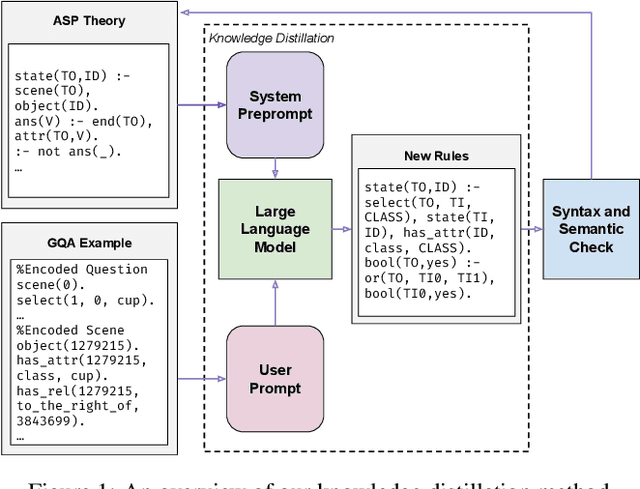
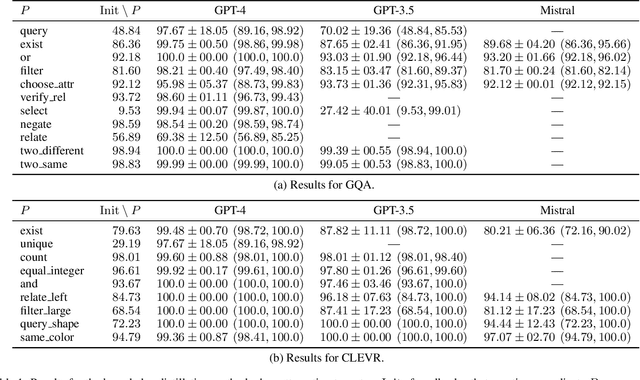
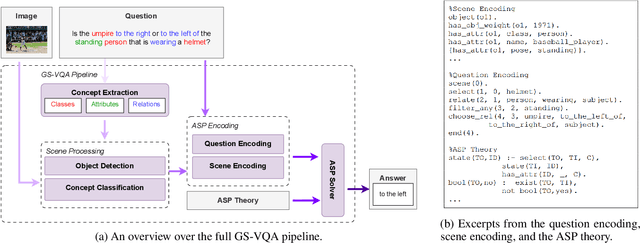
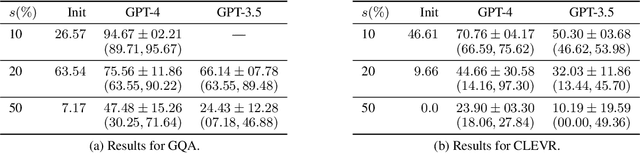
Visual Question Answering (VQA) is the task of answering a question about an image and requires processing multimodal input and reasoning to obtain the answer. Modular solutions that use declarative representations within the reasoning component have a clear advantage over end-to-end trained systems regarding interpretability. The downside is that crafting the rules for such a component can be an additional burden on the developer. We address this challenge by presenting an approach for declarative knowledge distillation from Large Language Models (LLMs). Our method is to prompt an LLM to extend an initial theory on VQA reasoning, given as an answer-set program, to meet the requirements of the VQA task. Examples from the VQA dataset are used to guide the LLM, validate the results, and mend rules if they are not correct by using feedback from the ASP solver. We demonstrate that our approach works on the prominent CLEVR and GQA datasets. Our results confirm that distilling knowledge from LLMs is in fact a promising direction besides data-driven rule learning approaches.