 Add to Chrome
 Add to Firefox
 Add to Edge
OccuFly: A 3D Vision Benchmark for Semantic Scene Completion from the Aerial Perspective
Dec 23, 2025
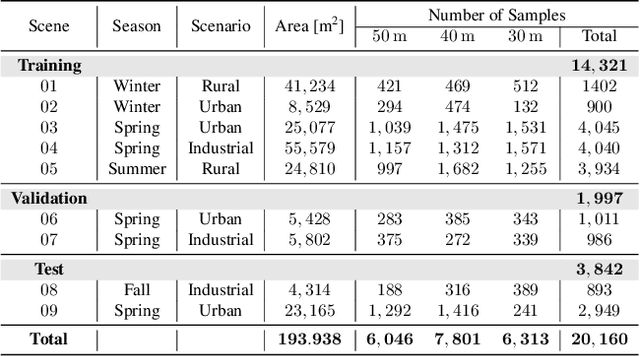
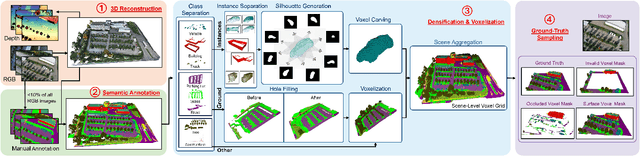
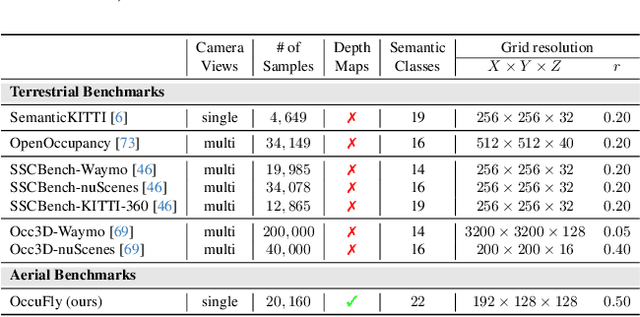

Semantic Scene Completion (SSC) is crucial for 3D perception in mobile robotics, as it enables holistic scene understanding by jointly estimating dense volumetric occupancy and per-voxel semantics. Although SSC has been widely studied in terrestrial domains such as autonomous driving, aerial scenarios like autonomous flying remain largely unexplored, thereby limiting progress on downstream applications. Furthermore, LiDAR sensors represent the primary modality for SSC data generation, which poses challenges for most uncrewed aerial vehicles (UAVs) due to flight regulations, mass and energy constraints, and the sparsity of LiDAR-based point clouds from elevated viewpoints. To address these limitations, we introduce OccuFly, the first real-world, camera-based aerial SSC benchmark, captured at altitudes of 50m, 40m, and 30m during spring, summer, fall, and winter. OccuFly covers urban, industrial, and rural scenarios, provides 22 semantic classes, and the data format adheres to established conventions to facilitate seamless integration with existing research. Crucially, we propose a LiDAR-free data generation framework based on camera modality, which is ubiquitous on modern UAVs. By utilizing traditional 3D reconstruction, our framework automates label transfer by lifting a subset of annotated 2D masks into the reconstructed point cloud, thereby substantially minimizing manual 3D annotation effort. Finally, we benchmark the state-of-the-art on OccuFly and highlight challenges specific to elevated viewpoints, yielding a comprehensive vision benchmark for holistic aerial 3D scene understanding.

IPFormer: Visual 3D Panoptic Scene Completion with Context-Adaptive Instance Proposals
Jun 25, 2025Semantic Scene Completion (SSC) has emerged as a pivotal approach for jointly learning scene geometry and semantics, enabling downstream applications such as navigation in mobile robotics. The recent generalization to Panoptic Scene Completion (PSC) advances the SSC domain by integrating instance-level information, thereby enhancing object-level sensitivity in scene understanding. While PSC was introduced using LiDAR modality, methods based on camera images remain largely unexplored. Moreover, recent Transformer-based SSC approaches utilize a fixed set of learned queries to reconstruct objects within the scene volume. Although these queries are typically updated with image context during training, they remain static at test time, limiting their ability to dynamically adapt specifically to the observed scene. To overcome these limitations, we propose IPFormer, the first approach that leverages context-adaptive instance proposals at train and test time to address vision-based 3D Panoptic Scene Completion. Specifically, IPFormer adaptively initializes these queries as panoptic instance proposals derived from image context and further refines them through attention-based encoding and decoding to reason about semantic instance-voxel relationships. Experimental results show that our approach surpasses state-of-the-art methods in overall panoptic metrics PQ$^\dagger$ and PQ-All, matches performance in individual metrics, and achieves a runtime reduction exceeding 14$\times$. Furthermore, our ablation studies reveal that dynamically deriving instance proposals from image context, as opposed to random initialization, leads to a 3.62% increase in PQ-All and a remarkable average improvement of 18.65% in combined Thing-metrics. These results highlight our introduction of context-adaptive instance proposals as a pioneering effort in addressing vision-based 3D Panoptic Scene Completion.