 Add to Chrome
 Add to Firefox
 Add to Edge
SkillShapley: Boundary-Adaptive Shapley Valuation for Skill Step Attribution in LLM Agents
Aug 13, 2026
Agent skills are crucial external instructions that enable language agents to execute long procedural tasks such as coding or document processing. Existing agent skills are primarily created through human manual crafting or agent execution traces, with limited understanding of how each step contributes to overall skill performance on specific tasks; i.e., there remains an open problem in quantifying the contribution of individual steps within an agent skill. To address this issue, we first model skill-step attribution as a Shapley value-based contribution estimation problem, and then propose SkillShapley, a step-level attribution framework for agent skills. Notably, SkillShapley operates in two phases, motivated by key empirical insights, i.e., discretized benchmark rewards that create sharp performance cliffs, and step interactions that are largely additive rather than synergistic. Specifically, it first identifies informative coalitional regions, and then adaptively samples new coalitions that can yield reusable marginal evidence. Experiments on skills from the widely adopted SkillsBench demonstrate that our SkillShapley can effectively and efficiently identify high- or low-value skill steps, providing several key takeaways for agent skill creation.

Random Transformation of Image Brightness for Adversarial Attack
Jan 12, 2021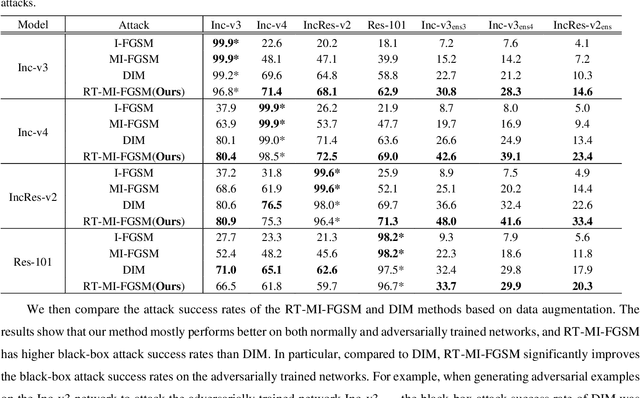
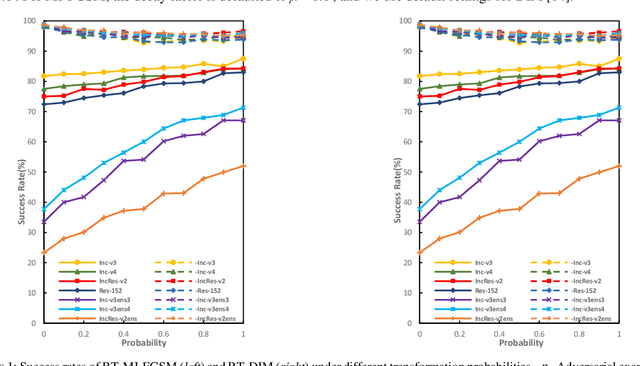
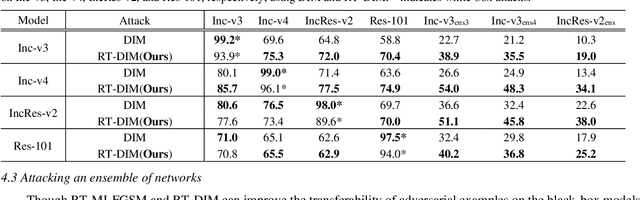
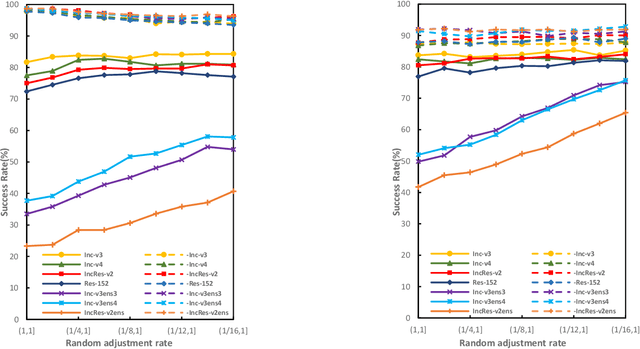
Deep neural networks are vulnerable to adversarial examples, which are crafted by adding small, human-imperceptible perturbations to the original images, but make the model output inaccurate predictions. Before deep neural networks are deployed, adversarial attacks can thus be an important method to evaluate and select robust models in safety-critical applications. However, under the challenging black-box setting, the attack success rate, i.e., the transferability of adversarial examples, still needs to be improved. Based on image augmentation methods, we found that random transformation of image brightness can eliminate overfitting in the generation of adversarial examples and improve their transferability. To this end, we propose an adversarial example generation method based on this phenomenon, which can be integrated with Fast Gradient Sign Method (FGSM)-related methods to build a more robust gradient-based attack and generate adversarial examples with better transferability. Extensive experiments on the ImageNet dataset demonstrate the method's effectiveness. Whether on normally or adversarially trained networks, our method has a higher success rate for black-box attacks than other attack methods based on data augmentation. We hope that this method can help to evaluate and improve the robustness of models.