 Add to Chrome
 Add to Firefox
 Add to Edge
What If We Allocate Test-Time Compute Adaptively?
Feb 01, 2026
Test-time compute scaling allocates inference computation uniformly, uses fixed sampling strategies, and applies verification only for reranking. In contrast, we propose a verifier-guided adaptive framework treating reasoning as iterative trajectory generation and selection. For each problem, the agent runs multiple inference iterations. In each iteration, it optionally produces a high-level plan, selects a set of reasoning tools and a compute strategy together with an exploration parameter, and then generates a candidate reasoning trajectory. A process reward model (PRM) serves as a unified control signal: within each iteration, step-level PRM scores are aggregated to guide pruning and expansion during generation, and across iterations, aggregated trajectory rewards are used to select the final response. Across datasets, our dynamic, PRM-guided approach consistently outperforms direct test-time scaling, yielding large gains on MATH-500 and several-fold improvements on harder benchmarks such as AIME24 and AMO-Bench. We characterize efficiency using theoretical FLOPs and a compute intensity metric penalizing wasted generation and tool overhead, demonstrating that verification-guided allocation concentrates computation on high-utility reasoning paths.

On the Fundamental Limits of LLMs at Scale
Nov 17, 2025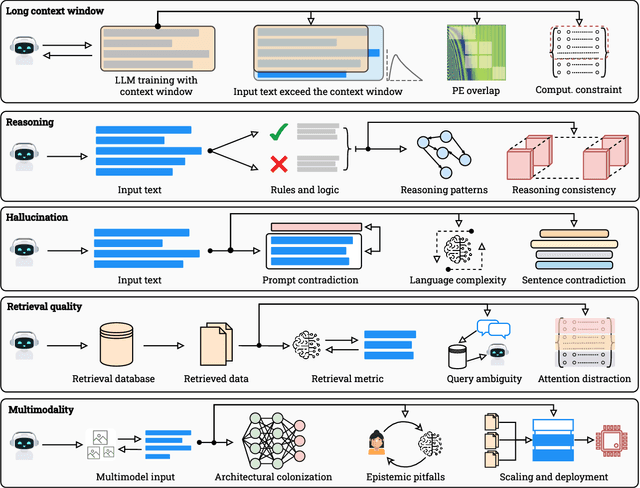
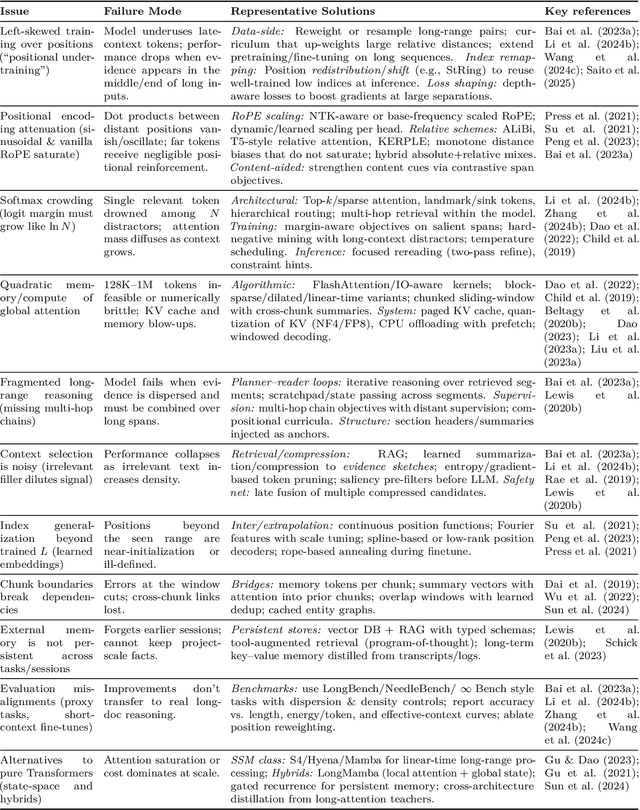
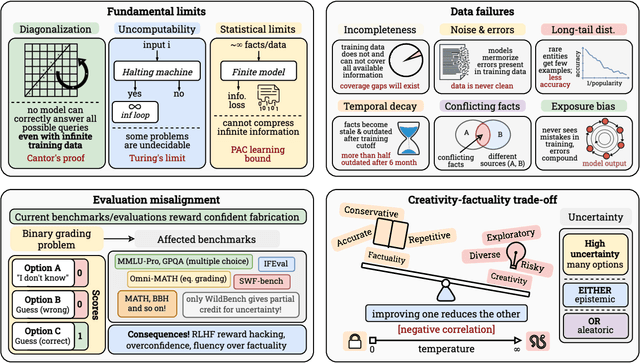
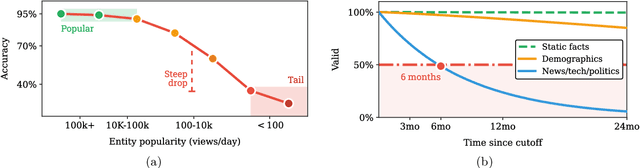
Large Language Models (LLMs) have benefited enormously from scaling, yet these gains are bounded by five fundamental limitations: (1) hallucination, (2) context compression, (3) reasoning degradation, (4) retrieval fragility, and (5) multimodal misalignment. While existing surveys describe these phenomena empirically, they lack a rigorous theoretical synthesis connecting them to the foundational limits of computation, information, and learning. This work closes that gap by presenting a unified, proof-informed framework that formalizes the innate theoretical ceilings of LLM scaling. First, computability and uncomputability imply an irreducible residue of error: for any computably enumerable model family, diagonalization guarantees inputs on which some model must fail, and undecidable queries (e.g., halting-style tasks) induce infinite failure sets for all computable predictors. Second, information-theoretic and statistical constraints bound attainable accuracy even on decidable tasks, finite description length enforces compression error, and long-tail factual knowledge requires prohibitive sample complexity. Third, geometric and computational effects compress long contexts far below their nominal size due to positional under-training, encoding attenuation, and softmax crowding. We further show how likelihood-based training favors pattern completion over inference, how retrieval under token limits suffers from semantic drift and coupling noise, and how multimodal scaling inherits shallow cross-modal alignment. Across sections, we pair theorems and empirical evidence to outline where scaling helps, where it saturates, and where it cannot progress, providing both theoretical foundations and practical mitigation paths like bounded-oracle retrieval, positional curricula, and sparse or hierarchical attention.
Hierarchical Deep Reinforcement Learning for Adaptive Resource Management in Integrated Terrestrial and Non-Terrestrial Networks
Jan 16, 2025Efficient spectrum allocation has become crucial as the surge in wireless-connected devices demands seamless support for more users and applications, a trend expected to grow with 6G. Innovations in satellite technologies such as SpaceX's Starlink have enabled non-terrestrial networks (NTNs) to work alongside terrestrial networks (TNs) and allocate spectrum based on regional demands. Existing spectrum sharing approaches in TNs use machine learning for interference minimization through power allocation and spectrum sensing, but the unique characteristics of NTNs like varying orbital dynamics and coverage patterns require more sophisticated coordination mechanisms. The proposed work uses a hierarchical deep reinforcement learning (HDRL) approach for efficient spectrum allocation across TN-NTN networks. DRL agents are present at each TN-NTN hierarchy that dynamically learn and allocate spectrum based on regional trends. This framework is 50x faster than the exhaustive search algorithm while achieving 95\% of optimum spectral efficiency. Moreover, it is 3.75x faster than multi-agent DRL, which is commonly used for spectrum sharing, and has a 12\% higher overall average throughput.
Deep Reinforcement Learning Optimized Intelligent Resource Allocation in Active RIS-Integrated TN-NTN Networks
Jan 11, 2025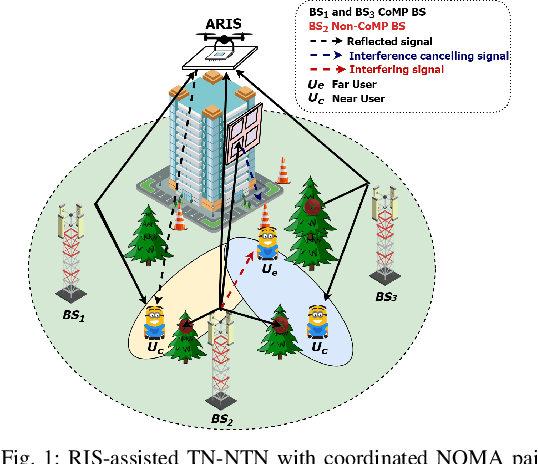
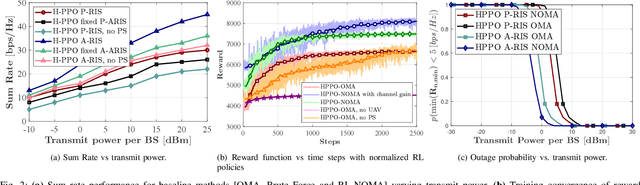
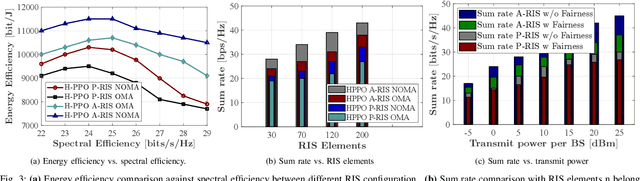
This work explores the deployment of active reconfigurable intelligent surfaces (A-RIS) in integrated terrestrial and non-terrestrial networks (TN-NTN) while utilizing coordinated multipoint non-orthogonal multiple access (CoMP-NOMA). Our system model incorporates a UAV-assisted RIS in coordination with a terrestrial RIS which aims for signal enhancement. We aim to maximize the sum rate for all users in the network using a custom hybrid proximal policy optimization (H-PPO) algorithm by optimizing the UAV trajectory, base station (BS) power allocation factors, active RIS amplification factor, and phase shift matrix. We integrate edge users into NOMA pairs to achieve diversity gain, further enhancing the overall experience for edge users. Exhaustive comparisons are made with passive RIS-assisted networks to demonstrate the superior efficacy of active RIS in terms of energy efficiency, outage probability, and network sum rate.