 Add to Chrome
 Add to Firefox
 Add to Edge
What If We Allocate Test-Time Compute Adaptively?
Feb 01, 2026
Test-time compute scaling allocates inference computation uniformly, uses fixed sampling strategies, and applies verification only for reranking. In contrast, we propose a verifier-guided adaptive framework treating reasoning as iterative trajectory generation and selection. For each problem, the agent runs multiple inference iterations. In each iteration, it optionally produces a high-level plan, selects a set of reasoning tools and a compute strategy together with an exploration parameter, and then generates a candidate reasoning trajectory. A process reward model (PRM) serves as a unified control signal: within each iteration, step-level PRM scores are aggregated to guide pruning and expansion during generation, and across iterations, aggregated trajectory rewards are used to select the final response. Across datasets, our dynamic, PRM-guided approach consistently outperforms direct test-time scaling, yielding large gains on MATH-500 and several-fold improvements on harder benchmarks such as AIME24 and AMO-Bench. We characterize efficiency using theoretical FLOPs and a compute intensity metric penalizing wasted generation and tool overhead, demonstrating that verification-guided allocation concentrates computation on high-utility reasoning paths.

ItDPDM: Information-Theoretic Discrete Poisson Diffusion Model
May 08, 2025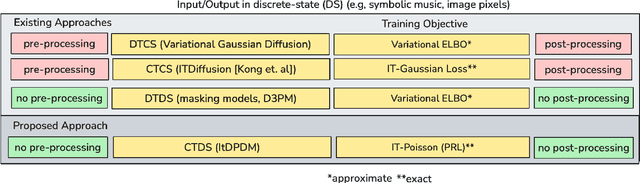
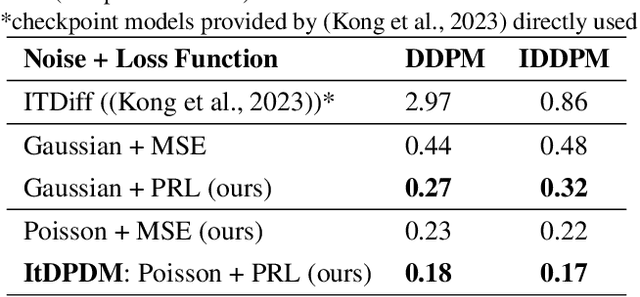
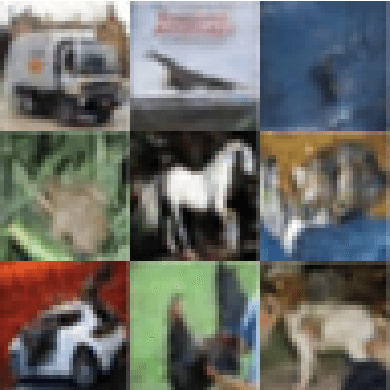
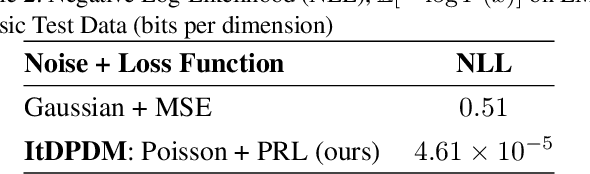
Existing methods for generative modeling of discrete data, such as symbolic music tokens, face two primary challenges: (1) they either embed discrete inputs into continuous state-spaces or (2) rely on variational losses that only approximate the true negative log-likelihood. Previous efforts have individually targeted these limitations. While information-theoretic Gaussian diffusion models alleviate the suboptimality of variational losses, they still perform modeling in continuous domains. In this work, we introduce the Information-Theoretic Discrete Poisson Diffusion Model (ItDPDM), which simultaneously addresses both limitations by directly operating in a discrete state-space via a Poisson diffusion process inspired by photon arrival processes in camera sensors. We introduce a novel Poisson Reconstruction Loss (PRL) and derive an exact relationship between PRL and the true negative log-likelihood, thereby eliminating the need for approximate evidence lower bounds. Experiments conducted on the Lakh MIDI symbolic music dataset and the CIFAR-10 image benchmark demonstrate that ItDPDM delivers significant improvements, reducing test NLL by up to 80% compared to prior baselines, while also achieving faster convergence.