 Add to Chrome
 Add to Firefox
 Add to Edge
An Empirical Analysis of Static Analysis Methods for Detection and Mitigation of Code Library Hallucinations
Apr 09, 2026
Despite extensive research, Large Language Models continue to hallucinate when generating code, particularly when using libraries. On NL-to-code benchmarks that require library use, we find that LLMs generate code that uses non-existent library features in 8.1-40% of responses.One intuitive approach for detection and mitigation of hallucinations is static analysis. In this paper, we analyse the potential of static analysis tools, both in terms of what they can solve and what they cannot. We find that static analysis tools can detect 16-70% of all errors, and 14-85% of library hallucinations, with performance varying by LLM and dataset. Through manual analysis, we identify cases a static method could not plausibly catch, which gives an upper bound on their potential from 48.5% to 77%. Overall, we show that static analysis methods are cheap method for addressing some forms of hallucination, and we quantify how far short of solving the problem they will always be.

A Framework for Dynamic Situational Awareness in Human Robot Teams: An Interview Study
Jan 15, 2025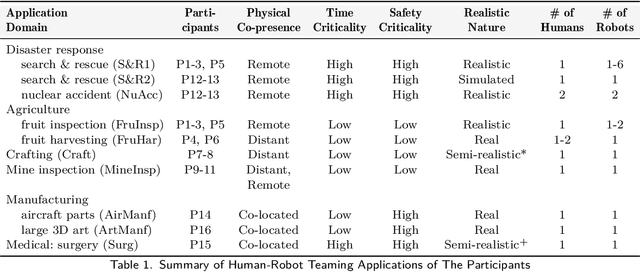

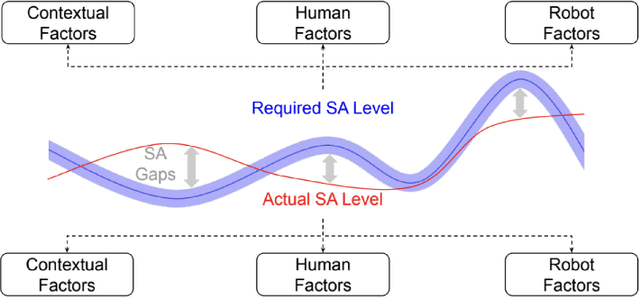

In human-robot teams, human situational awareness is the operator's conscious knowledge of the team's states, actions, plans and their environment. Appropriate human situational awareness is critical to successful human-robot collaboration. In human-robot teaming, it is often assumed that the best and required level of situational awareness is knowing everything at all times. This view is problematic, because what a human needs to know for optimal team performance varies given the dynamic environmental conditions, task context and roles and capabilities of team members. We explore this topic by interviewing 16 participants with active and repeated experience in diverse human-robot teaming applications. Based on analysis of these interviews, we derive a framework explaining the dynamic nature of required situational awareness in human-robot teaming. In addition, we identify a range of factors affecting the dynamic nature of required and actual levels of situational awareness (i.e., dynamic situational awareness), types of situational awareness inefficiencies resulting from gaps between actual and required situational awareness, and their main consequences. We also reveal various strategies, initiated by humans and robots, that assist in maintaining the required situational awareness. Our findings inform the implementation of accurate estimates of dynamic situational awareness and the design of user-adaptive human-robot interfaces. Therefore, this work contributes to the future design of more collaborative and effective human-robot teams.