 Add to Chrome
 Add to Firefox
 Add to Edge
Flexible Flows for Biological Sequence Design
Jun 09, 2026
Designing functional biological sequences requires navigating vast discrete spaces under strict evolutionary and biophysical constraints. Discrete Flow Matching (DFM) offers a generative framework over such spaces, but existing approaches rely on biologically uninformative couplings and offer limited flexibility for variable-length sequence generation and fine-grained control. We propose a structured coupling that encodes domain-specific preferences among sequence elements, biasing the source distribution toward plausible regions without modifying the flow objective or training procedure. Building on this, we introduce a latent edit-based rate parameterization that models variable-length generation via edit operations conditioned on a shared global latent, akin to a latent variable model, while remaining tractable. We further introduce a latent classifier-free guidance mechanism that steers generation coherently in continuous latent space, along with Dirichlet-prior temperature scaling for test-time control over edit operations. Our method achieves state-of-the-art performance across diverse biological sequence tasks, including density estimation, unconditional and conditional DNA sequence generation, and peptide sequence generation.

In-Context Learning for Latent Space Bayesian Optimization
Jun 08, 2026Bayesian optimization (BO) is a central tool for sample-efficient design, and latent-space Bayesian optimization (LSBO) extends it to structured objects such as molecules and proteins. In parallel, tabular foundation models such as TabPFN and TabICL now achieve state-of-the-art regression performance and are increasingly used as BO surrogates. Because their Bayesian behavior is induced by large synthetic pretraining collections, the composition of this pretraining distribution is crucial. LSBO creates a distinctive mismatch: the induced map from latent code to objective value differs markedly from the regression tasks used to train current in-context models. We address this mismatch by complementing the pretraining stage of tabular foundation model surrogates with synthetic optimization tasks defined on the latent space of a molecular VAE. The continued-pretraining objective features a regularizer that anchors the model to the original checkpoint, preserving its broad regression prior while avoiding overspecialization to the adaptation tasks. On held-out molecular optimization benchmarks, the resulting model achieves strong performance, supporting the relevance of LSBO-specific adaptation for in-context surrogates.
Modeling Temporal scRNA-seq Data with Latent Gaussian Process and Optimal Transport
May 20, 2026Single-cell RNA sequencing provides insights into gene expression at single-cell resolution, yet inferring temporal processes from these static snapshot measurements remains a fundamental challenge. Current approaches utilizing neural differential equations and flows are sensitive to overfitting and lack careful considerations of biological variability. In this work, we propose a generative framework that models population trends using a latent heteroscedastic Gaussian process (GP) approximated by Hilbert space methods. To address the absence of genuine cell trajectories, we leverage an optimal transport (OT) objective that aligns generated and observed population distributions. Our method explicitly captures biological heterogeneity by incorporating cell-specific latent time and cell type conditioning to disentangle temporal asynchrony and trajectories to different cell types. We demonstrate state-of-the-art performance on complex interpolation and extrapolation benchmarks and introduce a novel gradient-based strategy for inferring perturbation trajectories.
Bayesian Nonparametric Mixed-Effect ODEs with Gaussian Processes
May 13, 2026Dynamical modelling is central to many scientific domains, including pharmacometrics, systems biology, physiology, and epidemiology. In these settings, heterogeneity is often intrinsic: different subjects or units follow related but distinct continuous-time dynamics. Classical nonlinear mixed-effects Ordinary Differential Equation (ODE) models address this by combining population-level structure with subject-specific effects, but they rely on a parametric vector field and are therefore vulnerable to structural misspecification and unmodelled mechanisms. This motivates nonparametric approaches that can retain principled uncertainty quantification, yet existing nonparametric ODE methods typically assume a single shared dynamical system rather than an explicit mixed-effect hierarchy over subject-specific dynamics. We propose MEGPODE, a Bayesian nonparametric mixed-effect ODE model in which each subject's vector field is decomposed into a shared population component and a subject-specific deviation, both endowed with Gaussian process (GP) priors. To avoid repeated ODE solves per subject during training, we combine state-space GP trajectory priors with virtual collocation observations, yielding Kalman-smoothing trajectory updates and closed-form regressions for the vector fields. Across controlled heterogeneous ODE benchmarks spanning oscillatory, biomedical systems, MEGPODE improves population-field recovery and subject-level trajectory prediction relative to strong baselines.
Time-Aware Latent Space Bayesian Optimization
Mar 01, 2026Latent-space Bayesian optimization (LSBO) extends Bayesian optimization to structured domains, such as molecular design, by searching in the continuous latent space of a generative model. However, most LSBO methods assume a fixed objective, whereas real design campaigns often face temporal drift (e.g., evolving preferences or shifting targets). Bringing time-varying BO into LSBO is nontrivial: drift can affect not only the surrogate, but also the latent search space geometry induced by the representation. We propose Time-Aware Latent-space Bayesian Optimization (TALBO), which incorporates time in both the surrogate and the learned generative representation via a GP-prior variational autoencoder, yielding a latent space aligned as objectives evolve. To evaluate timevarying LSBO systematically, we adapt widely used molecular design tasks to drifting multi-property objectives and introduce metrics tailored to changing targets. Across these benchmarks, TALBO consistently outperforms strong LSBO baselines and remains robust across drift speeds and design choices, while remaining competitive under actually time-invariant objectives.
Latent mixed-effect models for high-dimensional longitudinal data
Sep 17, 2024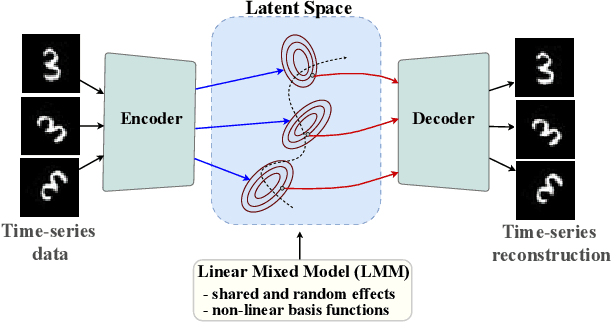
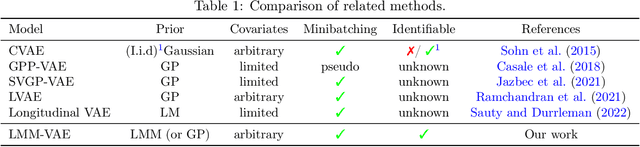
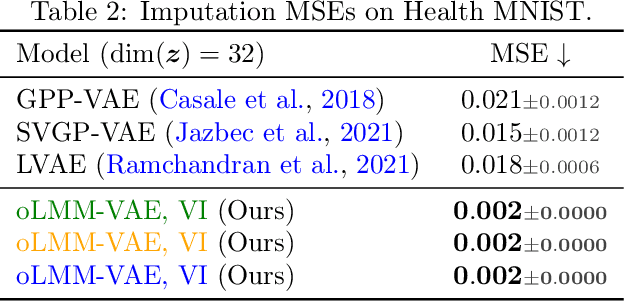
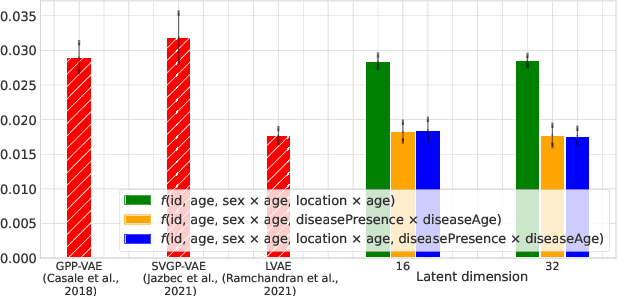
Modelling longitudinal data is an important yet challenging task. These datasets can be high-dimensional, contain non-linear effects and time-varying covariates. Gaussian process (GP) prior-based variational autoencoders (VAEs) have emerged as a promising approach due to their ability to model time-series data. However, they are costly to train and struggle to fully exploit the rich covariates characteristic of longitudinal data, making them difficult for practitioners to use effectively. In this work, we leverage linear mixed models (LMMs) and amortized variational inference to provide conditional priors for VAEs, and propose LMM-VAE, a scalable, interpretable and identifiable model. We highlight theoretical connections between it and GP-based techniques, providing a unified framework for this class of methods. Our proposal performs competitively compared to existing approaches across simulated and real-world datasets.
Modeling Randomly Observed Spatiotemporal Dynamical Systems
Jun 01, 2024


Spatiotemporal processes are a fundamental tool for modeling dynamics across various domains, from heat propagation in materials to oceanic and atmospheric flows. However, currently available neural network-based modeling approaches fall short when faced with data collected randomly over time and space, as is often the case with sensor networks in real-world applications like crowdsourced earthquake detection or pollution monitoring. In response, we developed a new spatiotemporal method that effectively handles such randomly sampled data. Our model integrates techniques from amortized variational inference, neural differential equations, neural point processes, and implicit neural representations to predict both the dynamics of the system and the probabilistic locations and timings of future observations. It outperforms existing methods on challenging spatiotemporal datasets by offering substantial improvements in predictive accuracy and computational efficiency, making it a useful tool for modeling and understanding complex dynamical systems observed under realistic, unconstrained conditions.
Field-based Molecule Generation
Feb 24, 2024


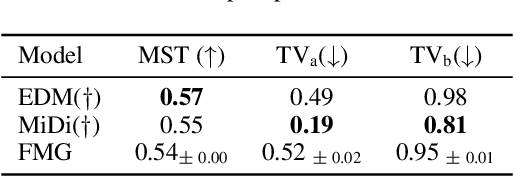
This work introduces FMG, a field-based model for drug-like molecule generation. We show how the flexibility of this method provides crucial advantages over the prevalent, point-cloud based methods, and achieves competitive molecular stability generation. We tackle optical isomerism (enantiomers), a previously omitted molecular property that is crucial for drug safety and effectiveness, and thus account for all molecular geometry aspects. We demonstrate how previous methods are invariant to a group of transformations that includes enantiomer pairs, leading them invariant to the molecular R and S configurations, while our field-based generative model captures this property.
Latent variable model for high-dimensional point process with structured missingness
Feb 08, 2024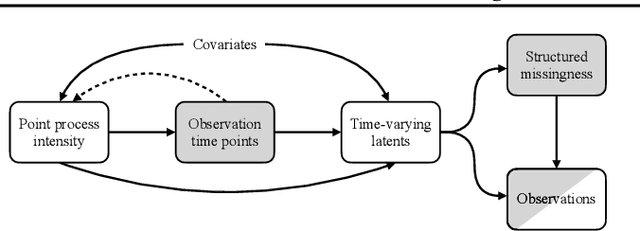
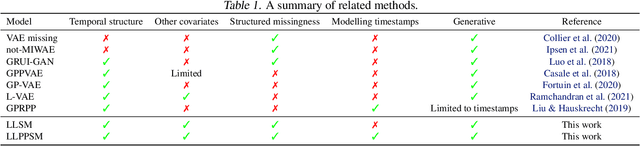
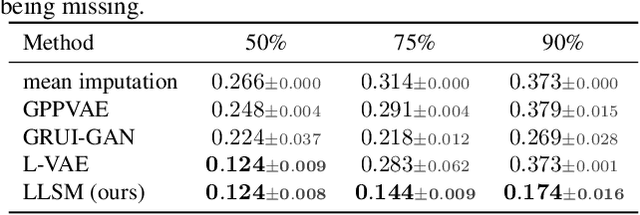
Longitudinal data are important in numerous fields, such as healthcare, sociology and seismology, but real-world datasets present notable challenges for practitioners because they can be high-dimensional, contain structured missingness patterns, and measurement time points can be governed by an unknown stochastic process. While various solutions have been suggested, the majority of them have been designed to account for only one of these challenges. In this work, we propose a flexible and efficient latent-variable model that is capable of addressing all these limitations. Our approach utilizes Gaussian processes to capture temporal correlations between samples and their associated missingness masks as well as to model the underlying point process. We construct our model as a variational autoencoder together with deep neural network parameterised encoder and decoder models, and develop a scalable amortised variational inference approach for efficient model training. We demonstrate competitive performance using both simulated and real datasets.
Estimating treatment effects from single-arm trials via latent-variable modeling
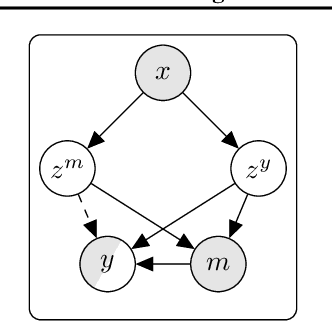
Nov 06, 2023Randomized controlled trials (RCTs) are the accepted standard for treatment effect estimation but they can be infeasible due to ethical reasons and prohibitive costs. Single-arm trials, where all patients belong to the treatment group, can be a viable alternative but require access to an external control group. We propose an identifiable deep latent-variable model for this scenario that can also account for missing covariate observations by modeling their structured missingness patterns. Our method uses amortized variational inference to learn both group-specific and identifiable shared latent representations, which can subsequently be used for (i) patient matching if treatment outcomes are not available for the treatment group, or for (ii) direct treatment effect estimation assuming outcomes are available for both groups. We evaluate the model on a public benchmark as well as on a data set consisting of a published RCT study and real-world electronic health records. Compared to previous methods, our results show improved performance both for direct treatment effect estimation as well as for effect estimation via patient matching.