 Add to Chrome
 Add to Firefox
 Add to Edge
Bayesian Nonparametric Mixed-Effect ODEs with Gaussian Processes
May 13, 2026
Dynamical modelling is central to many scientific domains, including pharmacometrics, systems biology, physiology, and epidemiology. In these settings, heterogeneity is often intrinsic: different subjects or units follow related but distinct continuous-time dynamics. Classical nonlinear mixed-effects Ordinary Differential Equation (ODE) models address this by combining population-level structure with subject-specific effects, but they rely on a parametric vector field and are therefore vulnerable to structural misspecification and unmodelled mechanisms. This motivates nonparametric approaches that can retain principled uncertainty quantification, yet existing nonparametric ODE methods typically assume a single shared dynamical system rather than an explicit mixed-effect hierarchy over subject-specific dynamics. We propose MEGPODE, a Bayesian nonparametric mixed-effect ODE model in which each subject's vector field is decomposed into a shared population component and a subject-specific deviation, both endowed with Gaussian process (GP) priors. To avoid repeated ODE solves per subject during training, we combine state-space GP trajectory priors with virtual collocation observations, yielding Kalman-smoothing trajectory updates and closed-form regressions for the vector fields. Across controlled heterogeneous ODE benchmarks spanning oscillatory, biomedical systems, MEGPODE improves population-field recovery and subject-level trajectory prediction relative to strong baselines.

Latent variable model for high-dimensional point process with structured missingness
Feb 08, 2024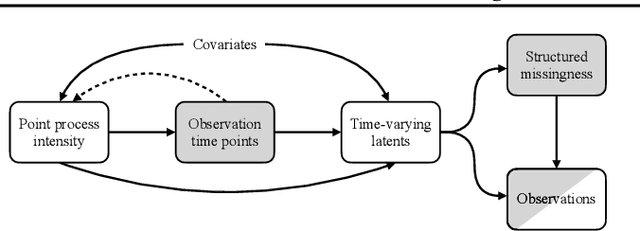
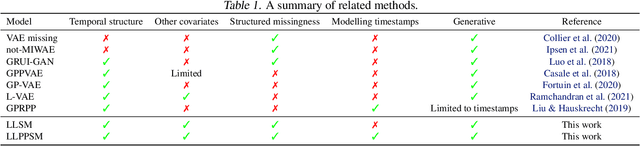
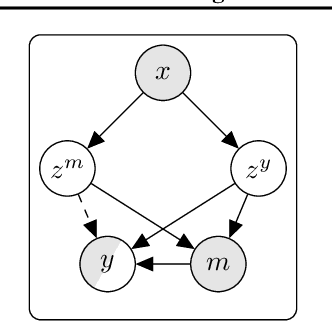
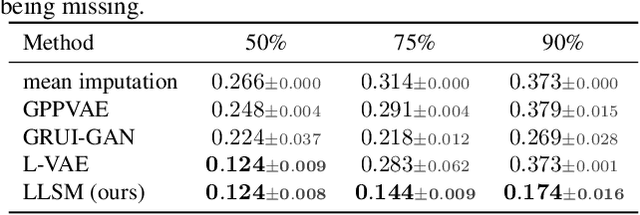
Longitudinal data are important in numerous fields, such as healthcare, sociology and seismology, but real-world datasets present notable challenges for practitioners because they can be high-dimensional, contain structured missingness patterns, and measurement time points can be governed by an unknown stochastic process. While various solutions have been suggested, the majority of them have been designed to account for only one of these challenges. In this work, we propose a flexible and efficient latent-variable model that is capable of addressing all these limitations. Our approach utilizes Gaussian processes to capture temporal correlations between samples and their associated missingness masks as well as to model the underlying point process. We construct our model as a variational autoencoder together with deep neural network parameterised encoder and decoder models, and develop a scalable amortised variational inference approach for efficient model training. We demonstrate competitive performance using both simulated and real datasets.