 Add to Chrome
 Add to Firefox
 Add to Edge
Flexible Flows for Biological Sequence Design
Jun 09, 2026
Designing functional biological sequences requires navigating vast discrete spaces under strict evolutionary and biophysical constraints. Discrete Flow Matching (DFM) offers a generative framework over such spaces, but existing approaches rely on biologically uninformative couplings and offer limited flexibility for variable-length sequence generation and fine-grained control. We propose a structured coupling that encodes domain-specific preferences among sequence elements, biasing the source distribution toward plausible regions without modifying the flow objective or training procedure. Building on this, we introduce a latent edit-based rate parameterization that models variable-length generation via edit operations conditioned on a shared global latent, akin to a latent variable model, while remaining tractable. We further introduce a latent classifier-free guidance mechanism that steers generation coherently in continuous latent space, along with Dirichlet-prior temperature scaling for test-time control over edit operations. Our method achieves state-of-the-art performance across diverse biological sequence tasks, including density estimation, unconditional and conditional DNA sequence generation, and peptide sequence generation.

Field-based Molecule Generation
Feb 24, 2024


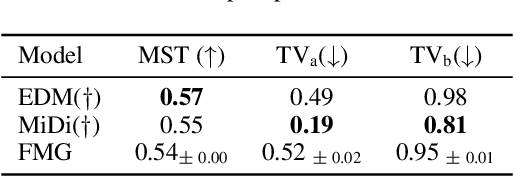
This work introduces FMG, a field-based model for drug-like molecule generation. We show how the flexibility of this method provides crucial advantages over the prevalent, point-cloud based methods, and achieves competitive molecular stability generation. We tackle optical isomerism (enantiomers), a previously omitted molecular property that is crucial for drug safety and effectiveness, and thus account for all molecular geometry aspects. We demonstrate how previous methods are invariant to a group of transformations that includes enantiomer pairs, leading them invariant to the molecular R and S configurations, while our field-based generative model captures this property.