 Add to Chrome
 Add to Firefox
 Add to Edge
EvoPlan: Evolutionary Neuro-Symbolic Robot Planning with Spatio-Temporal Guarantees
Jul 07, 2026
LLM-based robot planners are fluent but cannot guarantee that their plans are executable or safe. Classical PDDL planners can guarantee these properties, but only after the problem is fully specified, and they make poor use of an LLM's ability to read context and repair plans. This paper presents a neuro-symbolic framework with three parts. All LLM calls use a locally-hosted open-weight model, so the pipeline can be deployed on-robot with no cloud dependency. First, an offline procedure that mines a single global Signal Temporal Logic (STL) constraint on mobility from demonstration data. The procedure recovers codified rules (e.g., stopping at red lights, mined from nuPlan driving logs) or population preferences (e.g., social-navigation comfort, mined from SCAND teleoperation), depending on what the demonstrations encode. Because the demonstrations are a one-class signal, we generate the missing negatives with counterfactual perturbations and an LLM violation generator and then fit the constraint by evolutionary search. We use the mined constraint to shield a vision-language driving policy on Bench2Drive and two discrete-action navigation policies on HA-VLN-CE. Second, an evolutionary PDDL planner: an LLM proposes and repairs plans, programmatic validators decide which ones survive, and the validated portion of the plan grows over iterations. We test the planner on the open-world ALFWorld Text benchmark, where it beats strong baselines and stays robust when the goal vocabulary does not match the action-model vocabulary. Third, a constrained execution loop: the planner's plan is compiled into waypoints, the waypoints are checked against the mined constraint, and the planner re-plans on a violation. We illustrate the full pipeline via demonstrations using the Gazebo simulator.

Internalizing Multi-Agent Reasoning for Accurate and Efficient LLM-based Recommendation
Feb 12, 2026Large Language Models (LLMs) are reshaping recommender systems by leveraging extensive world knowledge and semantic reasoning to interpret user intent. However, effectively integrating these capabilities with collaborative signals while avoiding prohibitive inference latency remains a critical bottleneck. To address this, we propose a trajectory-driven internalization framework to develop a Single-agent Trajectory-Aligned Recommender (STAR). Specifically, to internalize complex reasoning capabilities into a single efficient model, we first design a multi-agent teacher system capable of multi-turn tool usage and reflection. This teacher utilizes a Collaborative Signal Translation mechanism to explicitly convert latent behavioral patterns into descriptive natural language evidence to enhance reasoning accuracy. Subsequently, a trajectory-driven distillation pipeline transfers this agentic logic, including planning, tool usage, and self-reflection, into the compact STAR model. Extensive experiments demonstrate that STAR surpasses its teacher by 8.7% to 39.5% while eliminating iterative latency, paving the way for real-time, reasoning-enhanced recommendation.
AlignedKV: Reducing Memory Access of KV-Cache with Precision-Aligned Quantization
Sep 25, 2024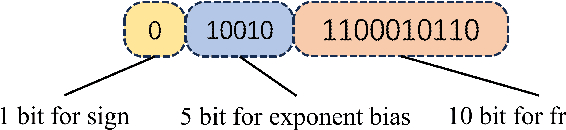
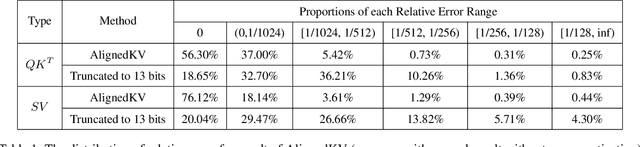
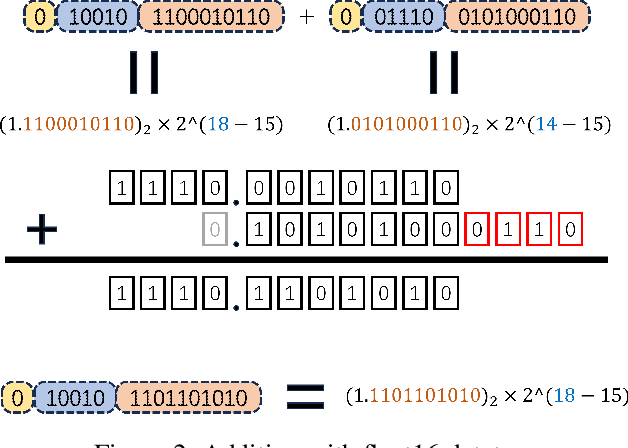
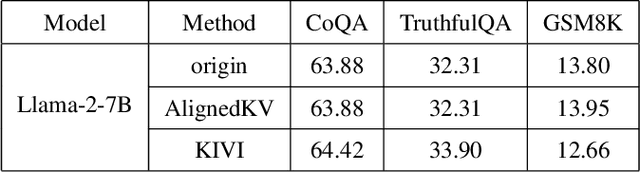
Model quantization has become a crucial technique to address the issues of large memory consumption and long inference times associated with LLMs. Mixed-precision quantization, which distinguishes between important and unimportant parameters, stands out among numerous quantization schemes as it achieves a balance between precision and compression rate. However, existing approaches can only identify important parameters through qualitative analysis and manual experiments without quantitatively analyzing how their importance is determined. We propose a new criterion, so-called 'precision alignment', to build a quantitative framework to holistically evaluate the importance of parameters in mixed-precision quantization. Our observations on floating point addition under various real-world scenarios suggest that two addends should have identical precision, otherwise the information in the higher-precision number will be wasted. Such an observation offers an essential principle to determine the precision of each parameter in matrix multiplication operation. As the first step towards applying the above discovery to large model inference, we develop a dynamic KV-Cache quantization technique to effectively reduce memory access latency. Different from existing quantization approaches that focus on memory saving, this work directly aims to accelerate LLM inference through quantifying floating numbers. The proposed technique attains a 25% saving of memory access and delivers up to 1.3x speedup in the computation of attention in the decoding phase of LLM, with almost no loss of precision.