 Add to Chrome
 Add to Firefox
 Add to Edge
IDPruner: Harmonizing Importance and Diversity in Visual Token Pruning for MLLMs
Feb 10, 2026
Multimodal Large Language Models (MLLMs) have demonstrated impressive capabilities, yet they encounter significant computational bottlenecks due to the massive volume of visual tokens. Consequently, visual token pruning, which substantially reduces the token count, has emerged as a critical technique for accelerating MLLM inference. Existing approaches focus on token importance, diversity, or an intuitive combination of both, without a principled framework for their optimal integration. To address this issue, we first conduct a systematic analysis to characterize the trade-off between token importance and semantic diversity. Guided by this analysis, we propose the \textbf{I}mportance and \textbf{D}iversity Pruner (\textbf{IDPruner}), which leverages the Maximal Marginal Relevance (MMR) algorithm to achieve a Pareto-optimal balance between these two objectives. Crucially, our method operates without requiring attention maps, ensuring full compatibility with FlashAttention and efficient deployment via one-shot pruning. We conduct extensive experiments across various model architectures and multimodal benchmarks, demonstrating that IDPruner achieves state-of-the-art performance and superior generalization across diverse architectures and tasks. Notably, on Qwen2.5-VL-7B-Instruct, IDPruner retains 95.18\% of baseline performance when pruning 75\% of the tokens, and still maintains 86.40\% even under an extreme 90\% pruning ratio. Our code is available at https://github.com/Tencent/AngelSlim.

AlignedKV: Reducing Memory Access of KV-Cache with Precision-Aligned Quantization
Sep 25, 2024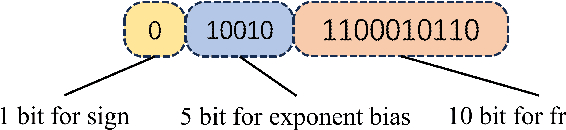
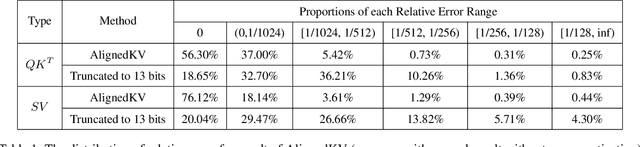
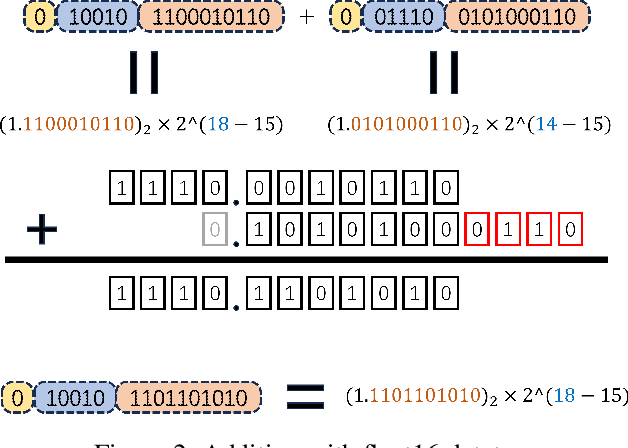
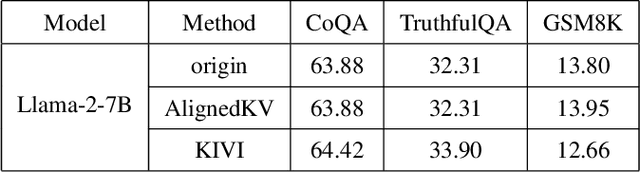
Model quantization has become a crucial technique to address the issues of large memory consumption and long inference times associated with LLMs. Mixed-precision quantization, which distinguishes between important and unimportant parameters, stands out among numerous quantization schemes as it achieves a balance between precision and compression rate. However, existing approaches can only identify important parameters through qualitative analysis and manual experiments without quantitatively analyzing how their importance is determined. We propose a new criterion, so-called 'precision alignment', to build a quantitative framework to holistically evaluate the importance of parameters in mixed-precision quantization. Our observations on floating point addition under various real-world scenarios suggest that two addends should have identical precision, otherwise the information in the higher-precision number will be wasted. Such an observation offers an essential principle to determine the precision of each parameter in matrix multiplication operation. As the first step towards applying the above discovery to large model inference, we develop a dynamic KV-Cache quantization technique to effectively reduce memory access latency. Different from existing quantization approaches that focus on memory saving, this work directly aims to accelerate LLM inference through quantifying floating numbers. The proposed technique attains a 25% saving of memory access and delivers up to 1.3x speedup in the computation of attention in the decoding phase of LLM, with almost no loss of precision.