 Add to Chrome
 Add to Firefox
 Add to Edge
A Cookbook of 3D Vision: Data, Learning Paradigms, and Application
Jun 02, 2026
3D vision has rapidly evolved, driven by increasingly diverse data representations, learning paradigms, and modeling strategies. Yet the field remains fragmented across representations and benchmarks, making it difficult to develop unified perspectives on efficiency, fidelity, and scalability. This work provides a data-centric taxonomy of 3D vision that connects geometric representations, datasets, learning frameworks, and applications within a single conceptual map. We begin by analysing the principal structural representations of 3D data--point clouds, meshes, voxels, and 3D Gaussians--along with their acquisition pipelines. We then examine how dataset design, benchmark construction, and supervision regimes shape recent advances, spanning 2D-supervised 3D learning, implicit neural representations, and 4D world modeling. Through this integrative lens, we clarify the relationships among representations, learning paradigms, and downstream tasks in reconstruction, generation, and video modeling, offering a consolidated view of emerging trends toward balancing efficiency and fidelity and toward multimodal geometric grounding.
* Accepted to the CVPR 2026 OpenSUN3D Workshop. Official version available at CVF Open Access. https://openaccess.thecvf.com/content/CVPR2026W/OpenSUN3D/html/Du_A_Cookbook_of_3D_Vision_Data_Learning_Paradigms_and_Application_CVPRW_2026_paper.html

REPAIR: Robust Editing via Progressive Adaptive Intervention and Reintegration
Oct 02, 2025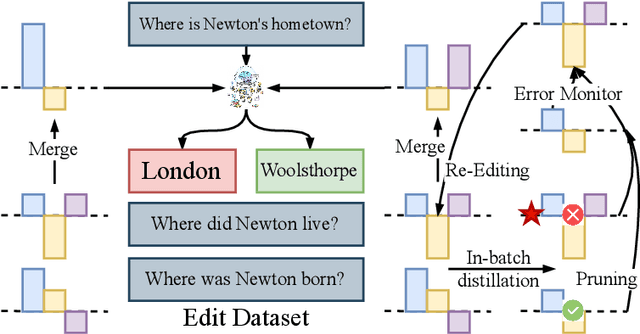
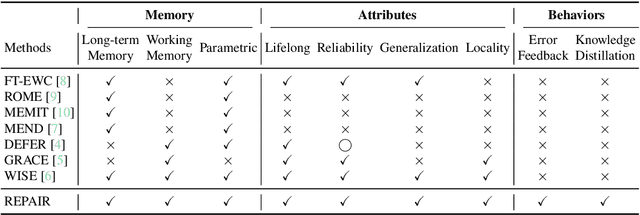
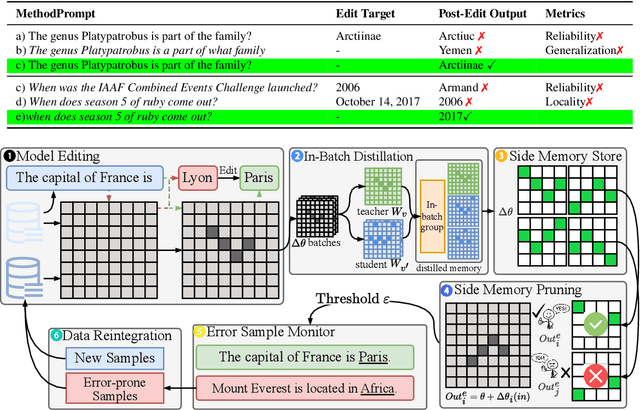
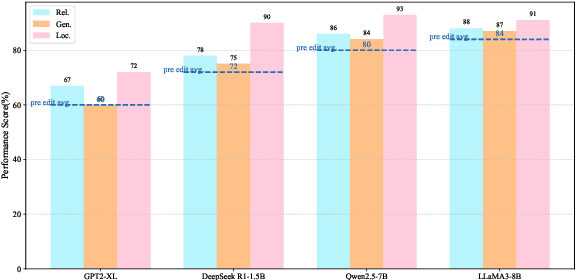
Post-training for large language models (LLMs) is constrained by the high cost of acquiring new knowledge or correcting errors and by the unintended side effects that frequently arise from retraining. To address these issues, we introduce REPAIR (Robust Editing via Progressive Adaptive Intervention and Reintegration), a lifelong editing framework designed to support precise and low-cost model updates while preserving non-target knowledge. REPAIR mitigates the instability and conflicts of large-scale sequential edits through a closed-loop feedback mechanism coupled with dynamic memory management. Furthermore, by incorporating frequent knowledge fusion and enforcing strong locality guards, REPAIR effectively addresses the shortcomings of traditional distribution-agnostic approaches that often overlook unintended ripple effects. Our experiments demonstrate that REPAIR boosts editing accuracy by 10%-30% across multiple model families and significantly reduces knowledge forgetting. This work introduces a robust framework for developing reliable, scalable, and continually evolving LLMs.