 Add to Chrome
 Add to Firefox
 Add to Edge
Can a Lightweight Automated AI Pipeline Solve Research-Level Mathematical Problems?
Feb 14, 2026
Large language models (LLMs) have recently achieved remarkable success in generating rigorous mathematical proofs, with "AI for Math" emerging as a vibrant field of research. While these models have mastered competition-level benchmarks like the International Mathematical Olympiad and show promise in research applications through auto-formalization, their deployment via lightweight, natural-language pipelines for research problems remains underexplored. In this work, we demonstrate that next-generation models (e.g., Gemini 3 Pro, GPT-5.2 Pro), when integrated into a streamlined automated pipeline optimized for citation-based verification, can solve sophisticated research-grade problems. We evaluate our pipeline on two novel datasets: (1) the ICCM problem sets (comparable to the S.-T. Yau College Student Mathematics Contest) proposed by leading mathematicians, and (2) the "First Proof" problem set, consisting of previously unpublished research questions. Our pipeline generated candidate proofs for all problems in the first two ICCM sets and the "First Proof" set. The solutions for the first two ICCM sets and Problem 4 of the "First Proof" set have been fully verified by our team. All generated proofs have been submitted to the official organization, and our generated results are publicly available. We plan to open-source the complete pipeline methodology in due course.

Tokenizing 3D Molecule Structure with Quantized Spherical Coordinates
Dec 02, 2024
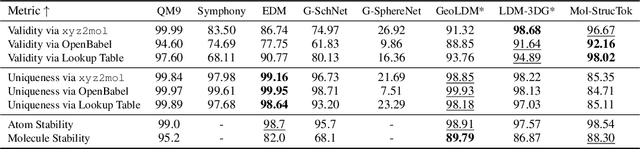


The application of language models (LMs) to molecular structure generation using line notations such as SMILES and SELFIES has been well-established in the field of cheminformatics. However, extending these models to generate 3D molecular structures presents significant challenges. Two primary obstacles emerge: (1) the difficulty in designing a 3D line notation that ensures SE(3)-invariant atomic coordinates, and (2) the non-trivial task of tokenizing continuous coordinates for use in LMs, which inherently require discrete inputs. To address these challenges, we propose Mol-StrucTok, a novel method for tokenizing 3D molecular structures. Our approach comprises two key innovations: (1) We design a line notation for 3D molecules by extracting local atomic coordinates in a spherical coordinate system. This notation builds upon existing 2D line notations and remains agnostic to their specific forms, ensuring compatibility with various molecular representation schemes. (2) We employ a Vector Quantized Variational Autoencoder (VQ-VAE) to tokenize these coordinates, treating them as generation descriptors. To further enhance the representation, we incorporate neighborhood bond lengths and bond angles as understanding descriptors. Leveraging this tokenization framework, we train a GPT-2 style model for 3D molecular generation tasks. Results demonstrate strong performance with significantly faster generation speeds and competitive chemical stability compared to previous methods. Further, by integrating our learned discrete representations into Graphormer model for property prediction on QM9 dataset, Mol-StrucTok reveals consistent improvements across various molecular properties, underscoring the versatility and robustness of our approach.
Towards Generalist Prompting for Large Language Models by Mental Models
Feb 28, 2024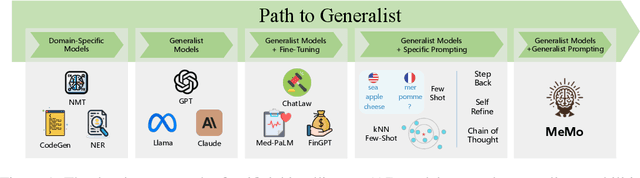
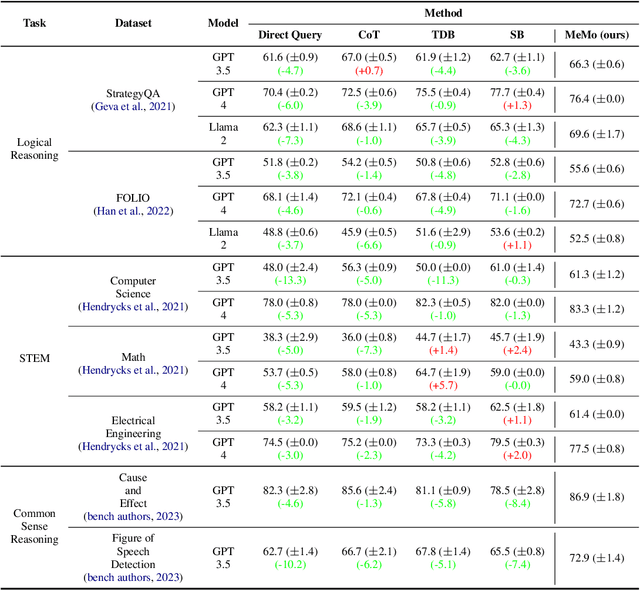
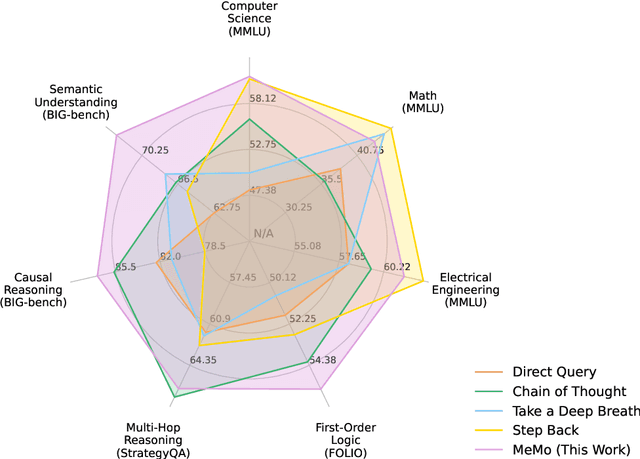
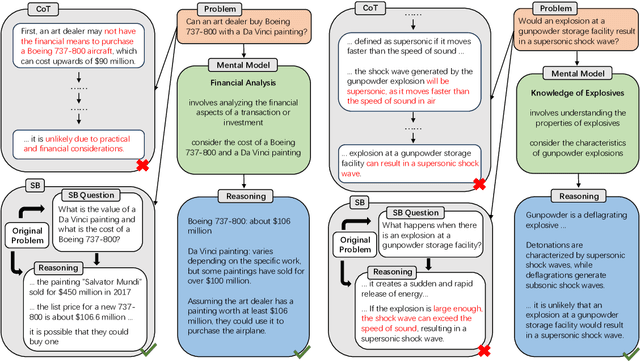
Large language models (LLMs) have demonstrated impressive performance on many tasks. However, to achieve optimal performance, specially designed prompting methods are still needed. These methods either rely on task-specific few-shot examples that require a certain level of domain knowledge, or are designed to be simple but only perform well on a few types of tasks. In this work, we attempt to introduce the concept of generalist prompting, which operates on the design principle of achieving optimal or near-optimal performance on a wide range of tasks while eliminating the need for manual selection and customization of prompts tailored to specific problems. Furthermore, we propose MeMo (Mental Models), an innovative prompting method that is simple-designed yet effectively fulfills the criteria of generalist prompting. MeMo distills the cores of various prompting methods into individual mental models and allows LLMs to autonomously select the most suitable mental models for the problem, achieving or being near to the state-of-the-art results on diverse tasks such as STEM, logical reasoning, and commonsense reasoning in zero-shot settings. We hope that the insights presented herein will stimulate further exploration of generalist prompting methods for LLMs.