 Add to Chrome
 Add to Firefox
 Add to Edge
A Two-Stage Time-Aware Transformer for Short-Horizon AECOPD Risk Prediction
Aug 20, 2026
Acute exacerbation of chronic obstructive pulmonary disease (AECOPD) can worsen rapidly, making timely prediction a clinical priority. Most existing machine learning approaches rely on episodically collected clinical variables, introducing delays that limit their practical utility in home monitoring settings. Home ventilators offer a lower-latency alternative, producing a near-continuous record of respiratory status during daily use. However existing ventilator-based approaches either compress the waveform into handcrafted features or focus primarily on binary risk classification, leaving the timing of an impending event unresolved. In this paper, we present a two-stage framework that operates directly on raw pressure and flow waveforms from the most recent seven days of home ventilator use. The first-stage classification model identifies patients at high risk of a severe exacerbation. The second-stage regression model then estimates how many days remain before the event occurs. Our experimental results demonstrate that the two-stage model outperforms traditional baseline models on both risk classification and time-to-event estimation, with our selected Stage 1 classifier achieving F1 = 0.91 and our Stage 2 regression model achieving RMSE = 1.00 days and R^2 = 0.76, giving clinicians both an early warning and actionable lead time before a severe exacerbation occurs.

Precise Localization of Memories: A Fine-grained Neuron-level Knowledge Editing Technique for LLMs
Mar 03, 2025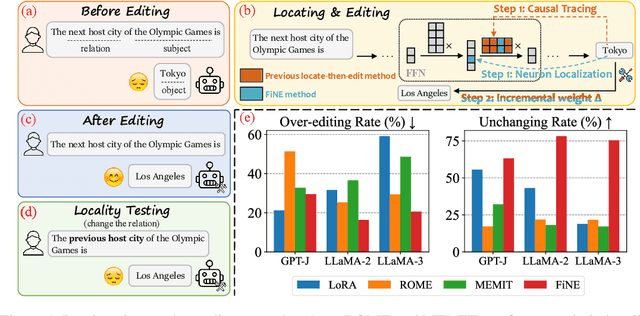
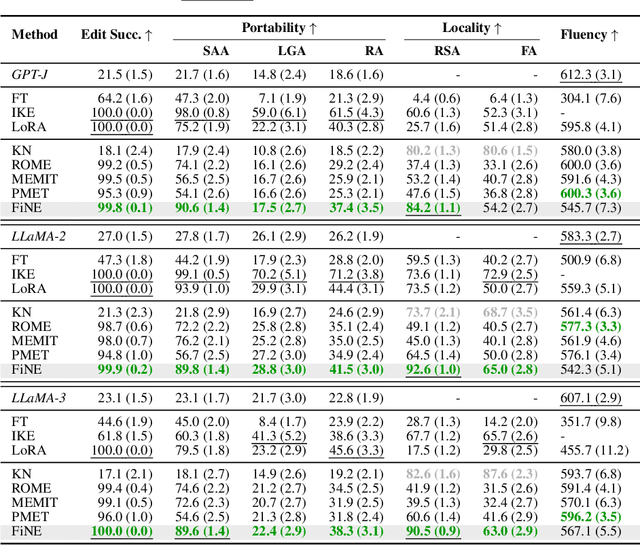
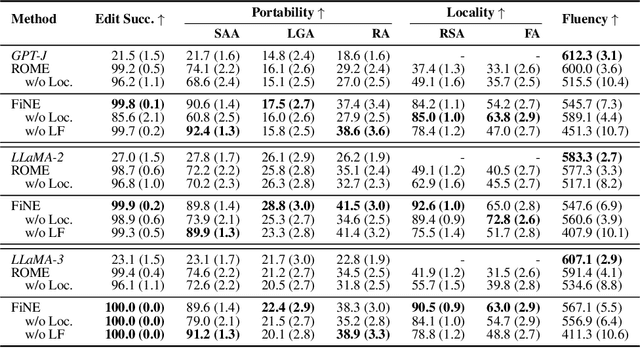
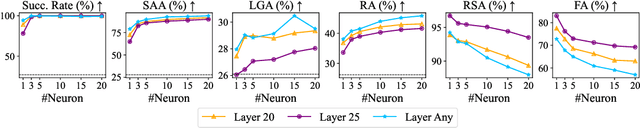
Knowledge editing aims to update outdated information in Large Language Models (LLMs). A representative line of study is locate-then-edit methods, which typically employ causal tracing to identify the modules responsible for recalling factual knowledge about entities. However, we find these methods are often sensitive only to changes in the subject entity, leaving them less effective at adapting to changes in relations. This limitation results in poor editing locality, which can lead to the persistence of irrelevant or inaccurate facts, ultimately compromising the reliability of LLMs. We believe this issue arises from the insufficient precision of knowledge localization. To address this, we propose a Fine-grained Neuron-level Knowledge Editing (FiNE) method that enhances editing locality without affecting overall success rates. By precisely identifying and modifying specific neurons within feed-forward networks, FiNE significantly improves knowledge localization and editing. Quantitative experiments demonstrate that FiNE efficiently achieves better overall performance compared to existing techniques, providing new insights into the localization and modification of knowledge within LLMs.
Finding and Editing Multi-Modal Neurons in Pre-Trained Transformer
Nov 13, 2023Multi-modal large language models (LLM) have achieved powerful capabilities for visual semantic understanding in recent years. However, little is known about how LLMs comprehend visual information and interpret different modalities of features. In this paper, we propose a new method for identifying multi-modal neurons in transformer-based multi-modal LLMs. Through a series of experiments, We highlight three critical properties of multi-modal neurons by four well-designed quantitative evaluation metrics. Furthermore, we introduce a knowledge editing method based on the identified multi-modal neurons, for modifying a specific token to another designative token. We hope our findings can inspire further explanatory researches on understanding mechanisms of multi-modal LLMs.