 Add to Chrome
 Add to Firefox
 Add to Edge
FAWAM: Force-Aware World Action Models for Closed-Loop Contact-Rich Manipulation
Jun 07, 2026
Force signals provide critical interaction cues for contact-rich robotic manipulation. However, existing methods mostly use force as an additional observation modality, without fully exploiting its role in modeling future interaction dynamics or guiding execution-time feedback correction. In this paper, we propose FAWAM, a force-aware world action model that incorporates force information at three levels: perception, prediction, and closed-loop execution. FAWAM first encodes historical 6-axis force/torque signals to modulate action generation, then jointly predicts future actions and end-effector wrenches to explicitly model contact evolution. It further introduces a residual correction module that uses the predicted wrench trajectory as an execution-time reference to refine actions online based on real-time force feedback. Real-world experiments across multiple contact-rich tasks show that FAWAM improves the average success rate by 36.25% over vision-only baselines and 21.25% over existing force-aware baselines, demonstrating the effectiveness of our force-aware framework for robust contact-rich manipulation.

Improving Generalization and Convergence by Enhancing Implicit Regularization
May 31, 2024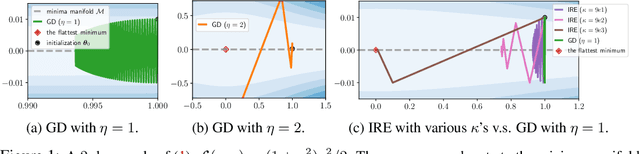
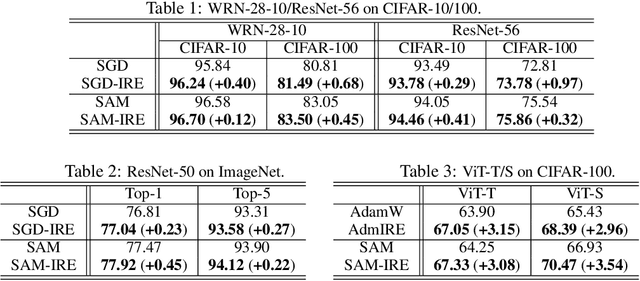
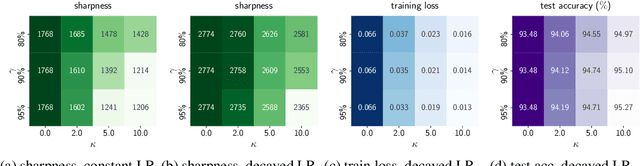
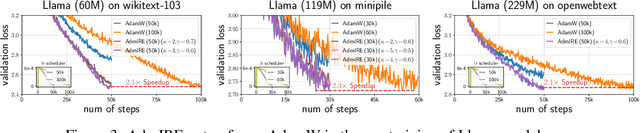
In this work, we propose an Implicit Regularization Enhancement (IRE) framework to accelerate the discovery of flat solutions in deep learning, thereby improving generalization and convergence. Specifically, IRE decouples the dynamics of flat and sharp directions, which boosts the sharpness reduction along flat directions while maintaining the training stability in sharp directions. We show that IRE can be practically incorporated with {\em generic base optimizers} without introducing significant computational overload. Experiments show that IRE consistently improves the generalization performance for image classification tasks across a variety of benchmark datasets (CIFAR-10/100, ImageNet) and models (ResNets and ViTs). Surprisingly, IRE also achieves a $2\times$ {\em speed-up} compared to AdamW in the pre-training of Llama models (of sizes ranging from 60M to 229M) on datasets including Wikitext-103, Minipile, and Openwebtext. Moreover, we provide theoretical guarantees, showing that IRE can substantially accelerate the convergence towards flat minima in Sharpness-aware Minimization (SAM).