 Add to Chrome
 Add to Firefox
 Add to Edge
Fibration Policy Optimization
Mar 09, 2026
Large language models are increasingly trained as heterogeneous systems spanning multiple domains, expert partitions, and agentic pipelines, yet prevalent proximal objectives operate at a single scale and lack a principled mechanism for coupling token-level, trajectory-level, and higher-level hierarchical stability control. To bridge this gap, we derive the Aggregational Policy Censoring Objective (APC-Obj), the first exact unconstrained reformulation of sample-based TV-TRPO, establishing that clipping-based surrogate design and trust-region optimization are dual formulations of the same problem. Building on this foundation, we develop Fiber Bundle Gating (FBG), an algebraic framework that organizes sampled RL data as a fiber bundle and decomposes ratio gating into a base-level gate on trajectory aggregates and a fiber-level gate on per-token residuals, with provable first-order agreement with the true RL objective near on-policy. From APC-Obj and FBG we derive Fibration Policy Optimization (or simply, FiberPO), a concrete objective whose Jacobian is block-diagonal over trajectories, reduces to identity at on-policy, and provides better update direction thus improving token efficiency. The compositional nature of the framework extends beyond the trajectory-token case: fibrations compose algebraically into a Fibration Gating Hierarchy (FGH) that scales the same gating mechanism to arbitrary hierarchical depth without new primitives, as demonstrated by FiberPO-Domain, a four-level instantiation with independent trust-region budgets at the domain, prompt group, trajectory, and token levels. Together, these results connect the trust-region theory, a compositional algebraic structure, and practical multi-scale stability control into a unified framework for LLM policy optimization.

Learning Temporal Abstractions via Variational Homomorphisms in Option-Induced Abstract MDPs
Jul 24, 2025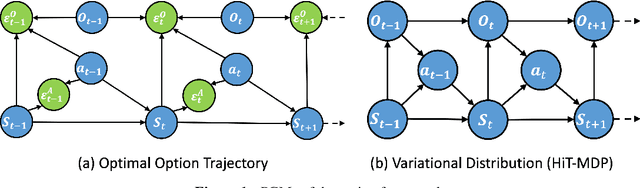
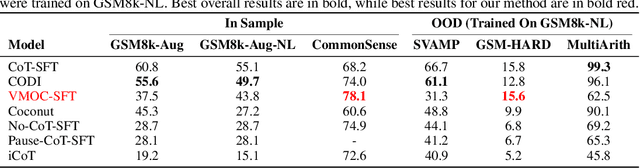
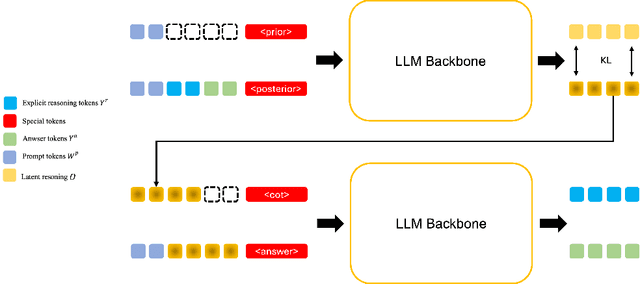
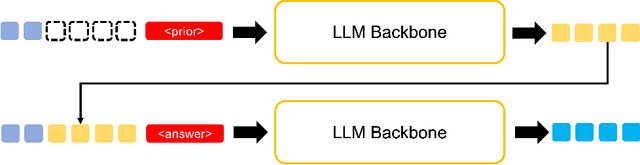
Large Language Models (LLMs) have shown remarkable reasoning ability through explicit Chain-of-Thought (CoT) prompting, but generating these step-by-step textual explanations is computationally expensive and slow. To overcome this, we aim to develop a framework for efficient, implicit reasoning, where the model "thinks" in a latent space without generating explicit text for every step. We propose that these latent thoughts can be modeled as temporally-extended abstract actions, or options, within a hierarchical reinforcement learning framework. To effectively learn a diverse library of options as latent embeddings, we first introduce the Variational Markovian Option Critic (VMOC), an off-policy algorithm that uses variational inference within the HiT-MDP framework. To provide a rigorous foundation for using these options as an abstract reasoning space, we extend the theory of continuous MDP homomorphisms. This proves that learning a policy in the simplified, abstract latent space, for which VMOC is suited, preserves the optimality of the solution to the original, complex problem. Finally, we propose a cold-start procedure that leverages supervised fine-tuning (SFT) data to distill human reasoning demonstrations into this latent option space, providing a rich initialization for the model's reasoning capabilities. Extensive experiments demonstrate that our approach achieves strong performance on complex logical reasoning benchmarks and challenging locomotion tasks, validating our framework as a principled method for learning abstract skills for both language and control.