 Add to Chrome
 Add to Firefox
 Add to Edge
nncase: An End-to-End Compiler for Efficient LLM Deployment on Heterogeneous Storage Architectures
Dec 25, 2025
The efficient deployment of large language models (LLMs) is hindered by memory architecture heterogeneity, where traditional compilers suffer from fragmented workflows and high adaptation costs. We present nncase, an open-source, end-to-end compilation framework designed to unify optimization across diverse targets. Central to nncase is an e-graph-based term rewriting engine that mitigates the phase ordering problem, enabling global exploration of computation and data movement strategies. The framework integrates three key modules: Auto Vectorize for adapting to heterogeneous computing units, Auto Distribution for searching parallel strategies with cost-aware communication optimization, and Auto Schedule for maximizing on-chip cache locality. Furthermore, a buffer-aware Codegen phase ensures efficient kernel instantiation. Evaluations show that nncase outperforms mainstream frameworks like MLC LLM and Intel IPEX on Qwen3 series models and achieves performance comparable to the hand-optimized llama.cpp on CPUs, demonstrating the viability of automated compilation for high-performance LLM deployment. The source code is available at https://github.com/kendryte/nncase.

Faster MoE LLM Inference for Extremely Large Models
May 06, 2025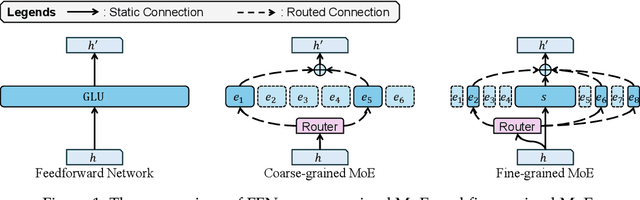

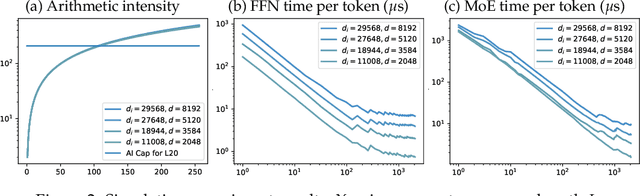
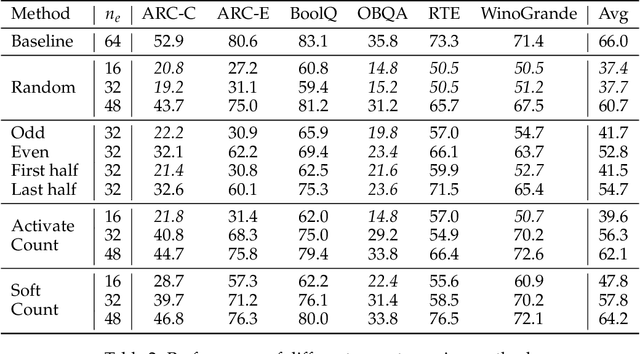
Sparse Mixture of Experts (MoE) large language models (LLMs) are gradually becoming the mainstream approach for ultra-large-scale models. Existing optimization efforts for MoE models have focused primarily on coarse-grained MoE architectures. With the emergence of DeepSeek Models, fine-grained MoE models are gaining popularity, yet research on them remains limited. Therefore, we want to discuss the efficiency dynamic under different service loads. Additionally, fine-grained models allow deployers to reduce the number of routed experts, both activated counts and total counts, raising the question of how this reduction affects the trade-off between MoE efficiency and performance. Our findings indicate that while deploying MoE models presents greater challenges, it also offers significant optimization opportunities. Reducing the number of activated experts can lead to substantial efficiency improvements in certain scenarios, with only minor performance degradation. Reducing the total number of experts provides limited efficiency gains but results in severe performance degradation. Our method can increase throughput by at least 10\% without any performance degradation. Overall, we conclude that MoE inference optimization remains an area with substantial potential for exploration and improvement.