 Add to Chrome
 Add to Firefox
 Add to Edge
The Last Human-Written Paper: Agent-Native Research Artifacts
Apr 27, 2026
Scientific publication compresses a branching, iterative research process into a linear narrative, discarding the majority of what was discovered along the way. This compilation imposes two structural costs: a Storytelling Tax, where failed experiments, rejected hypotheses, and the branching exploration process are discarded to fit a linear narrative; and an Engineering Tax, where the gap between reviewer-sufficient prose and agent-sufficient specification leaves critical implementation details unwritten. Tolerable for human readers, these costs become critical when AI agents must understand, reproduce, and extend published work. We introduce the Agent-Native Research Artifact (Ara), a protocol that replaces the narrative paper with a machine-executable research package structured around four layers: scientific logic, executable code with full specifications, an exploration graph that preserves the failures compilation discards, and evidence grounding every claim in raw outputs. Three mechanisms support the ecosystem: a Live Research Manager that captures decisions and dead ends during ordinary development; an Ara Compiler that translates legacy PDFs and repos into Aras; and an Ara-native review system that automates objective checks so human reviewers can focus on significance, novelty, and taste. On PaperBench and RE-Bench, Ara raises question-answering accuracy from 72.4% to 93.7% and reproduction success from 57.4% to 64.4%. On RE-Bench's five open-ended extension tasks, preserved failure traces in Ara accelerate progress, but can also constrain a capable agent from stepping outside the prior-run box depending on the agent's capabilities.

Understanding the Performance and Estimating the Cost of LLM Fine-Tuning
Aug 08, 2024


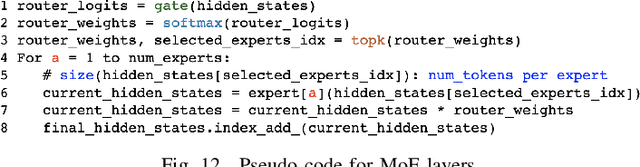
Due to the cost-prohibitive nature of training Large Language Models (LLMs), fine-tuning has emerged as an attractive alternative for specializing LLMs for specific tasks using limited compute resources in a cost-effective manner. In this paper, we characterize sparse Mixture of Experts (MoE) based LLM fine-tuning to understand their accuracy and runtime performance on a single GPU. Our evaluation provides unique insights into the training efficacy of sparse and dense versions of MoE models, as well as their runtime characteristics, including maximum batch size, execution time breakdown, end-to-end throughput, GPU hardware utilization, and load distribution. Our study identifies the optimization of the MoE layer as crucial for further improving the performance of LLM fine-tuning. Using our profiling results, we also develop and validate an analytical model to estimate the cost of LLM fine-tuning on the cloud. This model, based on parameters of the model and GPU architecture, estimates LLM throughput and the cost of training, aiding practitioners in industry and academia to budget the cost of fine-tuning a specific model.
CoDR: Computation and Data Reuse Aware CNN Accelerator
Apr 20, 2021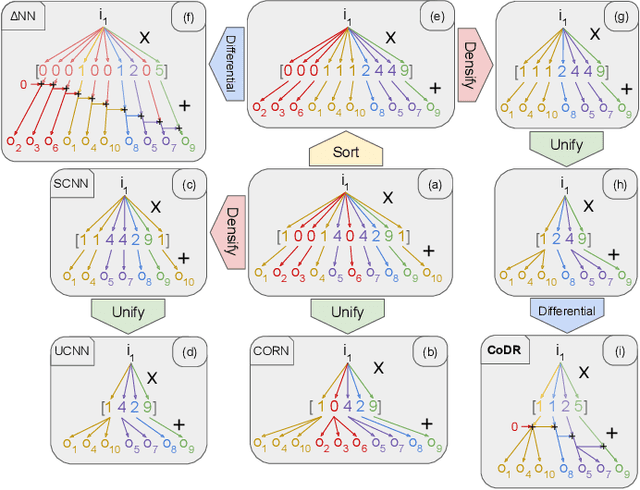

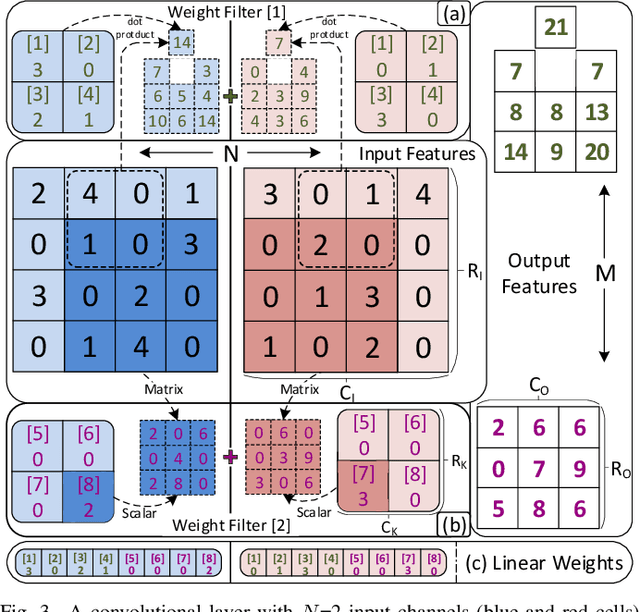
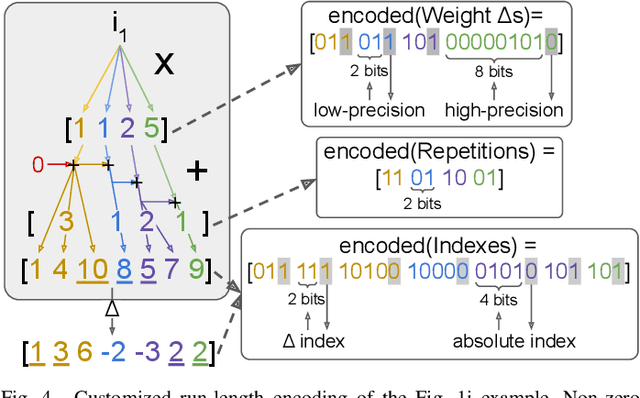
Computation and Data Reuse is critical for the resource-limited Convolutional Neural Network (CNN) accelerators. This paper presents Universal Computation Reuse to exploit weight sparsity, repetition, and similarity simultaneously in a convolutional layer. Moreover, CoDR decreases the cost of weight memory access by proposing a customized Run-Length Encoding scheme and the number of memory accesses to the intermediate results by introducing an input and output stationary dataflow. Compared to two recent compressed CNN accelerators with the same area of 2.85 mm^2, CoDR decreases SRAM access by 5.08x and 7.99x, and consumes 3.76x and 6.84x less energy.