 Add to Chrome
 Add to Firefox
 Add to Edge
Scalable Multiagent Reinforcement Learning with Collective Influence Estimation
Jan 13, 2026
Multiagent reinforcement learning (MARL) has attracted considerable attention due to its potential in addressing complex cooperative tasks. However, existing MARL approaches often rely on frequent exchanges of action or state information among agents to achieve effective coordination, which is difficult to satisfy in practical robotic systems. A common solution is to introduce estimator networks to model the behaviors of other agents and predict their actions; nevertheless, such designs cause the size and computational cost of the estimator networks to grow rapidly with the number of agents, thereby limiting scalability in large-scale systems. To address these challenges, this paper proposes a multiagent learning framework augmented with a Collective Influence Estimation Network (CIEN). By explicitly modeling the collective influence of other agents on the task object, each agent can infer critical interaction information solely from its local observations and the task object's states, enabling efficient collaboration without explicit action information exchange. The proposed framework effectively avoids network expansion as the team size increases; moreover, new agents can be incorporated without modifying the network structures of existing agents, demonstrating strong scalability. Experimental results on multiagent cooperative tasks based on the Soft Actor-Critic (SAC) algorithm show that the proposed method achieves stable and efficient coordination under communication-limited environments. Furthermore, policies trained with collective influence modeling are deployed on a real robotic platform, where experimental results indicate significantly improved robustness and deployment feasibility, along with reduced dependence on communication infrastructure.

Multiagent Reinforcement Learning with Neighbor Action Estimation
Jan 08, 2026Multiagent reinforcement learning, as a prominent intelligent paradigm, enables collaborative decision-making within complex systems. However, existing approaches often rely on explicit action exchange between agents to evaluate action value functions, which is frequently impractical in real-world engineering environments due to communication constraints, latency, energy consumption, and reliability requirements. From an artificial intelligence perspective, this paper proposes an enhanced multiagent reinforcement learning framework that employs action estimation neural networks to infer agent behaviors. By integrating a lightweight action estimation module, each agent infers neighboring agents' behaviors using only locally observable information, enabling collaborative policy learning without explicit action sharing. This approach is fully compatible with standard TD3 algorithms and scalable to larger multiagent systems. At the engineering application level, this framework has been implemented and validated in dual-arm robotic manipulation tasks: two robotic arms collaboratively lift objects. Experimental results demonstrate that this approach significantly enhances the robustness and deployment feasibility of real-world robotic systems while reducing dependence on information infrastructure. Overall, this research advances the development of decentralized multiagent artificial intelligence systems while enabling AI to operate effectively in dynamic, information-constrained real-world environments.
Double Actor-Critic with TD Error-Driven Regularization in Reinforcement Learning
Sep 28, 2024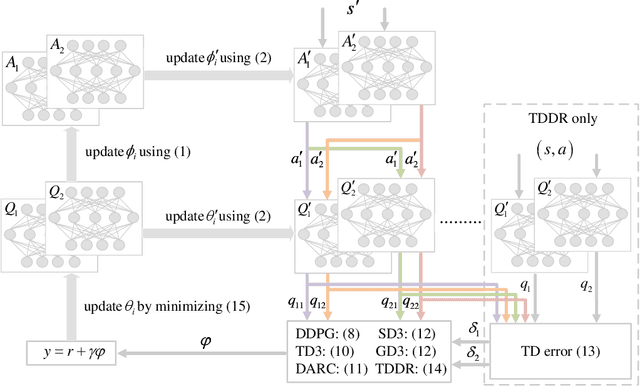
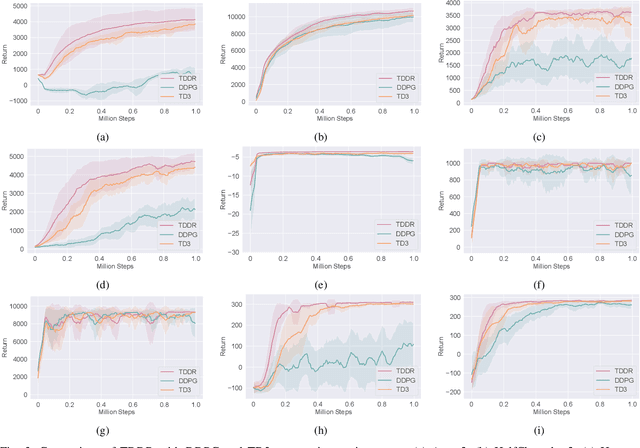

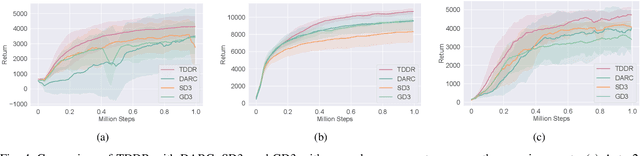
To obtain better value estimation in reinforcement learning, we propose a novel algorithm based on the double actor-critic framework with temporal difference error-driven regularization, abbreviated as TDDR. TDDR employs double actors, with each actor paired with a critic, thereby fully leveraging the advantages of double critics. Additionally, TDDR introduces an innovative critic regularization architecture. Compared to classical deterministic policy gradient-based algorithms that lack a double actor-critic structure, TDDR provides superior estimation. Moreover, unlike existing algorithms with double actor-critic frameworks, TDDR does not introduce any additional hyperparameters, significantly simplifying the design and implementation process. Experiments demonstrate that TDDR exhibits strong competitiveness compared to benchmark algorithms in challenging continuous control tasks.