 Add to Chrome
 Add to Firefox
 Add to Edge
ScrollScape: Unlocking 32K Image Generation With Video Diffusion Priors
Mar 25, 2026
While diffusion models excel at generating images with conventional dimensions, pushing them to synthesize ultra-high-resolution imagery at extreme aspect ratios (EAR) often triggers catastrophic structural failures, such as object repetition and spatial fragmentation.This limitation fundamentally stems from a lack of robust spatial priors, as static text-to-image models are primarily trained on image distributions with conventional dimensions.To overcome this bottleneck, we present ScrollScape, a novel framework that reformulates EAR image synthesis into a continuous video generation process through two core innovations.By mapping the spatial expansion of a massive canvas to the temporal evolution of video frames, ScrollScape leverages the inherent temporal consistency of video models as a powerful global constraint to ensure long-range structural integrity.Specifically, Scanning Positional Encoding (ScanPE) distributes global coordinates across frames to act as a flexible moving camera, while Scrolling Super-Resolution (ScrollSR) leverages video super-resolution priors to circumvent memory bottlenecks, efficiently scaling outputs to an unprecedented 32K resolution. Fine-tuned on a curated 3K multi-ratio image dataset, ScrollScape effectively aligns pre-trained video priors with the EAR generation task. Extensive evaluations demonstrate that it significantly outperforms existing image-diffusion baselines by eliminating severe localized artifacts. Consequently, our method overcomes inherent structural bottlenecks to ensure exceptional global coherence and visual fidelity across diverse domains at extreme scales.

VitaGlyph: Vitalizing Artistic Typography with Flexible Dual-branch Diffusion Models
Oct 02, 2024
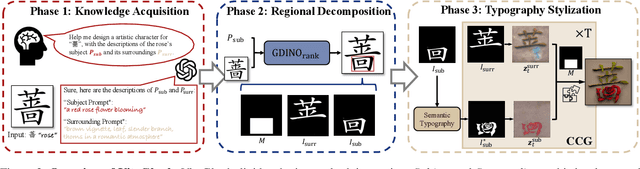


Artistic typography is a technique to visualize the meaning of input character in an imaginable and readable manner. With powerful text-to-image diffusion models, existing methods directly design the overall geometry and texture of input character, making it challenging to ensure both creativity and legibility. In this paper, we introduce a dual-branch and training-free method, namely VitaGlyph, enabling flexible artistic typography along with controllable geometry change to maintain the readability. The key insight of VitaGlyph is to treat input character as a scene composed of Subject and Surrounding, followed by rendering them under varying degrees of geometry transformation. The subject flexibly expresses the essential concept of input character, while the surrounding enriches relevant background without altering the shape. Specifically, we implement VitaGlyph through a three-phase framework: (i) Knowledge Acquisition leverages large language models to design text descriptions of subject and surrounding. (ii) Regional decomposition detects the part that most matches the subject description and divides input glyph image into subject and surrounding regions. (iii) Typography Stylization firstly refines the structure of subject region via Semantic Typography, and then separately renders the textures of Subject and Surrounding regions through Controllable Compositional Generation. Experimental results demonstrate that VitaGlyph not only achieves better artistry and readability, but also manages to depict multiple customize concepts, facilitating more creative and pleasing artistic typography generation. Our code will be made publicly at https://github.com/Carlofkl/VitaGlyph.
Real-Time 4K Super-Resolution of Compressed AVIF Images. AIS 2024 Challenge Survey
Apr 25, 2024

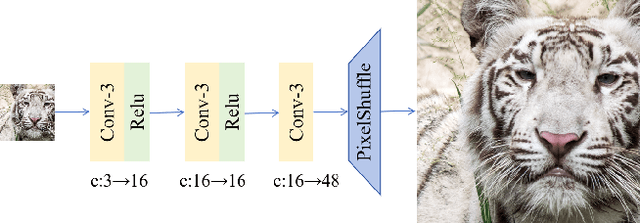

This paper introduces a novel benchmark as part of the AIS 2024 Real-Time Image Super-Resolution (RTSR) Challenge, which aims to upscale compressed images from 540p to 4K resolution (4x factor) in real-time on commercial GPUs. For this, we use a diverse test set containing a variety of 4K images ranging from digital art to gaming and photography. The images are compressed using the modern AVIF codec, instead of JPEG. All the proposed methods improve PSNR fidelity over Lanczos interpolation, and process images under 10ms. Out of the 160 participants, 25 teams submitted their code and models. The solutions present novel designs tailored for memory-efficiency and runtime on edge devices. This survey describes the best solutions for real-time SR of compressed high-resolution images.