 Add to Chrome
 Add to Firefox
 Add to Edge
Boosting Vision-Language-Action Finetuning with Feasible Action Neighborhood Prior
Apr 02, 2026
In real-world robotic manipulation, states typically admit a neighborhood of near-equivalent actions. That is, for each state, there exist a feasible action neighborhood (FAN) rather than a single correct action, within which motions yield indistinguishable progress. However, prevalent VLA training methodologies are directly inherited from linguistic settings and do not exploit the FAN property, thus leading to poor generalization and low sample efficiency. To address this limitation, we introduce a FAN-guided regularizer that shapes the model's output distribution to align with the geometry of FAN. Concretely, we introduce a Gaussian prior that promotes locally smooth and unimodal predictions around the preferred direction and magnitude. In extensive experiments across both reinforced finetuning (RFT) and supervised finetuning (SFT), our method achieves significant improvement in sample efficiency, and success rate in both in-distribution and out-of-distribution (OOD) scenarios. By aligning with the intrinsic action tolerance of physical manipulation, FAN-guided regularization provides a principled and practical method for sample-efficient, and generalizable VLA adaptation.

SSMG-Nav: Enhancing Lifelong Object Navigation with Semantic Skeleton Memory Graph
Mar 02, 2026Navigating to out-of-sight targets from human instructions in unfamiliar environments is a core capability for service robots. Despite substantial progress, most approaches underutilize reusable, persistent memory, constraining performance in lifelong settings. Many are additionally limited to single-modality inputs and employ myopic greedy policies, which often induce inefficient back-and-forth maneuvers (BFMs). To address such limitations, we introduce SSMG-Nav, a framework for object navigation built on a \textit{Semantic Skeleton Memory Graph} (SSMG) that consolidates past observations into a spatially aligned, persistent memory anchored by topological keypoints (e.g., junctions, room centers). SSMG clusters nearby entities into subgraphs, unifying entity- and space-level semantics to yield a compact set of candidate destinations. To support multimodal targets (images, objects, and text), we integrate a vision-language model (VLM). For each subgraph, a multimodal prompt synthesized from memory guides the VLM to infer a target belief over destinations. A long-horizon planner then trades off this belief against traversability costs to produce a visit sequence that minimizes expected path length, thereby reducing backtracking. Extensive experiments on challenging lifelong benchmarks and standard ObjectNav benchmarks demonstrate that, compared to strong baselines, our method achieves higher success rates and greater path efficiency, validating the effectiveness of SSMG-Nav.
An Online Adaptation Method for Robust Depth Estimation and Visual Odometry in the Open World
Apr 16, 2025Recently, learning-based robotic navigation systems have gained extensive research attention and made significant progress. However, the diversity of open-world scenarios poses a major challenge for the generalization of such systems to practical scenarios. Specifically, learned systems for scene measurement and state estimation tend to degrade when the application scenarios deviate from the training data, resulting to unreliable depth and pose estimation. Toward addressing this problem, this work aims to develop a visual odometry system that can fast adapt to diverse novel environments in an online manner. To this end, we construct a self-supervised online adaptation framework for monocular visual odometry aided by an online-updated depth estimation module. Firstly, we design a monocular depth estimation network with lightweight refiner modules, which enables efficient online adaptation. Then, we construct an objective for self-supervised learning of the depth estimation module based on the output of the visual odometry system and the contextual semantic information of the scene. Specifically, a sparse depth densification module and a dynamic consistency enhancement module are proposed to leverage camera poses and contextual semantics to generate pseudo-depths and valid masks for the online adaptation. Finally, we demonstrate the robustness and generalization capability of the proposed method in comparison with state-of-the-art learning-based approaches on urban, in-house datasets and a robot platform. Code is publicly available at: https://github.com/jixingwu/SOL-SLAM.
A Skeleton-Based Topological Planner for Exploration in Complex Unknown Environments
Dec 18, 2024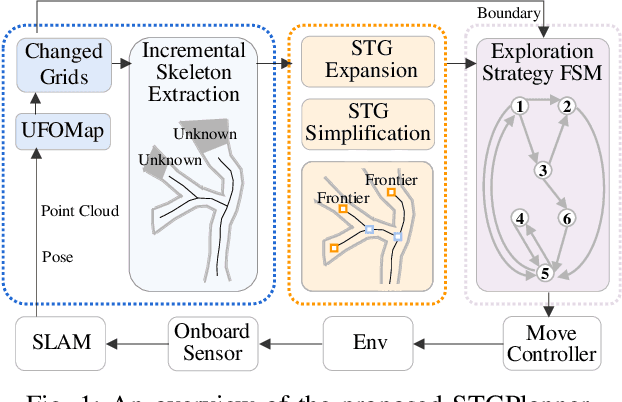


The capability of autonomous exploration in complex, unknown environments is important in many robotic applications. While recent research on autonomous exploration have achieved much progress, there are still limitations, e.g., existing methods relying on greedy heuristics or optimal path planning are often hindered by repetitive paths and high computational demands. To address such limitations, we propose a novel exploration framework that utilizes the global topology information of observed environment to improve exploration efficiency while reducing computational overhead. Specifically, global information is utilized based on a skeletal topological graph representation of the environment geometry. We first propose an incremental skeleton extraction method based on wavefront propagation, based on which we then design an approach to generate a lightweight topological graph that can effectively capture the environment's structural characteristics. Building upon this, we introduce a finite state machine that leverages the topological structure to efficiently plan coverage paths, which can substantially mitigate the back-and-forth maneuvers (BFMs) problem. Experimental results demonstrate the superiority of our method in comparison with state-of-the-art methods. The source code will be made publicly available at: \url{https://github.com/Haochen-Niu/STGPlanner}.
Loop Closure Detection Based on Object-level Spatial Layout and Semantic Consistency
Apr 14, 2023Visual simultaneous localization and mapping (SLAM) systems face challenges in detecting loop closure under the circumstance of large viewpoint changes. In this paper, we present an object-based loop closure detection method based on the spatial layout and semanic consistency of the 3D scene graph. Firstly, we propose an object-level data association approach based on the semantic information from semantic labels, intersection over union (IoU), object color, and object embedding. Subsequently, multi-view bundle adjustment with the associated objects is utilized to jointly optimize the poses of objects and cameras. We represent the refined objects as a 3D spatial graph with semantics and topology. Then, we propose a graph matching approach to select correspondence objects based on the structure layout and semantic property similarity of vertices' neighbors. Finally, we jointly optimize camera trajectories and object poses in an object-level pose graph optimization, which results in a globally consistent map. Experimental results demonstrate that our proposed data association approach can construct more accurate 3D semantic maps, and our loop closure method is more robust than point-based and object-based methods in circumstances with large viewpoint changes.