 Add to Chrome
 Add to Firefox
 Add to Edge
SSMG-Nav: Enhancing Lifelong Object Navigation with Semantic Skeleton Memory Graph
Mar 02, 2026
Navigating to out-of-sight targets from human instructions in unfamiliar environments is a core capability for service robots. Despite substantial progress, most approaches underutilize reusable, persistent memory, constraining performance in lifelong settings. Many are additionally limited to single-modality inputs and employ myopic greedy policies, which often induce inefficient back-and-forth maneuvers (BFMs). To address such limitations, we introduce SSMG-Nav, a framework for object navigation built on a \textit{Semantic Skeleton Memory Graph} (SSMG) that consolidates past observations into a spatially aligned, persistent memory anchored by topological keypoints (e.g., junctions, room centers). SSMG clusters nearby entities into subgraphs, unifying entity- and space-level semantics to yield a compact set of candidate destinations. To support multimodal targets (images, objects, and text), we integrate a vision-language model (VLM). For each subgraph, a multimodal prompt synthesized from memory guides the VLM to infer a target belief over destinations. A long-horizon planner then trades off this belief against traversability costs to produce a visit sequence that minimizes expected path length, thereby reducing backtracking. Extensive experiments on challenging lifelong benchmarks and standard ObjectNav benchmarks demonstrate that, compared to strong baselines, our method achieves higher success rates and greater path efficiency, validating the effectiveness of SSMG-Nav.

A Skeleton-Based Topological Planner for Exploration in Complex Unknown Environments
Dec 18, 2024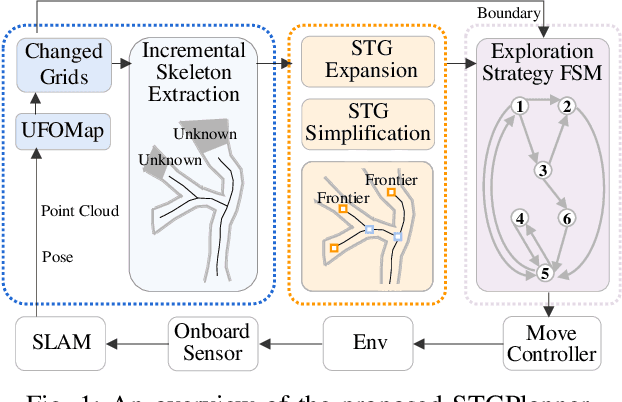


The capability of autonomous exploration in complex, unknown environments is important in many robotic applications. While recent research on autonomous exploration have achieved much progress, there are still limitations, e.g., existing methods relying on greedy heuristics or optimal path planning are often hindered by repetitive paths and high computational demands. To address such limitations, we propose a novel exploration framework that utilizes the global topology information of observed environment to improve exploration efficiency while reducing computational overhead. Specifically, global information is utilized based on a skeletal topological graph representation of the environment geometry. We first propose an incremental skeleton extraction method based on wavefront propagation, based on which we then design an approach to generate a lightweight topological graph that can effectively capture the environment's structural characteristics. Building upon this, we introduce a finite state machine that leverages the topological structure to efficiently plan coverage paths, which can substantially mitigate the back-and-forth maneuvers (BFMs) problem. Experimental results demonstrate the superiority of our method in comparison with state-of-the-art methods. The source code will be made publicly available at: \url{https://github.com/Haochen-Niu/STGPlanner}.