 Add to Chrome
 Add to Firefox
 Add to Edge
RIPCN: A Road Impedance Principal Component Network for Probabilistic Traffic Flow Forecasting
Dec 25, 2025
Accurate traffic flow forecasting is crucial for intelligent transportation services such as navigation and ride-hailing. In such applications, uncertainty estimation in forecasting is important because it helps evaluate traffic risk levels, assess forecast reliability, and provide timely warnings. As a result, probabilistic traffic flow forecasting (PTFF) has gained significant attention, as it produces both point forecasts and uncertainty estimates. However, existing PTFF approaches still face two key challenges: (1) how to uncover and model the causes of traffic flow uncertainty for reliable forecasting, and (2) how to capture the spatiotemporal correlations of uncertainty for accurate prediction. To address these challenges, we propose RIPCN, a Road Impedance Principal Component Network that integrates domain-specific transportation theory with spatiotemporal principal component learning for PTFF. RIPCN introduces a dynamic impedance evolution network that captures directional traffic transfer patterns driven by road congestion level and flow variability, revealing the direct causes of uncertainty and enhancing both reliability and interpretability. In addition, a principal component network is designed to forecast the dominant eigenvectors of future flow covariance, enabling the model to capture spatiotemporal uncertainty correlations. This design allows for accurate and efficient uncertainty estimation while also improving point prediction performance. Experimental results on real-world datasets show that our approach outperforms existing probabilistic forecasting methods.

UniTE: A Survey and Unified Pipeline for Pre-training ST Trajectory Embeddings
Jul 17, 2024
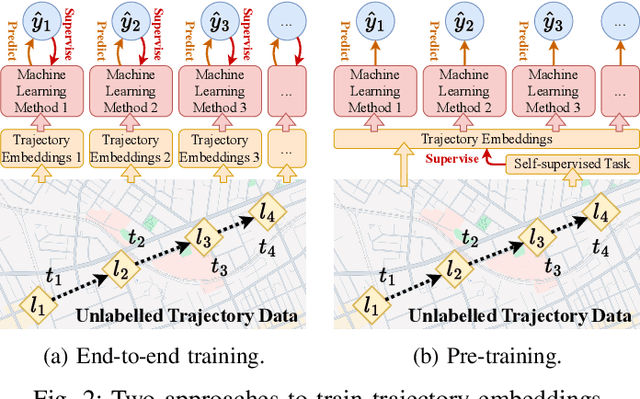


Spatio-temporal (ST) trajectories are sequences of timestamped locations, which enable a variety of analyses that in turn enable important real-world applications. It is common to map trajectories to vectors, called embeddings, before subsequent analyses. Thus, the qualities of embeddings are very important. Methods for pre-training embeddings, which leverage unlabeled trajectories for training universal embeddings, have shown promising applicability across different tasks, thus attracting considerable interest. However, research progress on this topic faces two key challenges: a lack of a comprehensive overview of existing methods, resulting in several related methods not being well-recognized, and the absence of a unified pipeline, complicating the development new methods and the analysis of methods. To overcome these obstacles and advance the field of pre-training of trajectory embeddings, we present UniTE, a survey and a unified pipeline for this domain. In doing so, we present a comprehensive list of existing methods for pre-training trajectory embeddings, which includes methods that either explicitly or implicitly employ pre-training techniques. Further, we present a unified and modular pipeline with publicly available underlying code, simplifying the process of constructing and evaluating methods for pre-training trajectory embeddings. Additionally, we contribute a selection of experimental results using the proposed pipeline on real-world datasets.