 Add to Chrome
 Add to Firefox
 Add to Edge
S2-MoE: Enabling Efficient Self-Speculative Decoding for Mixture-of-Experts on Edge Devices
Aug 15, 2026
Deploying large language models (LLMs) for inference on edge devices is challenging due to severe memory and bandwidth constraints. While speculative decoding and Mixture-of-Experts (MoE) have been proposed to improve inference efficiency, naively combining them often incurs excessive verification overhead and poor expert reuse, limiting their effectiveness in memory-bound edge settings. In this work, we propose S2-MoE, an efficient self-speculative decoding framework for MoE inference on edge devices. S2-MoE reduces redundant verification through routing-aware adaptive speculative expansion, improves verification efficiency with reuse-aware expert gating, and aligns draft and target execution via shared context. Implemented in llama.cpp, S2-MoE achieves up to 5.3x speedup (about 2.0x on average) over standard autoregressive de?coding across diverse MoE models and datasets on edge devices.Code is available at https://github.com/angerybob/S2-MoE.

Breaking the Reward Barrier: Accelerating Tree-of-Thought Reasoning via Speculative Exploration
May 11, 2026Tree-of-Thought (ToT) reasoning structures Large Language Model (LLM) inference as a tree-based search, demonstrating strong potential for solving complex mathematical and programming tasks. However, its efficiency is constrained by the reward dependency barrier -- a synchronization bottleneck caused by sequential reward-guided exploration that limits search parallelism and introduces substantial latency. Prior system optimizations, mainly designed for linear Chain-of-Thought (CoT) reasoning, cannot address these challenges, leaving the efficiency of ToT underexplored. To enhance ToT reasoning efficiency, we observe that the reasoning paths can be explored speculatively to break the reward synchronization barrier. Therefore, in this paper, we propose SPEX and introduce three key techniques: (i) intra-query speculative path selection to predict and expand high-potential branches of ToT, (ii) inter-query budget allocation to balance speculative resource allocation across queries dynamically, and (iii) adaptive early termination to prune deep and redundant branches for a skewed search tree. We implement SPEX on top of the SGLang framework and evaluate it across diverse ToT algorithms and LLMs. Extensive experiments show that SPEX achieves $1.2 \sim 3 \times$ speedup for different ToT reasoning algorithms. Moreover, SPEX synergizes with token-level speculative decoding, achieving cumulative speedups of up to $4.1\times$. Ablation studies further confirm the contributions of each technique. Overall, SPEX represents a significant step toward efficient and scalable ToT reasoning, unlocking the parallelism required for high-performance inference-time scaling for LLMs.
HyPER: Bridging Exploration and Exploitation for Scalable LLM Reasoning with Hypothesis Path Expansion and Reduction
Feb 06, 2026Scaling test-time compute with multi-path chain-of-thought improves reasoning accuracy, but its effectiveness depends critically on the exploration-exploitation trade-off. Existing approaches address this trade-off in rigid ways: tree-structured search hard-codes exploration through brittle expansion rules that interfere with post-trained reasoning, while parallel reasoning over-explores redundant hypothesis paths and relies on weak answer selection. Motivated by the observation that the optimal balance is phase-dependent and that correct and incorrect reasoning paths often diverge only at late stages, we reformulate test-time scaling as a dynamic expand-reduce control problem over a pool of hypotheses. We propose HyPER, a training-free online control policy for multi-path decoding in mixture-of-experts models that reallocates computation under a fixed budget using lightweight path statistics. HyPER consists of an online controller that transitions from exploration to exploitation as the hypothesis pool evolves, a token-level refinement mechanism that enables efficient generation-time exploitation without full-path resampling, and a length- and confidence-aware aggregation strategy for reliable answer-time exploitation. Experiments on four mixture-of-experts language models across diverse reasoning benchmarks show that HyPER consistently achieves a superior accuracy-compute trade-off, improving accuracy by 8 to 10 percent while reducing token usage by 25 to 40 percent.
Autonomous Workflow for Multimodal Fine-Grained Training Assistants Towards Mixed Reality
May 16, 2024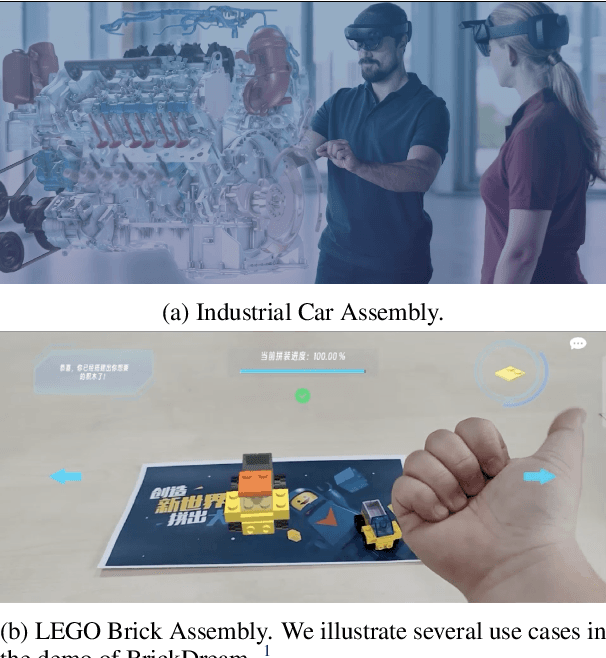


Autonomous artificial intelligence (AI) agents have emerged as promising protocols for automatically understanding the language-based environment, particularly with the exponential development of large language models (LLMs). However, a fine-grained, comprehensive understanding of multimodal environments remains under-explored. This work designs an autonomous workflow tailored for integrating AI agents seamlessly into extended reality (XR) applications for fine-grained training. We present a demonstration of a multimodal fine-grained training assistant for LEGO brick assembly in a pilot XR environment. Specifically, we design a cerebral language agent that integrates LLM with memory, planning, and interaction with XR tools and a vision-language agent, enabling agents to decide their actions based on past experiences. Furthermore, we introduce LEGO-MRTA, a multimodal fine-grained assembly dialogue dataset synthesized automatically in the workflow served by a commercial LLM. This dataset comprises multimodal instruction manuals, conversations, XR responses, and vision question answering. Last, we present several prevailing open-resource LLMs as benchmarks, assessing their performance with and without fine-tuning on the proposed dataset. We anticipate that the broader impact of this workflow will advance the development of smarter assistants for seamless user interaction in XR environments, fostering research in both AI and HCI communities.