 Add to Chrome
 Add to Firefox
 Add to Edge
Shell-Supervised Gaussian Splatting for Urban Real-to-Sim Reconstruction
Jun 29, 2026
Real-to-sim reconstruction for embodied AI requires geometry that is useful for collision reasoning, navigation, and agent-environment interaction, not only photorealistic novel-view synthesis. However, close-range urban facades are difficult for video-to-3D reconstruction: glass, reflections, repeated windows, and weak texture can produce visually plausible renderings with unstable surface geometry. We introduce shell-supervised Gaussian Splatting, a reconstruction-stage framework that uses an external facade structural shell as lightweight geometric supervision for video-driven Gaussian reconstruction. The method aligns an exterior shell to the video reconstruction frame, renders per-view depth, camera-space normal, and valid-mask maps, and applies these cues through mask-gated losses during Gaussian optimization. This design preserves RGB-driven appearance while regularizing only visible shell-supported facade regions. Experiments on anonymized close-range urban facade scenes show improved facade orientation and visible-surface point-cloud consistency over photo-only, monocular-cue, and surface-oriented Gaussian baselines, while maintaining comparable held-out rendering quality.

Provably Safe Trajectory Generation for Manipulators Under Motion and Environmental Uncertainties
Mar 10, 2026Robot manipulators operating in uncertain and non-convex environments present significant challenges for safe and optimal motion planning. Existing methods often struggle to provide efficient and formally certified collision risk guarantees, particularly when dealing with complex geometries and non-Gaussian uncertainties. This article proposes a novel risk-bounded motion planning framework to address this unmet need. Our approach integrates a rigid manipulator deep stochastic Koopman operator (RM-DeSKO) model to robustly predict the robot's state distribution under motion uncertainty. We then introduce an efficient, hierarchical verification method that combines parallelizable physics simulations with sum-of-squares (SOS) programming as a filter for fine-grained, formal certification of collision risk. This method is embedded within a Model Predictive Path Integral (MPPI) controller that uniquely utilizes binary collision information from SOS decomposition to improve its policy. The effectiveness of the proposed framework is validated on two typical robot manipulators through extensive simulations and real-world experiments, including a challenging human-robot collaboration scenario, demonstrating sim-to-real transfer of the learned model and its ability to generate safe and efficient trajectories in complex, uncertain settings.
NTIRE 2025 Image Shadow Removal Challenge Report
Jun 18, 2025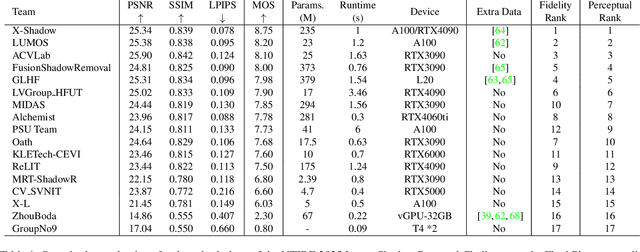

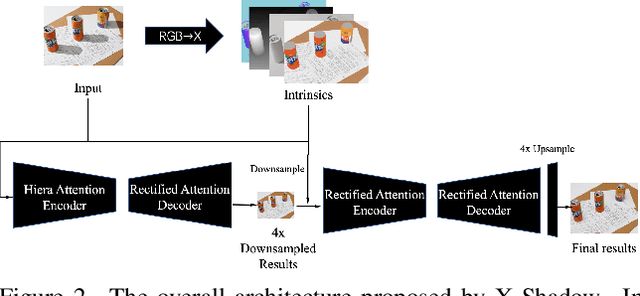

This work examines the findings of the NTIRE 2025 Shadow Removal Challenge. A total of 306 participants have registered, with 17 teams successfully submitting their solutions during the final evaluation phase. Following the last two editions, this challenge had two evaluation tracks: one focusing on reconstruction fidelity and the other on visual perception through a user study. Both tracks were evaluated with images from the WSRD+ dataset, simulating interactions between self- and cast-shadows with a large number of diverse objects, textures, and materials.
Quantitative Hardness Assessment with Vision-based Tactile Sensing for Fruit Classification and Grasping
May 09, 2025Accurate estimation of fruit hardness is essential for automated classification and handling systems, particularly in determining fruit variety, assessing ripeness, and ensuring proper harvesting force. This study presents an innovative framework for quantitative hardness assessment utilizing vision-based tactile sensing, tailored explicitly for robotic applications in agriculture. The proposed methodology derives normal force estimation from a vision-based tactile sensor, and, based on the dynamics of this normal force, calculates the hardness. This approach offers a rapid, non-destructive evaluation through single-contact interaction. The integration of this framework into robotic systems enhances real-time adaptability of grasping forces, thereby reducing the likelihood of fruit damage. Moreover, the general applicability of this approach, through a universal criterion based on average normal force dynamics, ensures its effectiveness across a wide variety of fruit types and sizes. Extensive experimental validation conducted across different fruit types and ripeness-tracking studies demonstrates the efficacy and robustness of the framework, marking a significant advancement in the domain of automated fruit handling.