 Add to Chrome
 Add to Firefox
 Add to Edge
Marrying Optimal Transport and ODEs for Unified Continuous-Time 4D Reconstruction and Tracking
Aug 10, 2026
Existing unified 4D reconstruction and point tracking approaches typically rely on heuristic interpolations or just predict at integer timestamps, lacking kinematic coherence and failing to model dynamics at any arbitrary timestamp. In this paper, we propose Uni4R, a framework that unifies these tasks by learning continuous velocity fields through the synergy of Optimal Transport (OT) and Ordinary Differential Equation (ODE). Importantly, this continuous velocity field acts as a kinematic prior that mutually benefits both 4D reconstruction and point tracking. Specifically, we propose the Flow Matching Guided Decoder (FMGD). A global velocity branch first extracts anchor features that capture the global dynamic state of the sequence. Then, FMGD leverages Flow Matching (FM) theory to formulate a probability path defined by OT on the anchor feature manifold, instantiating it as FM-guided velocity features for velocity prediction. This establishes a robust kinematic inductive bias. Meanwhile, a point reconstruction branch provides geometric features. The local velocity prediction module then joint above features and time embeddings, to decode velocities at arbitrary timestamps. To overcome the absence of high-quality ground-truth velocities in fractional frames, we propose an integral-consistency training strategy. This strategy uses an ODE solver to integrate velocities to recover target pointmaps, enabling the model to be supervised end-to-end directly from integer timestamps. Experimental results demonstrate that Uni4R achieves SOTA performance in both 4D reconstruction and point tracking, and achieves SOTA in our new kinematics-aware benchmark at continuous time.

PointCHR: Point Cloud Analysis via Curvature-Aware Hyperbolic Rectification
Jul 27, 2026High-curvature regions in 3D point clouds encapsulate critical fine-grained geometric semantics yet exhibit a distinct long-tail sparsity in their spatial distribution. The inherent limitations of polynomial volume growth in Euclidean space frequently render these intricate geometric features challenging to adequately resolve within a uniform-scale feature space. Consequently, these regions are frequently overshadowed by smooth global features dominated by low-curvature regions, thereby limiting the discriminative capacity of the network. To address this issue, we propose PointCHR, a curvature-aware hyperbolic rectification (CHR) for point cloud analysis. Utilising the property of exponential volume expansion in the vicinity of hyperbolic manifolds, CHR presents a learnable curvature-guided radial rectification mechanism. By adaptively projecting high-curvature points towards boundary regions endowed with larger effective embedding capacities, PointCHR effectively mitigates the representation crowding problem inherent in Euclidean settings. Extensive experimentation has demonstrated that PointCHR significantly enhances the ability of backbone to capture fine-grained geometric details, achieving state-of-the-art performance across multiple benchmarks.
UTSRMorph: A Unified Transformer and Superresolution Network for Unsupervised Medical Image Registration
Oct 27, 2024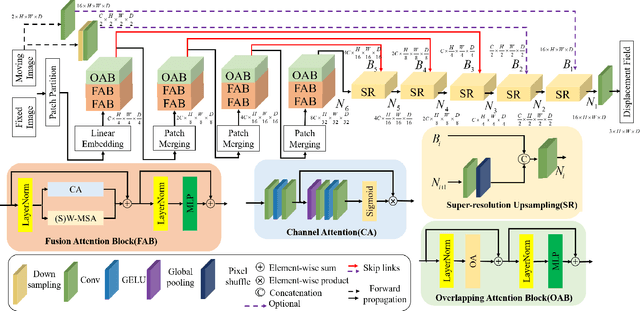
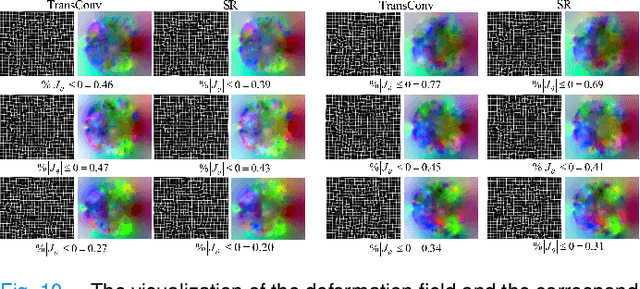
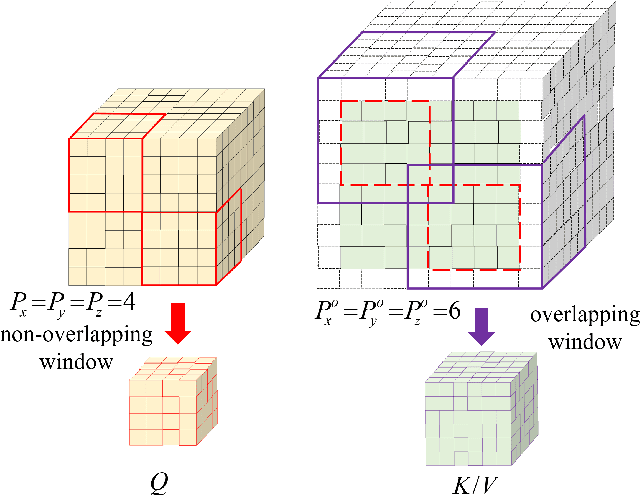
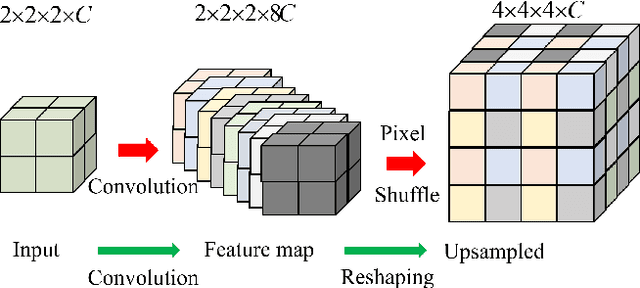
Complicated image registration is a key issue in medical image analysis, and deep learning-based methods have achieved better results than traditional methods. The methods include ConvNet-based and Transformer-based methods. Although ConvNets can effectively utilize local information to reduce redundancy via small neighborhood convolution, the limited receptive field results in the inability to capture global dependencies. Transformers can establish long-distance dependencies via a self-attention mechanism; however, the intense calculation of the relationships among all tokens leads to high redundancy. We propose a novel unsupervised image registration method named the unified Transformer and superresolution (UTSRMorph) network, which can enhance feature representation learning in the encoder and generate detailed displacement fields in the decoder to overcome these problems. We first propose a fusion attention block to integrate the advantages of ConvNets and Transformers, which inserts a ConvNet-based channel attention module into a multihead self-attention module. The overlapping attention block, a novel cross-attention method, uses overlapping windows to obtain abundant correlations with match information of a pair of images. Then, the blocks are flexibly stacked into a new powerful encoder. The decoder generation process of a high-resolution deformation displacement field from low-resolution features is considered as a superresolution process. Specifically, the superresolution module was employed to replace interpolation upsampling, which can overcome feature degradation. UTSRMorph was compared to state-of-the-art registration methods in the 3D brain MR (OASIS, IXI) and MR-CT datasets. The qualitative and quantitative results indicate that UTSRMorph achieves relatively better performance. The code and datasets are publicly available at https://github.com/Runshi-Zhang/UTSRMorph.
* 13pages,10 figures