 Add to Chrome
 Add to Firefox
 Add to Edge
How Do Graph Signals Affect Recommendation: Unveiling the Mystery of Low and High-Frequency Graph Signals
Dec 10, 2025
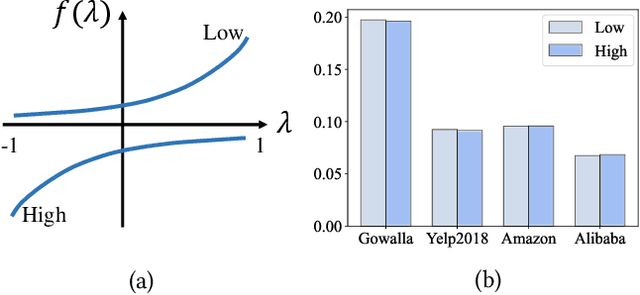
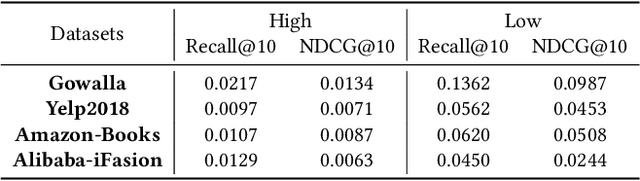
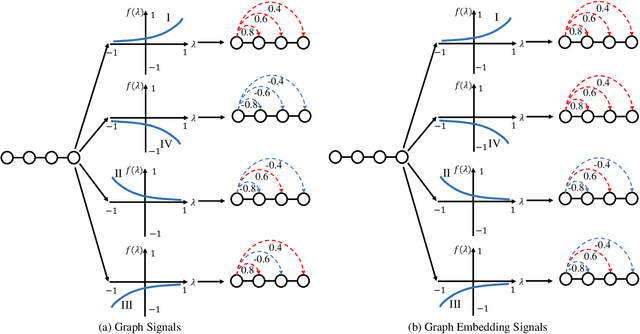
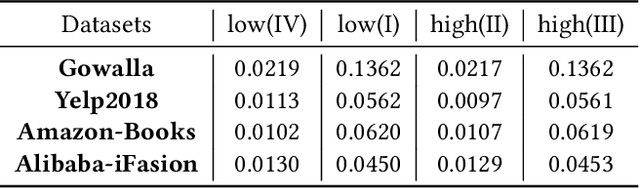
Spectral graph neural networks (GNNs) are highly effective in modeling graph signals, with their success in recommendation often attributed to low-pass filtering. However, recent studies highlight the importance of high-frequency signals. The role of low-frequency and high-frequency graph signals in recommendation remains unclear. This paper aims to bridge this gap by investigating the influence of graph signals on recommendation performance. We theoretically prove that the effects of low-frequency and high-frequency graph signals are equivalent in recommendation tasks, as both contribute by smoothing the similarities between user-item pairs. To leverage this insight, we propose a frequency signal scaler, a plug-and-play module that adjusts the graph signal filter function to fine-tune the smoothness between user-item pairs, making it compatible with any GNN model. Additionally, we identify and prove that graph embedding-based methods cannot fully capture the characteristics of graph signals. To address this limitation, a space flip method is introduced to restore the expressive power of graph embeddings. Remarkably, we demonstrate that either low-frequency or high-frequency graph signals alone are sufficient for effective recommendations. Extensive experiments on four public datasets validate the effectiveness of our proposed methods. Code is avaliable at https://github.com/mojosey/SimGCF.
