 Add to Chrome
 Add to Firefox
 Add to Edge
IndoorUAV: Benchmarking Vision-Language UAV Navigation in Continuous Indoor Environments
Dec 22, 2025
Vision-Language Navigation (VLN) enables agents to navigate in complex environments by following natural language instructions grounded in visual observations. Although most existing work has focused on ground-based robots or outdoor Unmanned Aerial Vehicles (UAVs), indoor UAV-based VLN remains underexplored, despite its relevance to real-world applications such as inspection, delivery, and search-and-rescue in confined spaces. To bridge this gap, we introduce \textbf{IndoorUAV}, a novel benchmark and method specifically tailored for VLN with indoor UAVs. We begin by curating over 1,000 diverse and structurally rich 3D indoor scenes from the Habitat simulator. Within these environments, we simulate realistic UAV flight dynamics to collect diverse 3D navigation trajectories manually, further enriched through data augmentation techniques. Furthermore, we design an automated annotation pipeline to generate natural language instructions of varying granularity for each trajectory. This process yields over 16,000 high-quality trajectories, comprising the \textbf{IndoorUAV-VLN} subset, which focuses on long-horizon VLN. To support short-horizon planning, we segment long trajectories into sub-trajectories by selecting semantically salient keyframes and regenerating concise instructions, forming the \textbf{IndoorUAV-VLA} subset. Finally, we introduce \textbf{IndoorUAV-Agent}, a novel navigation model designed for our benchmark, leveraging task decomposition and multimodal reasoning. We hope IndoorUAV serves as a valuable resource to advance research on vision-language embodied AI in the indoor aerial navigation domain.

BIMII-Net: Brain-Inspired Multi-Iterative Interactive Network for RGB-T Road Scene Semantic Segmentation
Mar 25, 2025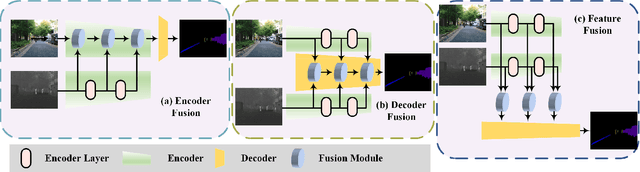
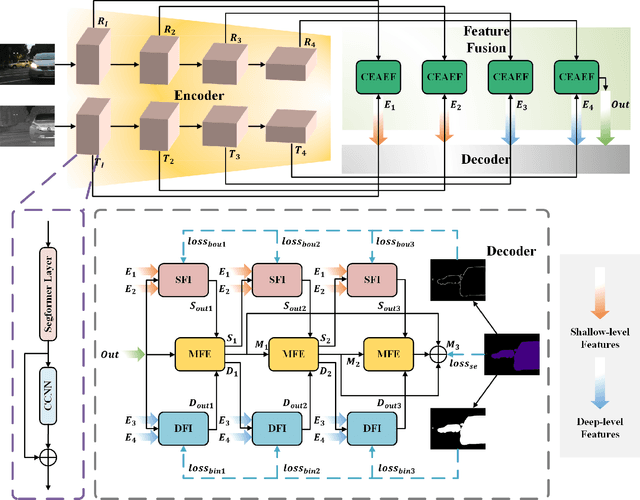
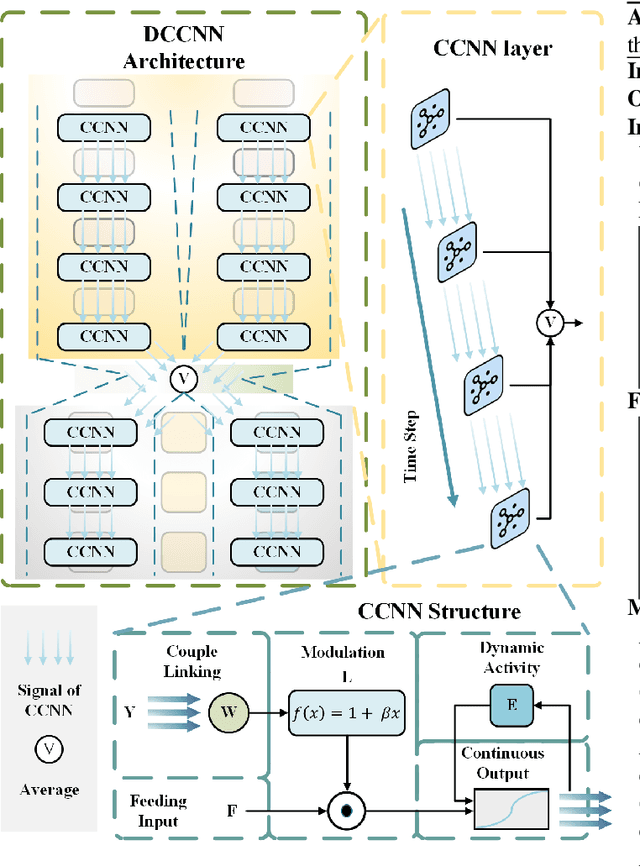
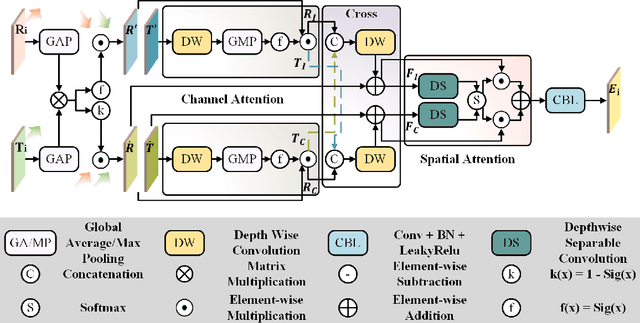
RGB-T road scene semantic segmentation enhances visual scene understanding in complex environments characterized by inadequate illumination or occlusion by fusing information from RGB and thermal images. Nevertheless, existing RGB-T semantic segmentation models typically depend on simple addition or concatenation strategies or ignore the differences between information at different levels. To address these issues, we proposed a novel RGB-T road scene semantic segmentation network called Brain-Inspired Multi-Iteration Interaction Network (BIMII-Net). First, to meet the requirements of accurate texture and local information extraction in road scenarios like autonomous driving, we proposed a deep continuous-coupled neural network (DCCNN) architecture based on a brain-inspired model. Second, to enhance the interaction and expression capabilities among multi-modal information, we designed a cross explicit attention-enhanced fusion module (CEAEF-Module) in the feature fusion stage of BIMII-Net to effectively integrate features at different levels. Finally, we constructed a complementary interactive multi-layer decoder structure, incorporating the shallow-level feature iteration module (SFI-Module), the deep-level feature iteration module (DFI-Module), and the multi-feature enhancement module (MFE-Module) to collaboratively extract texture details and global skeleton information, with multi-module joint supervision further optimizing the segmentation results. Experimental results demonstrate that BIMII-Net achieves state-of-the-art (SOTA) performance in the brain-inspired computing domain and outperforms most existing RGB-T semantic segmentation methods. It also exhibits strong generalization capabilities on multiple RGB-T datasets, proving the effectiveness of brain-inspired computer models in multi-modal image segmentation tasks.