 Add to Chrome
 Add to Firefox
 Add to Edge
A Learning-Rate-Gated Failure of GRPO in a Small Language and Vision-Language Model Web Agent: A Controlled Null and Its Mechanism
Jul 14, 2026
Reinforcement learning with verifiable rewards, and Group Relative Policy Optimization (GRPO) in particular, is now run routinely on a supervised checkpoint in the hope of producing a stronger agent. We ask whether it adds skill to a small language and vision-language model web agent at the 4B to 8B scale, or whether it mostly reshapes behavior the supervised model already has. Across a control grid of 18 runs that varies learning rate, KL weight, seed, initialization, and clipping, no configuration credibly improves the success rate of a strong supervised baseline on tasks the agent has largely mastered. On the text track, moderate to high learning rates make it credibly worse. The null holds under paired testing, 25 evaluation seeds, 6 training seeds, changes to the recipe, both text and Set-of-Marks screenshot observations, and scaling the backbone to 8B; the credible harm is a text-track finding and is only nominal under Set-of-Marks. To show that the null reflects the setting and not a broken pipeline, we run the identical harness, reward, and recipe on tasks whose reward is reachable by sampling, and there the success rate rises by 22 points with a paired interval that excludes zero. GRPO therefore helps only when there is headroom to climb, meaning the sampled policy already succeeds more often than the greedy one. We then explain the failure. A middle learning rate degrades the agent and a high one collapses it, and the two regimes form a double dissociation: grafting localizes the degrade regime to the attention and MLP blocks, while the collapse regime cannot be traced to any single group, and the embedding change that dominates the weight movement is causally inert. At 4B, effective rank in the late layers tracks capability in both directions; at 8B the two come apart. This coupling is specific to the smaller model, so we report it as scale-dependent.

MAG: A Web-Agent Benchmark and Harness for Multimodal Action and Guide Generation
Jul 14, 2026Digital Adoption Platforms (DAPs) are embedded overlays widely used on web systems to guide users through operations inside a page, helping them get started with unfamiliar interfaces quickly. Completing a real task, however, rarely means clicking a few buttons on a single page: it takes a sequence of actions that unfolds across changing page states. Prior studies have also treated automated web agent actions and guide text generation as two separate problems, and most of them feed models textual page representations such as the DOM or accessibility trees rather than the rendered screens that humans actually operate on. In this work we introduce MAG, the first benchmark that unifies task execution and guide writing into a single Multimodal Action and Guide task, with two grounding schemes over screenshots: Set-of-Mark element selection and raw pixel coordinates. We further build a complete harness for this compound task, covering annotation with LLM assistance and human verification, training, evaluation in live environments, and joint metrics for actions and guides. With this harness we evaluate frontier API models and open multimodal models, and report detailed analyses. Finally, we design a GRPO training method augmented with expert trajectories, which nearly doubles the success rate of a supervised 9B agent (from 6.9% to 13.2%) and improves guide quality at the same time. Even the strongest model completes fewer than 40% of the tasks, leaving ample room for future research.
AutoPPA: Automated Circuit PPA Optimization via Contrastive Code-based Rule Library Learning
Apr 20, 2026Performance, power, and area (PPA) optimization is a fundamental task in RTL design, requiring a precise understanding of circuit functionality and the relationship between circuit structures and PPA metrics. Recent studies attempt to automate this process using LLMs, but neither feedback-based nor knowledge-based methods are efficient enough, as they either design without any prior knowledge or rely heavily on human-summarized optimization rules. In this paper, we propose AutoPPA, a fully automated PPA optimization framework. The key idea is to automatically generate optimization rules that enhance the search for optimal solutions. To do this, AutoPPA employs an Explore-Evaluate-Induce ($E^2I$) workflow that contrasts and abstracts rules from diverse generated code pairs rather than manually defined prior knowledge, yielding better optimization patterns. To make the abstracted rules more generalizable, AutoPPA employs an adaptive multi-step search framework that adopts the most effective rules for a given circuit. Experiments show that AutoPPA outperforms both the manual optimization and the state-of-the-art methods SymRTLO and RTLRewriter.
MMM: Multilingual Mutual Reinforcement Effect Mix Datasets & Test with Open-domain Information Extraction Large Language Models
Jul 15, 2024
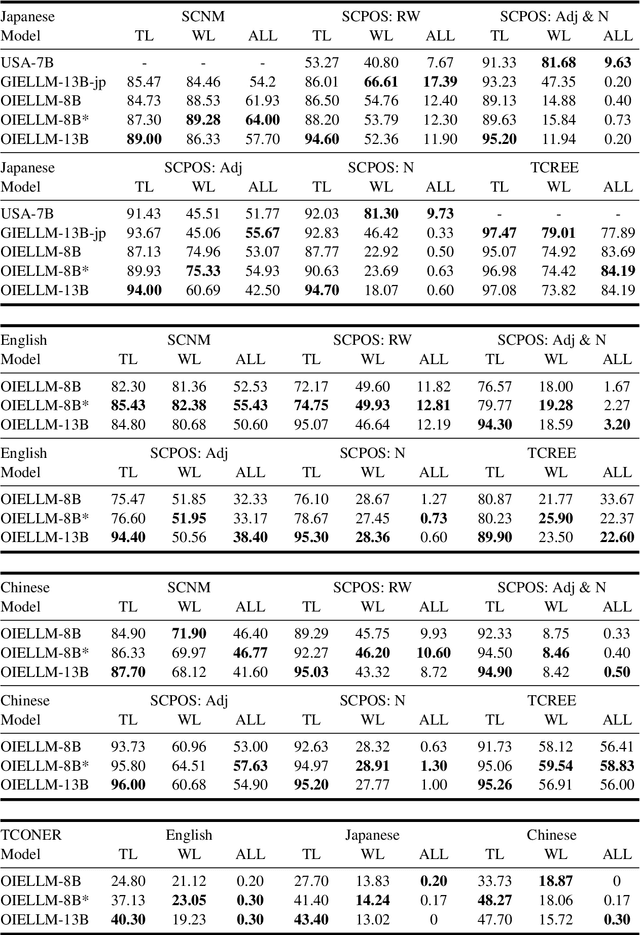
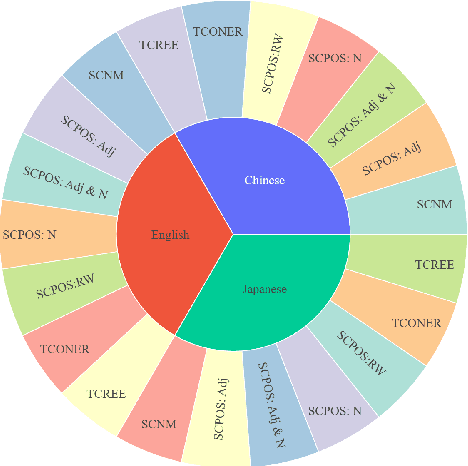

The Mutual Reinforcement Effect (MRE) represents a promising avenue in information extraction and multitasking research. Nevertheless, its applicability has been constrained due to the exclusive availability of MRE mix datasets in Japanese, thereby limiting comprehensive exploration by the global research community. To address this limitation, we introduce a Multilingual MRE mix dataset (MMM) that encompasses 21 sub-datasets in English, Japanese, and Chinese. In this paper, we also propose a method for dataset translation assisted by Large Language Models (LLMs), which significantly reduces the manual annotation time required for dataset construction by leveraging LLMs to translate the original Japanese datasets. Additionally, we have enriched the dataset by incorporating open-domain Named Entity Recognition (NER) and sentence classification tasks. Utilizing this expanded dataset, we developed a unified input-output framework to train an Open-domain Information Extraction Large Language Model (OIELLM). The OIELLM model demonstrates the capability to effectively process novel MMM datasets, exhibiting significant improvements in performance.