 Add to Chrome
 Add to Firefox
 Add to Edge
CAKE: Compiler-Agent Co-Design for Frontier Kernel Evolution
Aug 12, 2026
GPU kernel agents and GPU programming languages have advanced separately, leaving expert kernels difficult to reproduce. Agents usually treat the compiler as a fixed black box and receive only errors, correctness outcomes, and timing, while existing DSLs either hide critical scheduling decisions or expose them through difficult layout abstractions. We present CAKE, a compiler-agent co-design in which agents author CAKE IR, a typed, hardware-explicit schedule representation. CAKE exposes warp roles, memory movement, synchronization, and pipelines while supporting verification, cost modeling, and localized diagnostics. The harness itself evolves: recurring failures become verifier rules, IR primitives, model calibrations, and reusable optimization tactics. In matched implementation-hidden Flash-KMeans clean starts on B200, the best CAKE IR candidate at an 80-million-token budget runs at 1.144x the tuned FlashML baseline, compared with 0.928x for direct CUDA/PTX. Beyond this benchmark, agent-generated Kimi Delta Attention achieves a 2.05x geometric-mean speedup over official FlashKDA and passes end-to-end serving validation. Dispatcher-backed KNN and KMeans improve performance by 1.42x to 2.12x across more than 400 shapes, and four kernel changes are available as upstream PRs. CAKE targets NVIDIA GPUs from Ampere through Blackwell and separates single-shape evolution from library generalization and dispatch.

AVO: Agentic Variation Operators for Autonomous Evolutionary Search
Mar 25, 2026Agentic Variation Operators (AVO) are a new family of evolutionary variation operators that replace the fixed mutation, crossover, and hand-designed heuristics of classical evolutionary search with autonomous coding agents. Rather than confining a language model to candidate generation within a prescribed pipeline, AVO instantiates variation as a self-directed agent loop that can consult the current lineage, a domain-specific knowledge base, and execution feedback to propose, repair, critique, and verify implementation edits. We evaluate AVO on attention, among the most aggressively optimized kernel targets in AI, on NVIDIA Blackwell (B200) GPUs. Over 7 days of continuous autonomous evolution on multi-head attention, AVO discovers kernels that outperform cuDNN by up to 3.5% and FlashAttention-4 by up to 10.5% across the evaluated configurations. The discovered optimizations transfer readily to grouped-query attention, requiring only 30 minutes of additional autonomous adaptation and yielding gains of up to 7.0% over cuDNN and 9.3% over FlashAttention-4. Together, these results show that agentic variation operators move beyond prior LLM-in-the-loop evolutionary pipelines by elevating the agent from candidate generator to variation operator, and can discover performance-critical micro-architectural optimizations that produce kernels surpassing state-of-the-art expert-engineered attention implementations on today's most advanced GPU hardware.
SOL-ExecBench: Speed-of-Light Benchmarking for Real-World GPU Kernels Against Hardware Limits
Mar 19, 2026As agentic AI systems become increasingly capable of generating and optimizing GPU kernels, progress is constrained by benchmarks that reward speedup over software baselines rather than proximity to hardware-efficient execution. We present SOL-ExecBench, a benchmark of 235 CUDA kernel optimization problems extracted from 124 production and emerging AI models spanning language, diffusion, vision, audio, video, and hybrid architectures, targeting NVIDIA Blackwell GPUs. The benchmark covers forward and backward workloads across BF16, FP8, and NVFP4, including kernels whose best performance is expected to rely on Blackwell-specific capabilities. Unlike prior benchmarks that evaluate kernels primarily relative to software implementations, SOL-ExecBench measures performance against analytically derived Speed-of-Light (SOL) bounds computed by SOLAR, our pipeline for deriving hardware-grounded SOL bounds, yielding a fixed target for hardware-efficient optimization. We report a SOL Score that quantifies how much of the gap between a release-defined scoring baseline and the hardware SOL bound a candidate kernel closes. To support robust evaluation of agentic optimizers, we additionally provide a sandboxed harness with GPU clock locking, L2 cache clearing, isolated subprocess execution, and static analysis based checks against common reward-hacking strategies. SOL-ExecBench reframes GPU kernel benchmarking from beating a mutable software baseline to closing the remaining gap to hardware Speed-of-Light.
Scaling Deep Learning Training with MPMD Pipeline Parallelism
Dec 18, 2024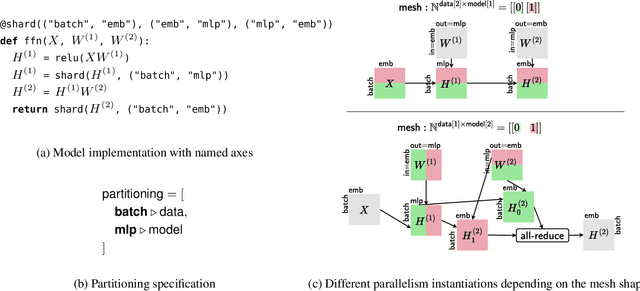
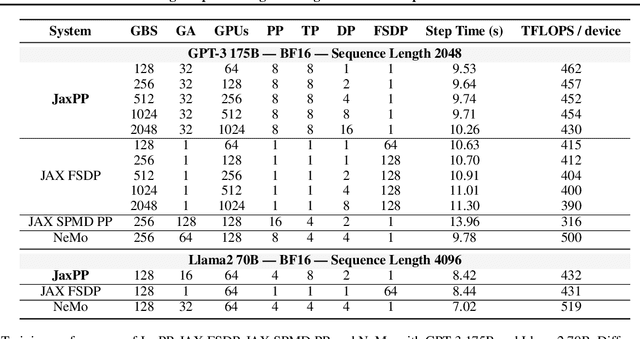
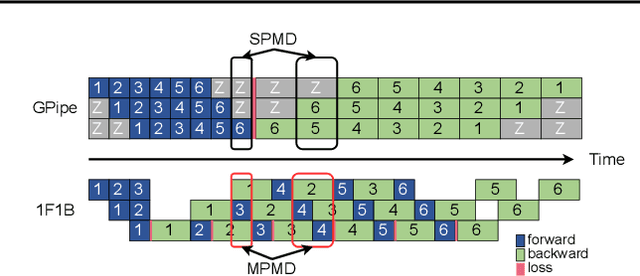
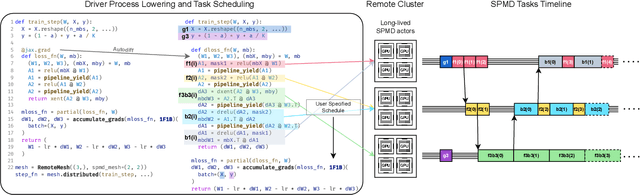
We present JaxPP, a system for efficiently scaling the training of large deep learning models with flexible pipeline parallelism. We introduce a seamless programming model that allows implementing user-defined pipeline schedules for gradient accumulation. JaxPP automatically distributes tasks, corresponding to pipeline stages, over a cluster of nodes and automatically infers the communication among them. We implement a MPMD runtime for asynchronous execution of SPMD tasks. The pipeline parallelism implementation of JaxPP improves hardware utilization by up to $1.11\times$ with respect to the best performing SPMD configuration.