 Add to Chrome
 Add to Firefox
 Add to Edge
SOLAR: AI-Powered Speed-of-Light Performance Analysis
Jun 24, 2026
How fast could a deep-learning model run on target hardware, and how far is today's implementation from that limit? These questions are central to software, hardware, and algorithm optimizations. Speed-of-Light (SOL) analysis answers them by computing a workload's theoretical minimum execution time on a given architecture. Yet deriving SOL bounds remains manual, error-prone, and disconnected from rapid model development. To close this gap, we introduce SOLAR, a framework that automatically derives validated SOL bounds from PyTorch and JAX source code. SOLAR leverages both generative and deterministic components in its flow: an LLM frontend translates any source programs into an executable Affine Loop IR, validated by output comparison; a deterministic flow lifts the IR into an einsum graph; and an analytical backend computes unfused, fused, and cache-aware SOL bounds. SOLAR provides comprehensive operator and language coverage, produces validated bounds with zero observed SOL violations, and offers multi-fidelity analysis that tightens bounds and surfaces optimization insights. We evaluate SOLAR across KernelBench, JAX/Flax models, and robotics workloads. These experiments demonstrate four use cases: headroom analysis at multiple fidelity levels, identifying optimization opportunities, cross-platform exploration, and inverse-roofline hardware provisioning.

Improving Efficiency of GPU Kernel Optimization Agents using a Domain-Specific Language and Speed-of-Light Guidance
Mar 30, 2026Optimizing GPU kernels with LLM agents is an iterative process over a large design space. Every candidate must be generated, compiled, validated, and profiled, so fewer trials will save both runtime and cost. We make two key observations. First, the abstraction level that agents operate at is important. If it is too low, the LLM wastes reasoning on low-impact details. If it is too high, it may miss important optimization choices. Second, agents cannot easily tell when they reach the point of diminishing returns, wasting resources as they continue searching. These observations motivate two design principles to improve efficiency: (1) a compact domain-specific language (DSL) that can be learned in context and lets the model reason at a higher level while preserving important optimization levers, and (2) Speed-of-Light (SOL) guidance that uses first-principles performance bounds to steer and budget search. We implement these principles in $μ$CUTLASS, a DSL with a compiler for CUTLASS-backed GPU kernels that covers kernel configuration, epilogue fusion, and multi-stage pipelines. We use SOL guidance to estimate headroom and guide optimization trials, deprioritize problems that are near SOL, and flag kernels that game the benchmark. On 59 KernelBench problems with the same iteration budgets, switching from generating low-level code to DSL code using GPT-5-mini turns a 0.40x geomean regression into a 1.27x speedup over PyTorch. Adding SOL-guided steering raises this to 1.56x. Across model tiers, $μ$CUTLASS + SOL-guidance lets weaker models outperform stronger baseline agents at lower token cost. SOL-guided budgeting saves 19-43% of tokens while retaining at least 95% of geomean speedup, with the best policy reaching a 1.68x efficiency gain. Lastly, SOL analysis helps detect benchmark-gaming cases, where kernels may appear fast while failing to perform the intended computation.
SOL-ExecBench: Speed-of-Light Benchmarking for Real-World GPU Kernels Against Hardware Limits
Mar 19, 2026As agentic AI systems become increasingly capable of generating and optimizing GPU kernels, progress is constrained by benchmarks that reward speedup over software baselines rather than proximity to hardware-efficient execution. We present SOL-ExecBench, a benchmark of 235 CUDA kernel optimization problems extracted from 124 production and emerging AI models spanning language, diffusion, vision, audio, video, and hybrid architectures, targeting NVIDIA Blackwell GPUs. The benchmark covers forward and backward workloads across BF16, FP8, and NVFP4, including kernels whose best performance is expected to rely on Blackwell-specific capabilities. Unlike prior benchmarks that evaluate kernels primarily relative to software implementations, SOL-ExecBench measures performance against analytically derived Speed-of-Light (SOL) bounds computed by SOLAR, our pipeline for deriving hardware-grounded SOL bounds, yielding a fixed target for hardware-efficient optimization. We report a SOL Score that quantifies how much of the gap between a release-defined scoring baseline and the hardware SOL bound a candidate kernel closes. To support robust evaluation of agentic optimizers, we additionally provide a sandboxed harness with GPU clock locking, L2 cache clearing, isolated subprocess execution, and static analysis based checks against common reward-hacking strategies. SOL-ExecBench reframes GPU kernel benchmarking from beating a mutable software baseline to closing the remaining gap to hardware Speed-of-Light.
KernelBlaster: Continual Cross-Task CUDA Optimization via Memory-Augmented In-Context Reinforcement Learning
Feb 15, 2026Optimizing CUDA code across multiple generations of GPU architectures is challenging, as achieving peak performance requires an extensive exploration of an increasingly complex, hardware-specific optimization space. Traditional compilers are constrained by fixed heuristics, whereas finetuning Large Language Models (LLMs) can be expensive. However, agentic workflows for CUDA code optimization have limited ability to aggregate knowledge from prior exploration, leading to biased sampling and suboptimal solutions. We propose KernelBlaster, a Memory-Augmented In-context Reinforcement Learning (MAIC-RL) framework designed to improve CUDA optimization search capabilities of LLM-based GPU coding agents. KernelBlaster enables agents to learn from experience and make systematically informed decisions on future tasks by accumulating knowledge into a retrievable Persistent CUDA Knowledge Base. We propose a novel profile-guided, textual-gradient-based agentic flow for CUDA generation and optimization to achieve high performance across generations of GPU architectures. KernelBlaster guides LLM agents to systematically explore high-potential optimization strategies beyond naive rewrites. Compared to the PyTorch baseline, our method achieves geometric mean speedups of 1.43x, 2.50x, and 1.50x on KernelBench Levels 1, 2, and 3, respectively. We release KernelBlaster as an open-source agentic framework, accompanied by a test harness, verification components, and a reproducible evaluation pipeline.
VEGETA: Vertically-Integrated Extensions for Sparse/Dense GEMM Tile Acceleration on CPUs
Feb 23, 2023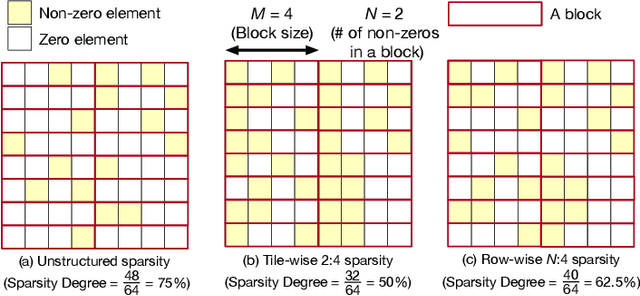
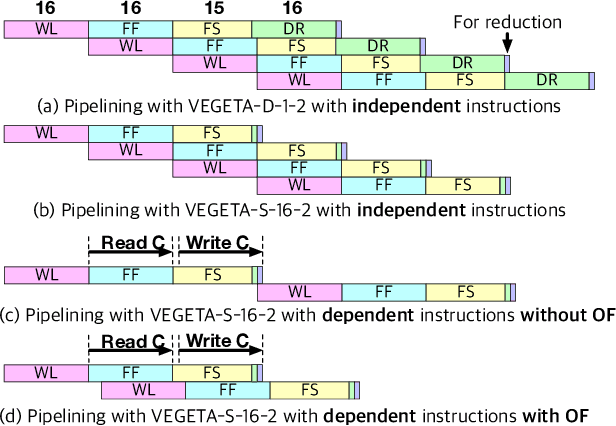
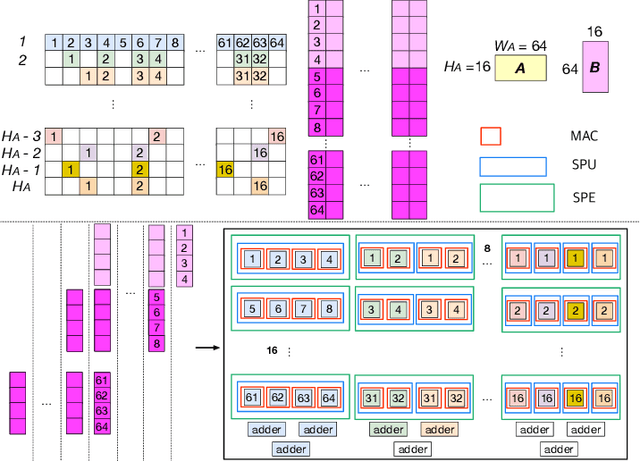
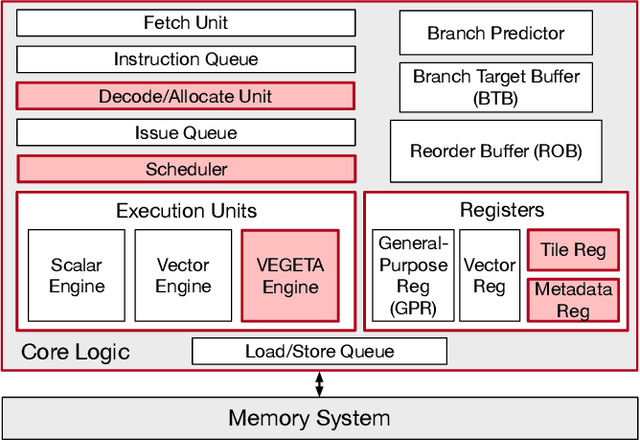
Deep Learning (DL) acceleration support in CPUs has recently gained a lot of traction, with several companies (Arm, Intel, IBM) announcing products with specialized matrix engines accessible via GEMM instructions. CPUs are pervasive and need to handle diverse requirements across DL workloads running in edge/HPC/cloud platforms. Therefore, as DL workloads embrace sparsity to reduce the computations and memory size of models, it is also imperative for CPUs to add support for sparsity to avoid under-utilization of the dense matrix engine and inefficient usage of the caches and registers. This work presents VEGETA, a set of ISA and microarchitecture extensions over dense matrix engines to support flexible structured sparsity for CPUs, enabling programmable support for diverse DL models with varying degrees of sparsity. Compared to the state-of-the-art (SOTA) dense matrix engine in CPUs, a VEGETA engine provides 1.09x, 2.20x, 3.74x, and 3.28x speed-ups when running 4:4 (dense), 2:4, 1:4, and unstructured (95%) sparse DNN layers.