 Add to Chrome
 Add to Firefox
 Add to Edge
Bringing Agentic Search to Earth Observation Data Discovery
Jul 02, 2026
NASA and its data centers hold thousands of geoscience datasets and tools like Worldview, Giovanni, the Science Discovery Engine, and Harmony. Finding the right one is hard even for domain experts. We present an agentic search system, deployed as a public service for the geoscience community, that takes a natural-language research query and returns the matching datasets and tools. We demonstrate that, in the era of large language models, the latent value of knowledge graphs (KGs) can be substantially amplified through agentic search. From the NASA Earth Observation Knowledge Graph (NASA EO-KG) we derive NASA-EO-Bench, an open benchmark of 47k query-dataset pairs (21k task-based queries). A neural scorer fine-tuned on NASA-EO-Bench beats cosine and BM25 baselines. Further combining it with BM25 via score fusion raises both Recall@10 (R@10) and MRR by over 5x. On top of this supervised pipeline, we add a zero-shot agentic reranking stage that, without any additional training, lifts MRR by 28% on a stratified N=200 subset, showing that LLM reasoning is complementary to supervised retrieval.

DRIFT: Detecting Representational Inconsistencies for Factual Truthfulness
Jan 29, 2026LLMs often produce fluent but incorrect answers, yet detecting such hallucinations typically requires multiple sampling passes or post-hoc verification, adding significant latency and cost. We hypothesize that intermediate layers encode confidence signals that are lost in the final output layer, and propose a lightweight probe to read these signals directly from hidden states. The probe adds less than 0.1\% computational overhead and can run fully in parallel with generation, enabling hallucination detection before the answer is produced. Building on this, we develop an LLM router that answers confident queries immediately while delegating uncertain ones to stronger models. Despite its simplicity, our method achieves SOTA AUROC on 10 out of 12 settings across four QA benchmarks and three LLM families, with gains of up to 13 points over prior methods, and generalizes across dataset shifts without retraining.
HALT: Hallucination Assessment via Latent Testing
Jan 20, 2026Hallucination in large language models (LLMs) can be understood as a failure of faithful readout: although internal representations may encode uncertainty about a query, decoding pressures still yield a fluent answer. We propose lightweight residual probes that read hallucination risk directly from intermediate hidden states of question tokens, motivated by the hypothesis that these layers retain epistemic signals that are attenuated in the final decoding stage. The probe is a small auxiliary network whose computation is orders of magnitude cheaper than token generation and can be evaluated fully in parallel with inference, enabling near-instantaneous hallucination risk estimation with effectively zero added latency in low-risk cases. We deploy the probe as an agentic critic for fast selective generation and routing, allowing LLMs to immediately answer confident queries while delegating uncertain ones to stronger verification pipelines. Across four QA benchmarks and multiple LLM families, the method achieves strong AUROC and AURAC, generalizes under dataset shift, and reveals interpretable structure in intermediate representations, positioning fast internal uncertainty readout as a principled foundation for reliable agentic AI.
ReSearch: A Multi-Stage Machine Learning Framework for Earth Science Data Discovery
Jan 20, 2026The rapid expansion of Earth Science data from satellite observations, reanalysis products, and numerical simulations has created a critical bottleneck in scientific discovery, namely identifying relevant datasets for a given research objective. Existing discovery systems are primarily retrieval-centric and struggle to bridge the gap between high-level scientific intent and heterogeneous metadata at scale. We introduce \textbf{ReSearch}, a multi-stage, reasoning-enhanced search framework that formulates Earth Science data discovery as an iterative process of intent interpretation, high-recall retrieval, and context-aware ranking. ReSearch integrates lexical search, semantic embeddings, abbreviation expansion, and large language model reranking within a unified architecture that explicitly separates recall and precision objectives. To enable realistic evaluation, we construct a literature-grounded benchmark by aligning natural language intent with datasets cited in peer-reviewed Earth Science studies. Experiments demonstrate that ReSearch consistently improves recall and ranking performance over baseline methods, particularly for task-based queries expressing abstract scientific goals. These results underscore the importance of intent-aware, multi-stage search as a foundational capability for reproducible and scalable Earth Science research.
Efficient Kilometer-Scale Precipitation Downscaling with Conditional Wavelet Diffusion
Jul 02, 2025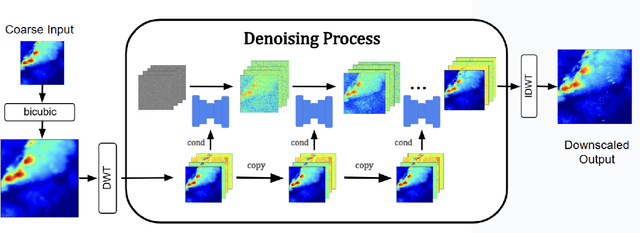
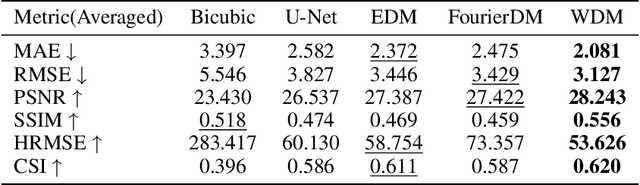
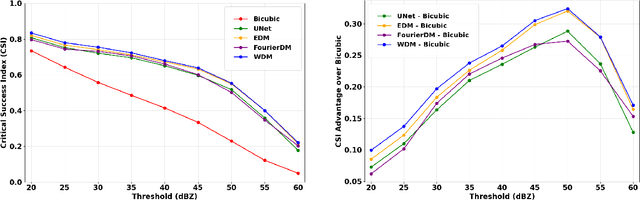
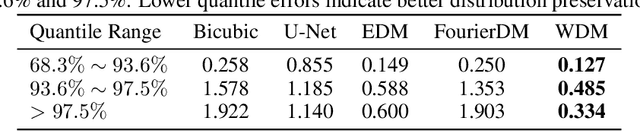
Effective hydrological modeling and extreme weather analysis demand precipitation data at a kilometer-scale resolution, which is significantly finer than the 10 km scale offered by standard global products like IMERG. To address this, we propose the Wavelet Diffusion Model (WDM), a generative framework that achieves 10x spatial super-resolution (downscaling to 1 km) and delivers a 9x inference speedup over pixel-based diffusion models. WDM is a conditional diffusion model that learns the learns the complex structure of precipitation from MRMS radar data directly in the wavelet domain. By focusing on high-frequency wavelet coefficients, it generates exceptionally realistic and detailed 1-km precipitation fields. This wavelet-based approach produces visually superior results with fewer artifacts than pixel-space models, and delivers a significant gains in sampling efficiency. Our results demonstrate that WDM provides a robust solution to the dual challenges of accuracy and speed in geoscience super-resolution, paving the way for more reliable hydrological forecasts.