 Add to Chrome
 Add to Firefox
 Add to Edge
Kimi K3: Open Frontier Intelligence
Jul 27, 2026
We introduce Kimi K3, a 2.8T parameter Mixture-of-Experts model with 104 billion activated parameters, native vision capabilities, and a 1-million-token context window. Kimi K3 is built on Kimi Delta Attention and Attention Residuals, which improve information flow across sequence length and model depth. Together with Stable LatentMoE, which effectively activates 16 of 896 routed experts per token, and refined training and data recipes, these advances yield an approximately 2.5x improvement in overall scaling efficiency over Kimi K2. Post-training highlights reinforcement learning across general, agentic, and coding domains and multiple reasoning-effort levels, enabling compositional generalization and robust long-horizon execution. At 2.8T scale, Kimi K3 is supported by infrastructure advances in multiple areas: algorithm-system co-design for KDA, perfectly balanced expert-parallel training with efficient memory management, million-token agentic RL with persistent rollout and sandbox states, and deployment innovations. Extensive evaluations show that Kimi K3 achieves frontier-level performance across long-horizon coding, agentic, knowledge, reasoning, and vision tasks. While its overall performance still trails the most powerful proprietary models, namely Claude Fable 5 and GPT-5.6 Sol, Kimi K3 consistently outperforms other open and proprietary models evaluated in our suite. We release the full Kimi K3 model weights to facilitate future research and accelerate the broader deployment and adoption of frontier intelligence.

Mechanistic Attention Guidance for Agent Memory Refinement
Jul 20, 2026Existing self-evolving memory systems mainly improve agent memory based on textual outputs, such as task trajectories and reflections. However, this text-based paradigm rarely incorporates internal mechanistic signals, leaving how retrieved memory is actually utilized during task execution underexplored. This limitation can lead to unreliable error attribution and hallucinated memory modifications. In this work, we show that retrieval-head attention provides a mechanistic signal for revealing segment-level memory utilization. By aggregating attention over memory segments and decision steps, we construct a context utilization matrix that exposes recurring memory-use patterns and indicates corresponding refinement strategies. Building on this observation, we propose Attention-Guided Memory Refinement (AGMR), a framework that uses utilization patterns revealed by attention to guide targeted segment-level memory updates. AGMR corrects or enhances memory for failed executions, simplifies memory for successful executions, and verifies each update through re-execution. Experiments on interactive decision-making benchmarks show that AGMR improves both task performance and memory efficiency over text-only memory refinement baselines. Code is available at https://anonymous.4open.science/r/AGMR_code-3262/
Neural Symbolic Regression of Complex Network Dynamics
Oct 15, 2024Complex networks describe important structures in nature and society, composed of nodes and the edges that connect them. The evolution of these networks is typically described by dynamics, which are labor-intensive and require expert knowledge to derive. However, because the complex network involves noisy observations from multiple trajectories of nodes, existing symbolic regression methods are either not applicable or ineffective on its dynamics. In this paper, we propose Physically Inspired Neural Dynamics Symbolic Regression (PI-NDSR), a method based on neural networks and genetic programming to automatically learn the symbolic expression of dynamics. Our method consists of two key components: a Physically Inspired Neural Dynamics (PIND) to augment and denoise trajectories through observed trajectory interpolation; and a coordinated genetic search algorithm to derive symbolic expressions. This algorithm leverages references of node dynamics and edge dynamics from neural dynamics to avoid overfitted expressions in symbolic space. We evaluate our method on synthetic datasets generated by various dynamics and real datasets on disease spreading. The results demonstrate that PI-NDSR outperforms the existing method in terms of both recovery probability and error.
Graph Unitary Message Passing
Mar 17, 2024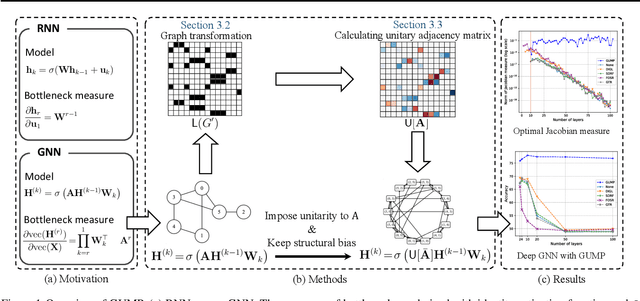
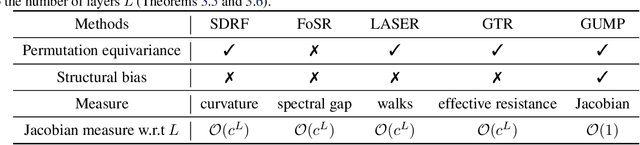
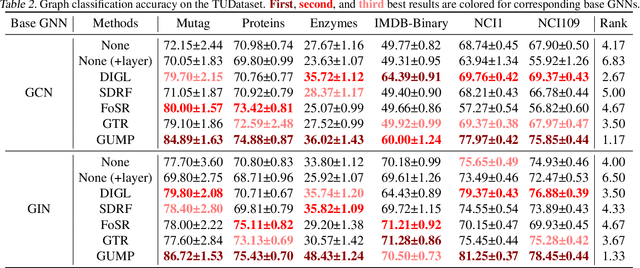
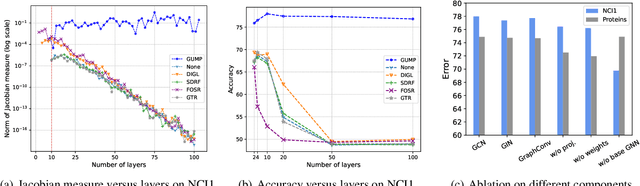
Message passing mechanism contributes to the success of GNNs in various applications, but also brings the oversquashing problem. Recent works combat oversquashing by improving the graph spectrums with rewiring techniques, disrupting the structural bias in graphs, and having limited improvement on oversquashing in terms of oversquashing measure. Motivated by unitary RNN, we propose Graph Unitary Message Passing (GUMP) to alleviate oversquashing in GNNs by applying unitary adjacency matrix for message passing. To design GUMP, a transformation is first proposed to make general graphs have unitary adjacency matrix and keep its structural bias. Then, unitary adjacency matrix is obtained with a unitary projection algorithm, which is implemented by utilizing the intrinsic structure of unitary adjacency matrix and allows GUMP to be permutation-equivariant. Experimental results show the effectiveness of GUMP in improving the performance on various graph learning tasks.
Logical Expressiveness of Graph Neural Network for Knowledge Graph Reasoning
Mar 22, 2023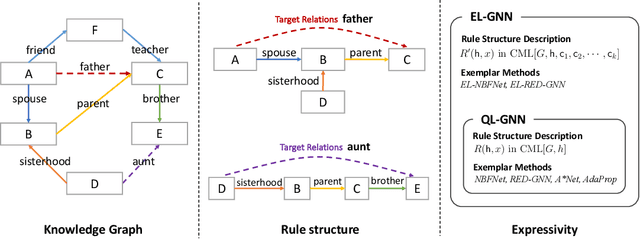
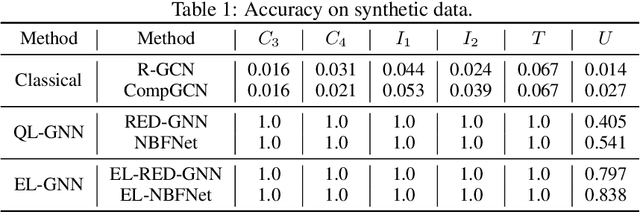
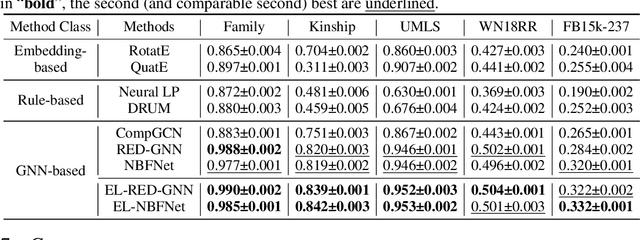
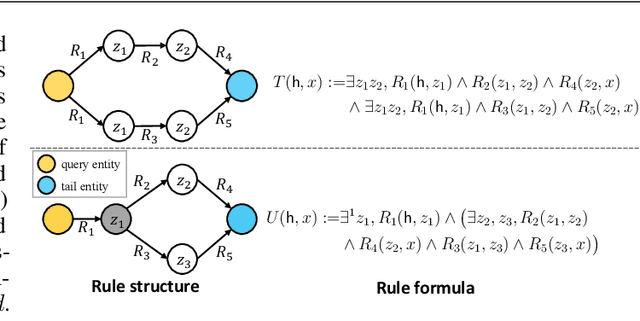
Graph Neural Networks (GNNs) have been recently introduced to learn from knowledge graph (KG) and achieved state-of-the-art performance in KG reasoning. However, a theoretical certification for their good empirical performance is still absent. Besides, while logic in KG is important for inductive and interpretable inference, existing GNN-based methods are just designed to fit data distributions with limited knowledge of their logical expressiveness. We propose to fill the above gap in this paper. Specifically, we theoretically analyze GNN from logical expressiveness and find out what kind of logical rules can be captured from KG. Our results first show that GNN can capture logical rules from graded modal logic, providing a new theoretical tool for analyzing the expressiveness of GNN for KG reasoning; and a query labeling trick makes it easier for GNN to capture logical rules, explaining why SOTA methods are mainly based on labeling trick. Finally, insights from our theory motivate the development of an entity labeling method for capturing difficult logical rules. Experimental results are consistent with our theoretical results and verify the effectiveness of our proposed method.