 Add to Chrome
 Add to Firefox
 Add to Edge
Retrieval-augmented Prompt Learning for Pre-trained Foundation Models
Dec 23, 2025
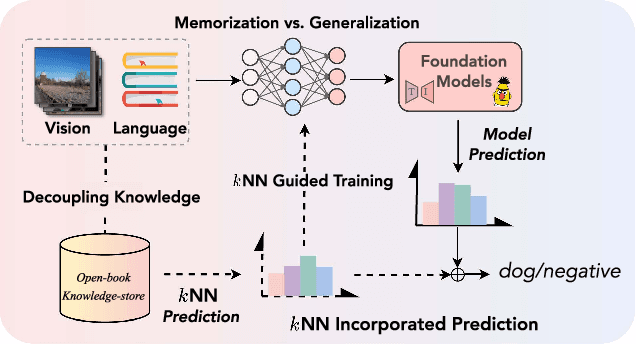
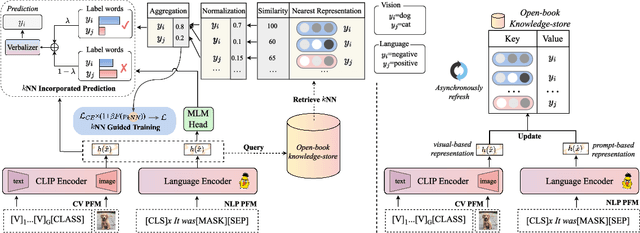
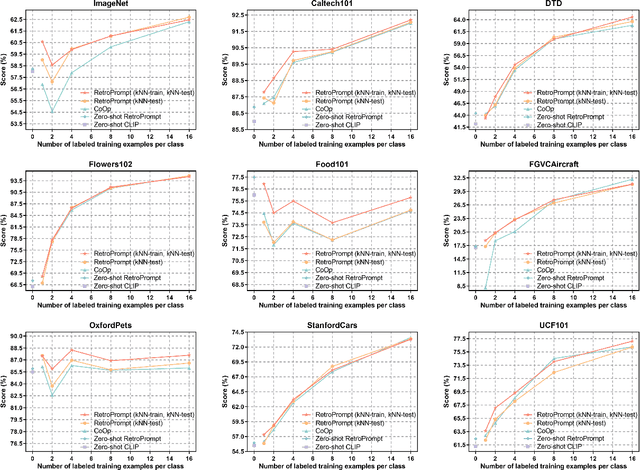
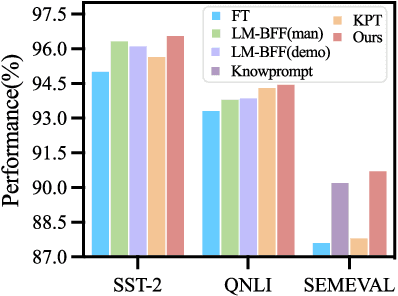
The pre-trained foundation models (PFMs) have become essential for facilitating large-scale multimodal learning. Researchers have effectively employed the ``pre-train, prompt, and predict'' paradigm through prompt learning to induce improved few-shot performance. However, prompt learning approaches for PFMs still follow a parametric learning paradigm. As such, the stability of generalization in memorization and rote learning can be compromised. More specifically, conventional prompt learning might face difficulties in fully utilizing atypical instances and avoiding overfitting to shallow patterns with limited data during the process of fully-supervised training. To overcome these constraints, we present our approach, named RetroPrompt, which aims to achieve a balance between memorization and generalization by decoupling knowledge from mere memorization. Unlike traditional prompting methods, RetroPrompt leverages a publicly accessible knowledge base generated from the training data and incorporates a retrieval mechanism throughout the input, training, and inference stages. This enables the model to actively retrieve relevant contextual information from the corpus, thereby enhancing the available cues. We conduct comprehensive experiments on a variety of datasets across natural language processing and computer vision tasks to demonstrate the superior performance of our proposed approach, RetroPrompt, in both zero-shot and few-shot scenarios. Through detailed analysis of memorization patterns, we observe that RetroPrompt effectively reduces the reliance on rote memorization, leading to enhanced generalization.

Divide, Weight, and Route: Difficulty-Aware Optimization with Dynamic Expert Fusion for Long-tailed Recognition
Aug 27, 2025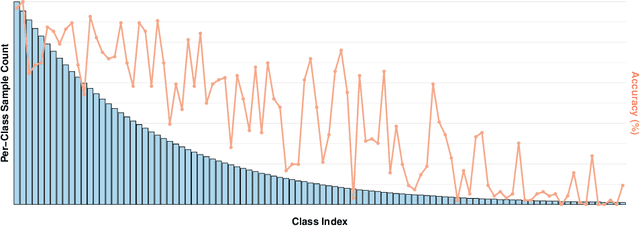

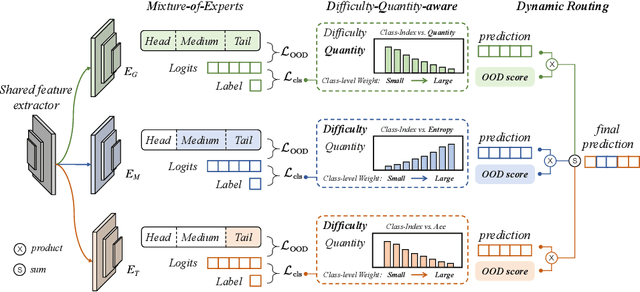
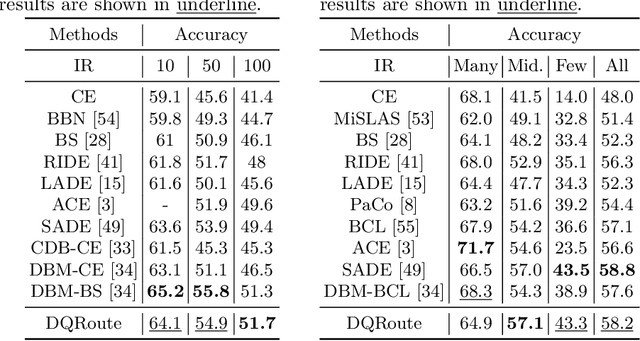
Long-tailed visual recognition is challenging not only due to class imbalance but also because of varying classification difficulty across categories. Simply reweighting classes by frequency often overlooks those that are intrinsically hard to learn. To address this, we propose \textbf{DQRoute}, a modular framework that combines difficulty-aware optimization with dynamic expert collaboration. DQRoute first estimates class-wise difficulty based on prediction uncertainty and historical performance, and uses this signal to guide training with adaptive loss weighting. On the architectural side, DQRoute employs a mixture-of-experts design, where each expert specializes in a different region of the class distribution. At inference time, expert predictions are weighted by confidence scores derived from expert-specific OOD detectors, enabling input-adaptive routing without the need for a centralized router. All components are trained jointly in an end-to-end manner. Experiments on standard long-tailed benchmarks demonstrate that DQRoute significantly improves performance, particularly on rare and difficult classes, highlighting the benefit of integrating difficulty modeling with decentralized expert routing.
Bidirectional Uncertainty-Based Active Learning for Open Set Annotation
Feb 23, 2024Active learning (AL) in open set scenarios presents a novel challenge of identifying the most valuable examples in an unlabeled data pool that comprises data from both known and unknown classes. Traditional methods prioritize selecting informative examples with low confidence, with the risk of mistakenly selecting unknown-class examples with similarly low confidence. Recent methods favor the most probable known-class examples, with the risk of picking simple already mastered examples. In this paper, we attempt to query examples that are both likely from known classes and highly informative, and propose a \textit{Bidirectional Uncertainty-based Active Learning} (BUAL) framework. Specifically, we achieve this by first pushing the unknown class examples toward regions with high-confidence predictions with our proposed \textit{Random Label Negative Learning} method. Then, we propose a \textit{Bidirectional Uncertainty sampling} strategy by jointly estimating uncertainty posed by both positive and negative learning to perform consistent and stable sampling. BUAL successfully extends existing uncertainty-based AL methods to complex open-set scenarios. Extensive experiments on multiple datasets with varying openness demonstrate that BUAL achieves state-of-the-art performance.
On the Sweet Spot of Contrastive Views for Knowledge-enhanced Recommendation
Sep 23, 2023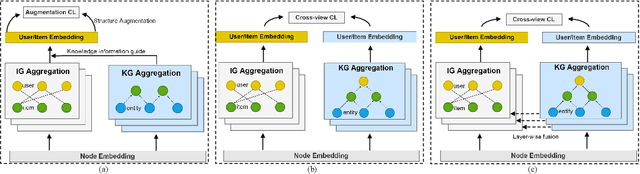
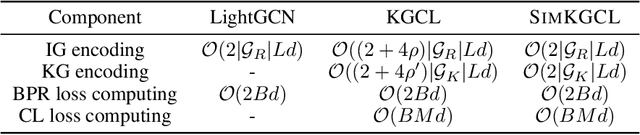
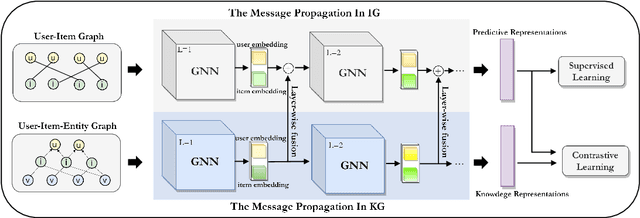

In recommender systems, knowledge graph (KG) can offer critical information that is lacking in the original user-item interaction graph (IG). Recent process has explored this direction and shows that contrastive learning is a promising way to integrate both. However, we observe that existing KG-enhanced recommenders struggle in balancing between the two contrastive views of IG and KG, making them sometimes even less effective than simply applying contrastive learning on IG without using KG. In this paper, we propose a new contrastive learning framework for KG-enhanced recommendation. Specifically, to make full use of the knowledge, we construct two separate contrastive views for KG and IG, and maximize their mutual information; to ease the contrastive learning on the two views, we further fuse KG information into IG in a one-direction manner.Extensive experimental results on three real-world datasets demonstrate the effectiveness and efficiency of our method, compared to the state-of-the-art. Our code is available through the anonymous link:https://figshare.com/articles/conference_contribution/SimKGCL/22783382