 Add to Chrome
 Add to Firefox
 Add to Edge
Resource-Constrained UAV-Based Weed Detection for Site-Specific Management on Edge Devices
Apr 25, 2026
Weeds compete with crops for light, water, and nutrients, reducing yield and crop quality. Efficient weed detection is essential for site-specific weed management (SSWM). Although deep learning models have been deployed on UAV-based edge systems, a systematic understanding of how different model architectures perform under real-world resource constraints is still lacking. To address this gap, this study proposes a deployment-oriented framework for real-time UAV-based weed detection on resource-constrained edge platforms. The framework integrates UAV data acquisition, model development, and on-device inference, with a focus on balancing detection accuracy and computational efficiency. A diverse set of state-of-the-art object detection models is evaluated, including convolution-based YOLO models (v8-v12) and transformer-based RT-DETR models (v1-v2). Experiments on three edge devices (Jetson Orin Nano, Jetson AGX Xavier, and Jetson AGX Orin) demonstrate clear trade-offs between accuracy and inference latency across models and hardware configurations. Results show that high-capacity models achieve up to 86.9% mAP50 but suffer from high latency, limiting real-time deployment. In contrast, lightweight models achieve 66%-71% mAP50 with significantly lower latency, enabling real-time performance. Among all models, RT-DETRv2-R50-M achieves competitive accuracy (79% mAP50) with improved efficiency, while YOLOv10n provides the fastest inference speed. YOLOv11s and RT-DETRv2-R50-M offer the best balance between accuracy and speed, making them strong candidates for real-time UAV deployment.

VLLFL: A Vision-Language Model Based Lightweight Federated Learning Framework for Smart Agriculture
Apr 17, 2025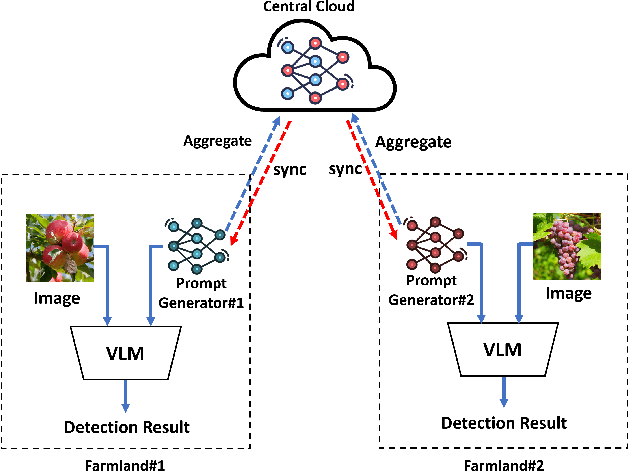
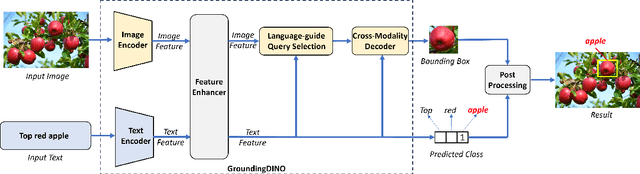
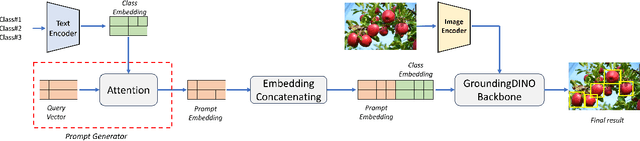
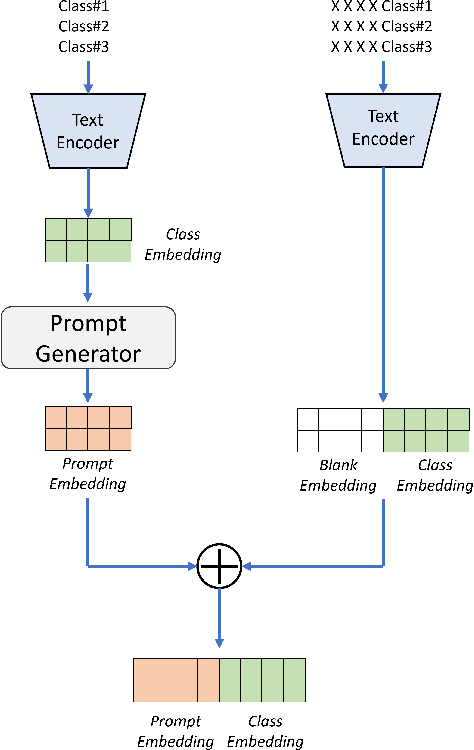
In modern smart agriculture, object detection plays a crucial role by enabling automation, precision farming, and monitoring of resources. From identifying crop health and pest infestations to optimizing harvesting processes, accurate object detection enhances both productivity and sustainability. However, training object detection models often requires large-scale data collection and raises privacy concerns, particularly when sensitive agricultural data is distributed across farms. To address these challenges, we propose VLLFL, a vision-language model-based lightweight federated learning framework (VLLFL). It harnesses the generalization and context-aware detection capabilities of the vision-language model (VLM) and leverages the privacy-preserving nature of federated learning. By training a compact prompt generator to boost the performance of the VLM deployed across different farms, VLLFL preserves privacy while reducing communication overhead. Experimental results demonstrate that VLLFL achieves 14.53% improvement in the performance of VLM while reducing 99.3% communication overhead. Spanning tasks from identifying a wide variety of fruits to detecting harmful animals in agriculture, the proposed framework offers an efficient, scalable, and privacy-preserving solution specifically tailored to agricultural applications.