 Add to Chrome
 Add to Firefox
 Add to Edge
REAL: A Reasoning-Enhanced Graph Framework for Long-Term Memory Management of LLMs
Jun 09, 2026
Large Language Models (LLMs) are increasingly expected to interact with users over long time horizons. However, due to their finite context window, LLMs cannot retain all past interactions, making long-term memory management essential for storing, updating, and retrieving historical information beyond the context limit. Although recent memory systems attempt to address this issue by storing historical information externally, existing approaches suffer from three key limitations: flat text-based memory organizations fail to capture explicit relations among memories, structured memory systems often destructively overwrite evolving facts, and current retrieval mechanisms remain query-agnostic and passive when evidence is incomplete. REAL constructs long-term conversational memory as a temporal and confidence-aware directed property graph, where each atomic fact is represented with entities, relations, valid-time intervals, confidence scores, and exploration intent labels. During memory construction, REAL adopts a non-destructive temporal update strategy that preserves parallel fact versions and their validity intervals, enabling faithful tracking of fact evolution. During retrieval, REAL anchors query-relevant root entities, decouples their exploration intents, and performs semantic evaluator-guided hybrid beam search to extract compact memory subgraphs. It further incorporates counterfactual inference to repair unreliable retrieval states and recover missing memory evidence through implicit logical relations. Comprehensive experiments demonstrate that REAL substantially improves long-term memory performance over flat-text, graph-based, and existing memory baselines, achieving an average improvement of 22.72\%.

SKDBERT: Compressing BERT via Stochastic Knowledge Distillation
Nov 29, 2022In this paper, we propose Stochastic Knowledge Distillation (SKD) to obtain compact BERT-style language model dubbed SKDBERT. In each iteration, SKD samples a teacher model from a pre-defined teacher ensemble, which consists of multiple teacher models with multi-level capacities, to transfer knowledge into student model in an one-to-one manner. Sampling distribution plays an important role in SKD. We heuristically present three types of sampling distributions to assign appropriate probabilities for multi-level teacher models. SKD has two advantages: 1) it can preserve the diversities of multi-level teacher models via stochastically sampling single teacher model in each iteration, and 2) it can also improve the efficacy of knowledge distillation via multi-level teacher models when large capacity gap exists between the teacher model and the student model. Experimental results on GLUE benchmark show that SKDBERT reduces the size of a BERT$_{\rm BASE}$ model by 40% while retaining 99.5% performances of language understanding and being 100% faster.
Understanding Why Neural Networks Generalize Well Through GSNR of Parameters
Feb 24, 2020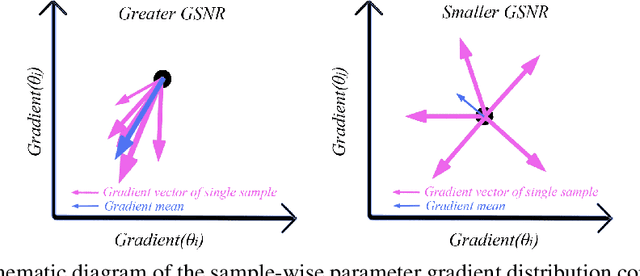
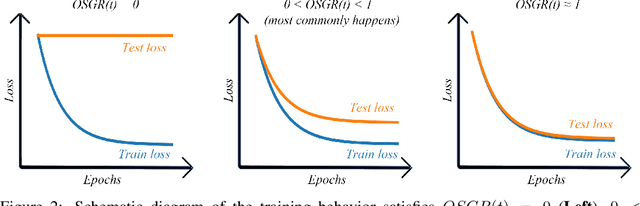
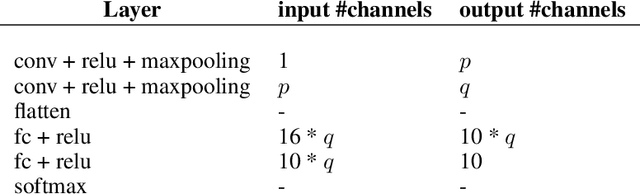
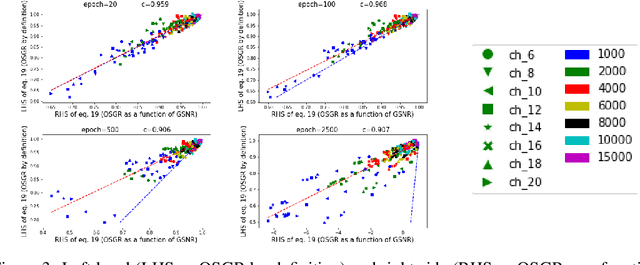
As deep neural networks (DNNs) achieve tremendous success across many application domains, researchers tried to explore in many aspects on why they generalize well. In this paper, we provide a novel perspective on these issues using the gradient signal to noise ratio (GSNR) of parameters during training process of DNNs. The GSNR of a parameter is defined as the ratio between its gradient's squared mean and variance, over the data distribution. Based on several approximations, we establish a quantitative relationship between model parameters' GSNR and the generalization gap. This relationship indicates that larger GSNR during training process leads to better generalization performance. Moreover, we show that, different from that of shallow models (e.g. logistic regression, support vector machines), the gradient descent optimization dynamics of DNNs naturally produces large GSNR during training, which is probably the key to DNNs' remarkable generalization ability.