 Add to Chrome
 Add to Firefox
 Add to Edge
EyeMVP: OCT-Informed Fundus Representation Learning via Paired CFP--OCT Pretraining
Jun 13, 2026
Color fundus photography (CFP) is the mainstay for large-scale retinal screening, yet its diagnostic capacity is constrained by the lack of depth-resolved structural information. Optical coherence tomography (OCT) provides cross-sectional retinal anatomy, but is less accessible in population-level screening. Here, we present EyeMVP, a cross-modal retinal foundation model that uses paired CFP--OCT pretraining to learn OCT-informed CFP representations. EyeMVP is pretrained on 674,893 strict same-eye same-day paired CFP--OCT image triples from 112,642 patients across eight hospitals in China. The model uses cross-modal masked reconstruction to enrich CFP representations with OCT-associated supervision, while requiring only CFP images at inference. To accommodate the non-aligned imaging geometry between en-face CFP and cross-sectional OCT, EyeMVP combines source-constrained cross-attention with CFP-derived structural masks. Across 16 downstream tasks, including classification, segmentation, few-shot adaptation, and cross-modal retrieval, EyeMVP outperforms representative retinal foundation models and shows consistent gains on tasks involving macular and optic nerve structure. For CFP-challenging macular diseases, EyeMVP achieves an AUROC of 0.948 for macular edema (vs.~0.852 for EyeCLIP) and 0.825 for myopic macular schisis. In an exploratory reader study, EyeMVP exceeds junior and intermediate ophthalmologist groups but does not reach senior ophthalmologist performance on macular edema, while showing numerically higher balanced accuracy than all reader groups on myopic macular schisis. These results suggest that pixel-level cross-modal reconstruction can enrich CFP representations with OCT-associated supervision, providing a practical route toward stronger CFP-based retinal analysis in screening settings.

Nemotron 3 Ultra: Open, Efficient Mixture-of-Experts Hybrid Mamba-Transformer Model for Agentic Reasoning
Jun 12, 2026We introduce Nemotron 3 Ultra, a 550 billion total and 55 billion active parameter Mixture-of-Experts Hybrid Mamba-Attention language model. We pre-trained Nemotron 3 Ultra on 20 trillion text tokens, then extended the context length to 1M tokens, and post-trained using Supervised Fine Tuning (SFT), Reinforcement Learning (RL), and Multi-teacher On-Policy Distillation (MOPD). Nemotron 3 Ultra is our most capable model yet, employing multiple key technologies - LatentMoE, Multi Token Prediction (MTP), NVFP4 pre-training, multi-environment RLVR, MOPD, and reasoning budget control. Nemotron 3 Ultra achieves up to ~6x higher inference throughput as compared to state-of-the-art publicly available LLMs while attaining on-par accuracy. The state-of-the-art accuracy, high inference throughput, and 1M token context length make Nemotron 3 Ultra ideal for long-running autonomous agentic tasks. We open-source the base, post-trained, and quantized checkpoints, along with the training data and recipe on HuggingFace.
Nemotron 3 Super: Open, Efficient Mixture-of-Experts Hybrid Mamba-Transformer Model for Agentic Reasoning
Apr 14, 2026We describe the pre-training, post-training, and quantization of Nemotron 3 Super, a 120 billion (active 12 billion) parameter hybrid Mamba-Attention Mixture-of-Experts model. Nemotron 3 Super is the first model in the Nemotron 3 family to 1) be pre-trained in NVFP4, 2) leverage LatentMoE, a new Mixture-of-Experts architecture that optimizes for both accuracy per FLOP and accuracy per parameter, and 3) include MTP layers for inference acceleration through native speculative decoding. We pre-trained Nemotron 3 Super on 25 trillion tokens followed by post-training using supervised fine tuning (SFT) and reinforcement learning (RL). The final model supports up to 1M context length and achieves comparable accuracy on common benchmarks, while also achieving up to 2.2x and 7.5x higher inference throughput compared to GPT-OSS-120B and Qwen3.5-122B, respectively. Nemotron 3 Super datasets, along with the base, post-trained, and quantized checkpoints, are open-sourced on HuggingFace.
Poisson-Gamma Dynamical Systems with Non-Stationary Transition Dynamics
Feb 26, 2024


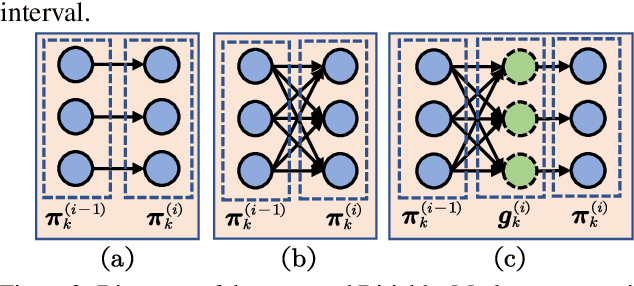
Bayesian methodologies for handling count-valued time series have gained prominence due to their ability to infer interpretable latent structures and to estimate uncertainties, and thus are especially suitable for dealing with noisy and incomplete count data. Among these Bayesian models, Poisson-Gamma Dynamical Systems (PGDSs) are proven to be effective in capturing the evolving dynamics underlying observed count sequences. However, the state-of-the-art PGDS still falls short in capturing the time-varying transition dynamics that are commonly observed in real-world count time series. To mitigate this limitation, a non-stationary PGDS is proposed to allow the underlying transition matrices to evolve over time, and the evolving transition matrices are modeled by sophisticatedly-designed Dirichlet Markov chains. Leveraging Dirichlet-Multinomial-Beta data augmentation techniques, a fully-conjugate and efficient Gibbs sampler is developed to perform posterior simulation. Experiments show that, in comparison with related models, the proposed non-stationary PGDS achieves improved predictive performance due to its capacity to learn non-stationary dependency structure captured by the time-evolving transition matrices.
AccEar: Accelerometer Acoustic Eavesdropping with Unconstrained Vocabulary
Dec 02, 2022
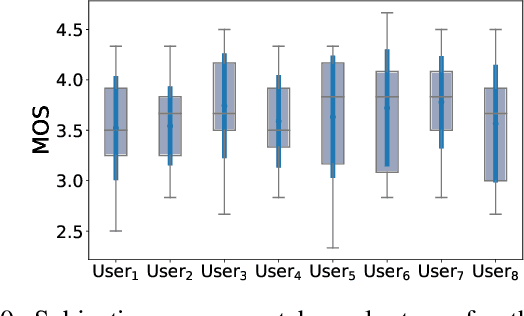
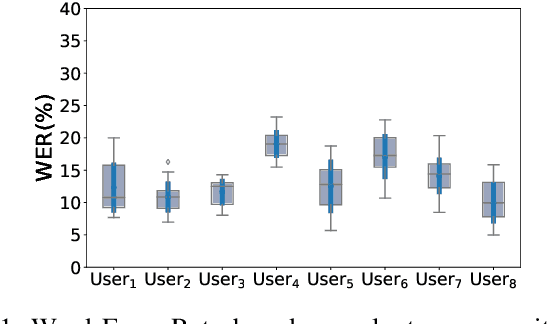
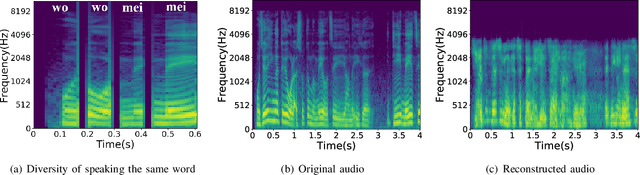
With the increasing popularity of voice-based applications, acoustic eavesdropping has become a serious threat to users' privacy. While on smartphones the access to microphones needs an explicit user permission, acoustic eavesdropping attacks can rely on motion sensors (such as accelerometer and gyroscope), which access is unrestricted. However, previous instances of such attacks can only recognize a limited set of pre-trained words or phrases. In this paper, we present AccEar, an accelerometerbased acoustic eavesdropping attack that can reconstruct any audio played on the smartphone's loudspeaker with unconstrained vocabulary. We show that an attacker can employ a conditional Generative Adversarial Network (cGAN) to reconstruct highfidelity audio from low-frequency accelerometer signals. The presented cGAN model learns to recreate high-frequency components of the user's voice from low-frequency accelerometer signals through spectrogram enhancement. We assess the feasibility and effectiveness of AccEar attack in a thorough set of experiments using audio from 16 public personalities. As shown by the results in both objective and subjective evaluations, AccEar successfully reconstructs user speeches from accelerometer signals in different scenarios including varying sampling rate, audio volume, device model, etc.
* 2022 IEEE Symposium on Security and Privacy (SP)
Highly Efficient 8-bit Low Precision Inference of Convolutional Neural Networks with IntelCaffe
May 04, 2018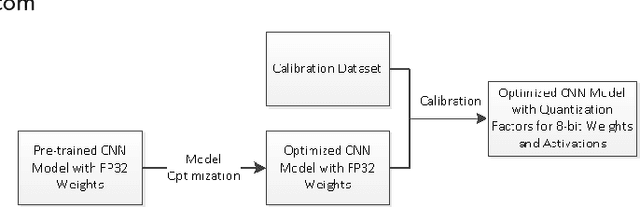
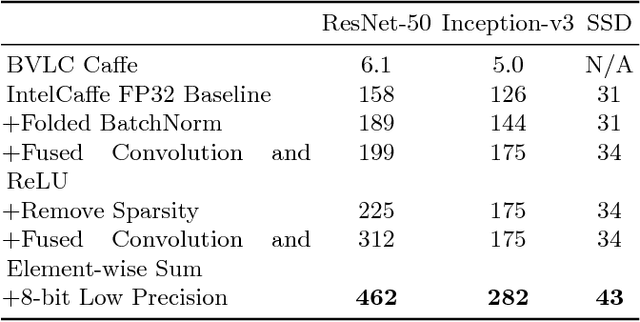

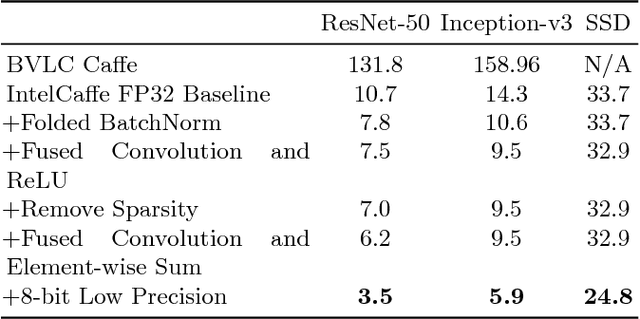
High throughput and low latency inference of deep neural networks are critical for the deployment of deep learning applications. This paper presents the efficient inference techniques of IntelCaffe, the first Intel optimized deep learning framework that supports efficient 8-bit low precision inference and model optimization techniques of convolutional neural networks on Intel Xeon Scalable Processors. The 8-bit optimized model is automatically generated with a calibration process from FP32 model without the need of fine-tuning or retraining. We show that the inference throughput and latency with ResNet-50, Inception-v3 and SSD are improved by 1.38X-2.9X and 1.35X-3X respectively with neglectable accuracy loss from IntelCaffe FP32 baseline and by 56X-75X and 26X-37X from BVLC Caffe. All these techniques have been open-sourced on IntelCaffe GitHub1, and the artifact is provided to reproduce the result on Amazon AWS Cloud.