 Add to Chrome
 Add to Firefox
 Add to Edge
EasyV2V: A High-quality Instruction-based Video Editing Framework
Dec 18, 2025
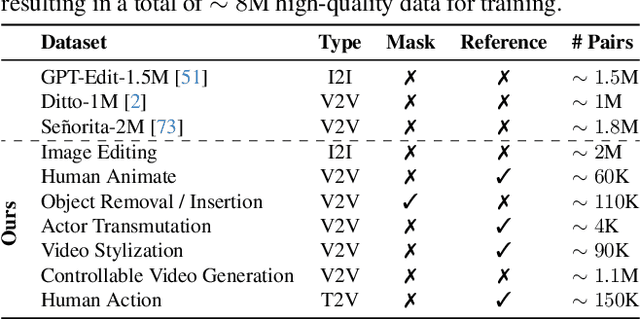
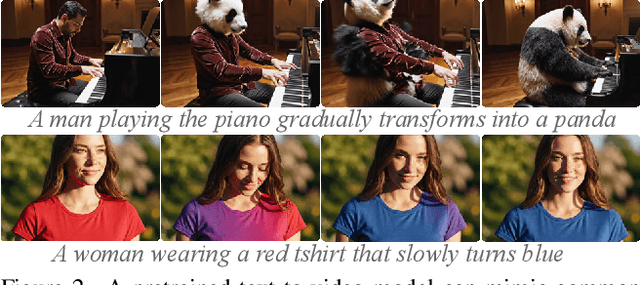
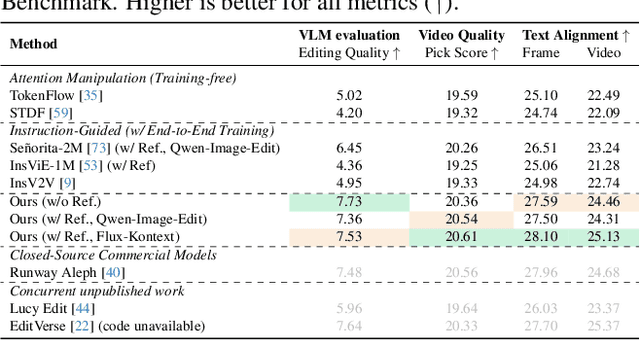
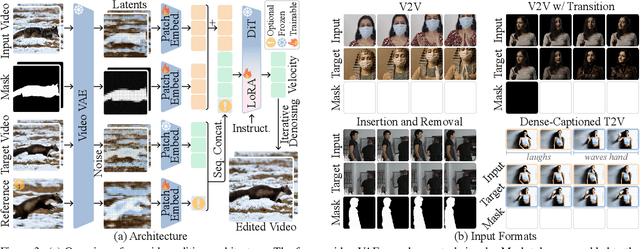
While image editing has advanced rapidly, video editing remains less explored, facing challenges in consistency, control, and generalization. We study the design space of data, architecture, and control, and introduce \emph{EasyV2V}, a simple and effective framework for instruction-based video editing. On the data side, we compose existing experts with fast inverses to build diverse video pairs, lift image edit pairs into videos via single-frame supervision and pseudo pairs with shared affine motion, mine dense-captioned clips for video pairs, and add transition supervision to teach how edits unfold. On the model side, we observe that pretrained text-to-video models possess editing capability, motivating a simplified design. Simple sequence concatenation for conditioning with light LoRA fine-tuning suffices to train a strong model. For control, we unify spatiotemporal control via a single mask mechanism and support optional reference images. Overall, EasyV2V works with flexible inputs, e.g., video+text, video+mask+text, video+mask+reference+text, and achieves state-of-the-art video editing results, surpassing concurrent and commercial systems. Project page: https://snap-research.github.io/easyv2v/

Omni-Attribute: Open-vocabulary Attribute Encoder for Visual Concept Personalization
Dec 11, 2025Visual concept personalization aims to transfer only specific image attributes, such as identity, expression, lighting, and style, into unseen contexts. However, existing methods rely on holistic embeddings from general-purpose image encoders, which entangle multiple visual factors and make it difficult to isolate a single attribute. This often leads to information leakage and incoherent synthesis. To address this limitation, we introduce Omni-Attribute, the first open-vocabulary image attribute encoder designed to learn high-fidelity, attribute-specific representations. Our approach jointly designs the data and model: (i) we curate semantically linked image pairs annotated with positive and negative attributes to explicitly teach the encoder what to preserve or suppress; and (ii) we adopt a dual-objective training paradigm that balances generative fidelity with contrastive disentanglement. The resulting embeddings prove effective for open-vocabulary attribute retrieval, personalization, and compositional generation, achieving state-of-the-art performance across multiple benchmarks.
LayerComposer: Interactive Personalized T2I via Spatially-Aware Layered Canvas
Oct 23, 2025Despite their impressive visual fidelity, existing personalized generative models lack interactive control over spatial composition and scale poorly to multiple subjects. To address these limitations, we present LayerComposer, an interactive framework for personalized, multi-subject text-to-image generation. Our approach introduces two main contributions: (1) a layered canvas, a novel representation in which each subject is placed on a distinct layer, enabling occlusion-free composition; and (2) a locking mechanism that preserves selected layers with high fidelity while allowing the remaining layers to adapt flexibly to the surrounding context. Similar to professional image-editing software, the proposed layered canvas allows users to place, resize, or lock input subjects through intuitive layer manipulation. Our versatile locking mechanism requires no architectural changes, relying instead on inherent positional embeddings combined with a new complementary data sampling strategy. Extensive experiments demonstrate that LayerComposer achieves superior spatial control and identity preservation compared to the state-of-the-art methods in multi-subject personalized image generation.