 Add to Chrome
 Add to Firefox
 Add to Edge
Learning Rollout from Sampling:An R1-Style Tokenized Traffic Simulation Model
Mar 26, 2026
Learning diverse and high-fidelity traffic simulations from human driving demonstrations is crucial for autonomous driving evaluation. The recent next-token prediction (NTP) paradigm, widely adopted in large language models (LLMs), has been applied to traffic simulation and achieves iterative improvements via supervised fine-tuning (SFT). However, such methods limit active exploration of potentially valuable motion tokens, particularly in suboptimal regions. Entropy patterns provide a promising perspective for enabling exploration driven by motion token uncertainty. Motivated by this insight, we propose a novel tokenized traffic simulation policy, R1Sim, which represents an initial attempt to explore reinforcement learning based on motion token entropy patterns, and systematically analyzes the impact of different motion tokens on simulation outcomes. Specifically, we introduce an entropy-guided adaptive sampling mechanism that focuses on previously overlooked motion tokens with high uncertainty yet high potential. We further optimize motion behaviors using Group Relative Policy Optimization (GRPO), guided by a safety-aware reward design. Overall, these components enable a balanced exploration-exploitation trade-off through diverse high-uncertainty sampling and group-wise comparative estimation, resulting in realistic, safe, and diverse multi-agent behaviors. Extensive experiments on the Waymo Sim Agent benchmark demonstrate that R1Sim achieves competitive performance compared to state-of-the-art methods.

Multimodal Trajectory Prediction for Autonomous Driving on Unstructured Roads using Deep Convolutional Network
Sep 27, 2024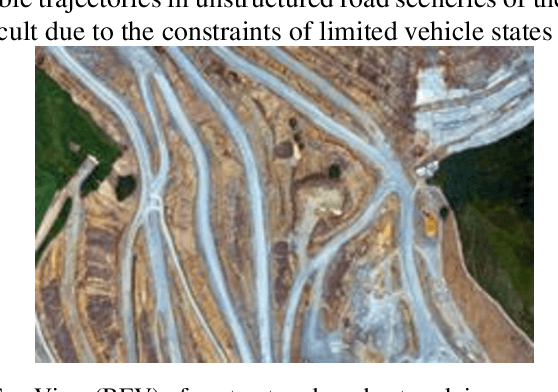
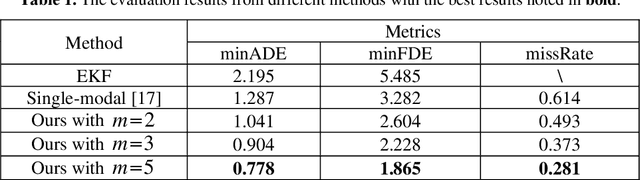
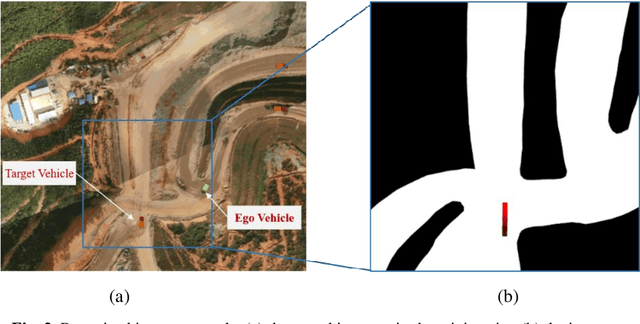
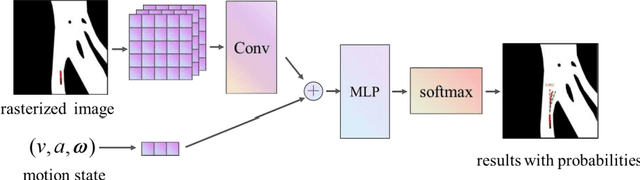
Recently, the application of autonomous driving in open-pit mining has garnered increasing attention for achieving safe and efficient mineral transportation. Compared to urban structured roads, unstructured roads in mining sites have uneven boundaries and lack clearly defined lane markings. This leads to a lack of sufficient constraint information for predicting the trajectories of other human-driven vehicles, resulting in higher uncertainty in trajectory prediction problems. A method is proposed to predict multiple possible trajectories and their probabilities of the target vehicle. The surrounding environment and historical trajectories of the target vehicle are encoded as a rasterized image, which is used as input to our deep convolutional network to predict the target vehicle's multiple possible trajectories. The method underwent offline testing on a dataset specifically designed for autonomous driving scenarios in open-pit mining and was compared and evaluated against physics-based method. The open-source code and data are available at https://github.com/LLsxyc/mine_motion_prediction.git