 Add to Chrome
 Add to Firefox
 Add to Edge
OP2GS: Object-Aware 3D Gaussian Splatting with Dual-Opacity Primitives
May 19, 2026
3D Gaussian Splatting (3DGS) provides an explicit and efficient scene representation, but its primitives lack inherent object-level identity, hindering downstream tasks such as open-vocabulary scene understanding. Existing methods typically address this by either distilling high-dimensional feature embeddings into Gaussians or by lifting 2D mask labels into 3D via heuristic refinement. However, feature-based approaches incur heavy storage and decoding overhead, while lifting-based pipelines remain vulnerable to label contamination: Gaussians necessary for appearance reconstruction often receive incorrect object labels during 2D-to-3D projection. We propose OP2GS, an object-aware Gaussian representation that augments each primitive with an explicit instance identity and a dedicated instance opacity $σ^{*}$ for object-mask rendering. The original opacity $σ$ remains responsible for visual reconstruction, while $σ^{*}$ models whether a Gaussian should contribute to a particular object mask. This dual-opacity formulation decouples visual existence from instance occupancy: mislabeled Gaussians can remain available for image rendering while becoming transparent in the object-mask branch. To learn this representation, we introduce a random object loss that optimizes the 1D instance occupancy field using the standard transmittance-based visibility of 3DGS. Semantic descriptors are then attached at the object level through multi-view aggregation, eliminating per-Gaussian feature storage. Compared with feature-training approaches, OP2GS achieves competitive open-vocabulary performance while significantly reducing computational overhead. Compared with training-free pipelines, it leverages physically consistent occupancy learning to resolve visibility ambiguities.

Scene-Agnostic Object-Centric Representation Learning for 3D Gaussian Splatting
Apr 10, 2026Recent works on 3D scene understanding leverage 2D masks from visual foundation models (VFMs) to supervise radiance fields, enabling instance-level 3D segmentation. However, the supervision signals from foundation models are not fundamentally object-centric and often require additional mask pre/post-processing or specialized training and loss design to resolve mask identity conflicts across views. The learned identity of the 3D scene is scene-dependent, limiting generalizability across scenes. Therefore, we propose a dataset-level, object-centric supervision scheme to learn object representations in 3D Gaussian Splatting (3DGS). Building on a pre-trained slot attention-based Global Object Centric Learning (GOCL) module, we learn a scene-agnostic object codebook that provides consistent, identity-anchored representations across views and scenes. By coupling the codebook with the module's unsupervised object masks, we can directly supervise the identity features of 3D Gaussians without additional mask pre-/post-processing or explicit multi-view alignment. The learned scene-agnostic codebook enables object supervision and identification without per-scene fine-tuning or retraining. Our method thus introduces unsupervised object-centric learning (OCL) into 3DGS, yielding more structured representations and better generalization for downstream tasks such as robotic interaction, scene understanding, and cross-scene generalization.
FULLER: Unified Multi-modality Multi-task 3D Perception via Multi-level Gradient Calibration
Jul 31, 2023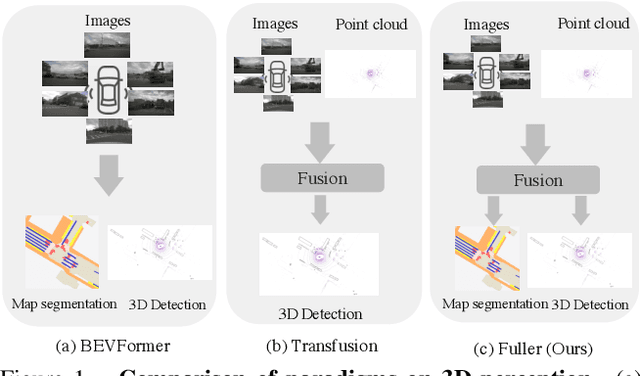
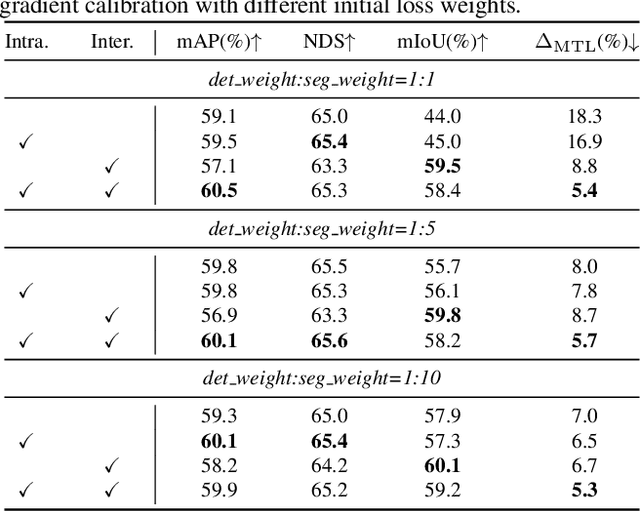
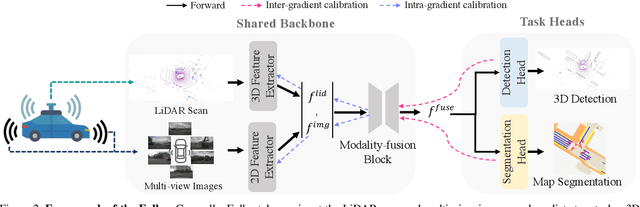
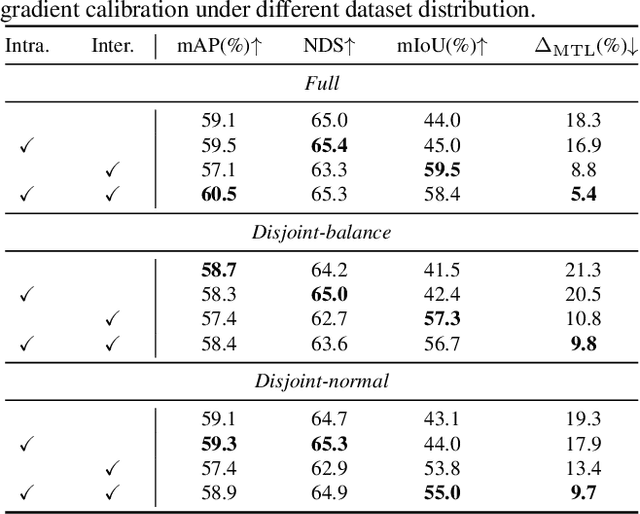
Multi-modality fusion and multi-task learning are becoming trendy in 3D autonomous driving scenario, considering robust prediction and computation budget. However, naively extending the existing framework to the domain of multi-modality multi-task learning remains ineffective and even poisonous due to the notorious modality bias and task conflict. Previous works manually coordinate the learning framework with empirical knowledge, which may lead to sub-optima. To mitigate the issue, we propose a novel yet simple multi-level gradient calibration learning framework across tasks and modalities during optimization. Specifically, the gradients, produced by the task heads and used to update the shared backbone, will be calibrated at the backbone's last layer to alleviate the task conflict. Before the calibrated gradients are further propagated to the modality branches of the backbone, their magnitudes will be calibrated again to the same level, ensuring the downstream tasks pay balanced attention to different modalities. Experiments on large-scale benchmark nuScenes demonstrate the effectiveness of the proposed method, eg, an absolute 14.4% mIoU improvement on map segmentation and 1.4% mAP improvement on 3D detection, advancing the application of 3D autonomous driving in the domain of multi-modality fusion and multi-task learning. We also discuss the links between modalities and tasks.