 Add to Chrome
 Add to Firefox
 Add to Edge
Object Search in Partially-Known Environments via LLM-informed Model-based Planning and Prompt Selection
Mar 25, 2026
We present a novel LLM-informed model-based planning framework, and a novel prompt selection method, for object search in partially-known environments. Our approach uses an LLM to estimate statistics about the likelihood of finding the target object when searching various locations throughout the scene that, combined with travel costs extracted from the environment map, are used to instantiate a model, thus using the LLM to inform planning and achieve effective search performance. Moreover, the abstraction upon which our approach relies is amenable to deployment-time model selection via the recent offline replay approach, an insight we leverage to enable fast prompt and LLM selection during deployment. Simulation experiments demonstrate that our LLM-informed model-based planning approach outperforms the baseline planning strategy that fully relies on LLM and optimistic strategy with as much as 11.8% and 39.2% improvements respectively, and our bandit-like selection approach enables quick selection of best prompts and LLMs resulting in 6.5% lower average cost and 33.8% lower average cumulative regret over baseline UCB bandit selection. Real-robot experiments in an apartment demonstrate similar improvements and so further validate our approach.

AnoMalNet: Outlier Detection based Malaria Cell Image Classification Method Leveraging Deep Autoencoder
Mar 10, 2023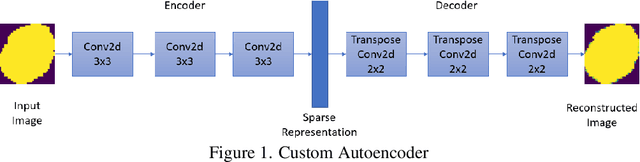
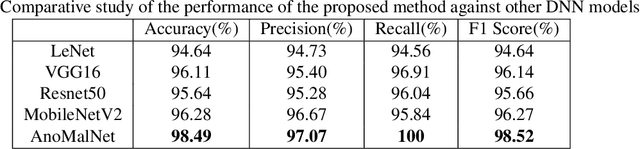
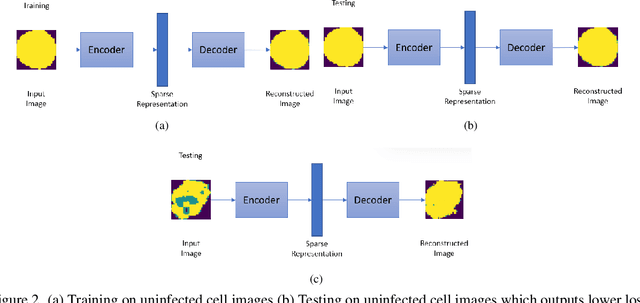
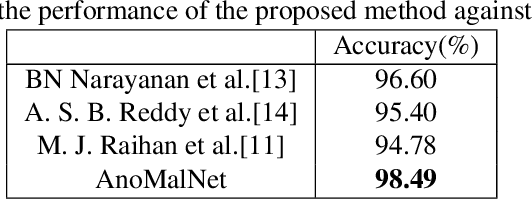
Class imbalance is a pervasive issue in the field of disease classification from medical images. It is necessary to balance out the class distribution while training a model for decent results. However, in the case of rare medical diseases, images from affected patients are much harder to come by compared to images from non-affected patients, resulting in unwanted class imbalance. Various processes of tackling class imbalance issues have been explored so far, each having its fair share of drawbacks. In this research, we propose an outlier detection based binary medical image classification technique which can handle even the most extreme case of class imbalance. We have utilized a dataset of malaria parasitized and uninfected cells. An autoencoder model titled AnoMalNet is trained with only the uninfected cell images at the beginning and then used to classify both the affected and non-affected cell images by thresholding a loss value. We have achieved an accuracy, precision, recall, and F1 score of 98.49%, 97.07%, 100%, and 98.52% respectively, performing better than large deep learning models and other published works. As our proposed approach can provide competitive results without needing the disease-positive samples during training, it should prove to be useful in binary disease classification on imbalanced datasets.