 Add to Chrome
 Add to Firefox
 Add to Edge
Visual Reasoning through Tool-supervised Reinforcement Learning
Apr 21, 2026
In this paper, we investigate the problem of how to effectively master tool-use to solve complex visual reasoning tasks for Multimodal Large Language Models. To achieve that, we propose a novel Tool-supervised Reinforcement Learning (ToolsRL) framework, with direct tool supervision for more effective tool-use learning. We focus on a series of simple, native, and interpretable visual tools, including zoom-in, rotate, flip, and draw point/line, whose tool supervision is easy to collect. A reinforcement learning curriculum is developed, where the first stage is solely optimized by a set of well motivated tool-specific rewards, and the second stage is trained with the accuracy targeted rewards while allowing calling tools. In this way, tool calling capability is mastered before using tools to complete visual reasoning tasks, avoiding the potential optimization conflict among those heterogeneous tasks. Our experiments have shown that the tool-supervised curriculum training is efficient and ToolsRL can achieve strong tool-use capabilities for complex visual reasoning tasks.

Lightweight Learner for Shared Knowledge Lifelong Learning
May 24, 2023
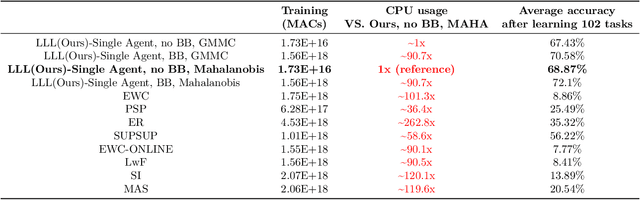

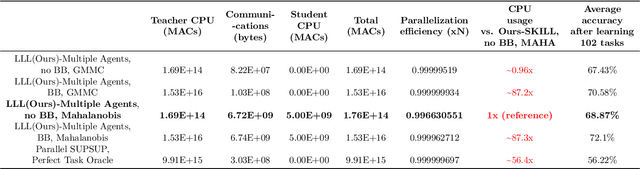
In Lifelong Learning (LL), agents continually learn as they encounter new conditions and tasks. Most current LL is limited to a single agent that learns tasks sequentially. Dedicated LL machinery is then deployed to mitigate the forgetting of old tasks as new tasks are learned. This is inherently slow. We propose a new Shared Knowledge Lifelong Learning (SKILL) challenge, which deploys a decentralized population of LL agents that each sequentially learn different tasks, with all agents operating independently and in parallel. After learning their respective tasks, agents share and consolidate their knowledge over a decentralized communication network, so that, in the end, all agents can master all tasks. We present one solution to SKILL which uses Lightweight Lifelong Learning (LLL) agents, where the goal is to facilitate efficient sharing by minimizing the fraction of the agent that is specialized for any given task. Each LLL agent thus consists of a common task-agnostic immutable part, where most parameters are, and individual task-specific modules that contain fewer parameters but are adapted to each task. Agents share their task-specific modules, plus summary information ("task anchors") representing their tasks in the common task-agnostic latent space of all agents. Receiving agents register each received task-specific module using the corresponding anchor. Thus, every agent improves its ability to solve new tasks each time new task-specific modules and anchors are received. On a new, very challenging SKILL-102 dataset with 102 image classification tasks (5,033 classes in total, 2,041,225 training, 243,464 validation, and 243,464 test images), we achieve much higher (and SOTA) accuracy over 8 LL baselines, while also achieving near perfect parallelization. Code and data can be found at https://github.com/gyhandy/Shared-Knowledge-Lifelong-Learning