 Add to Chrome
 Add to Firefox
 Add to Edge
News Without Borders: Domain Adaptation of Multilingual Sentence Embeddings for Cross-lingual News Recommendation
Jun 18, 2024
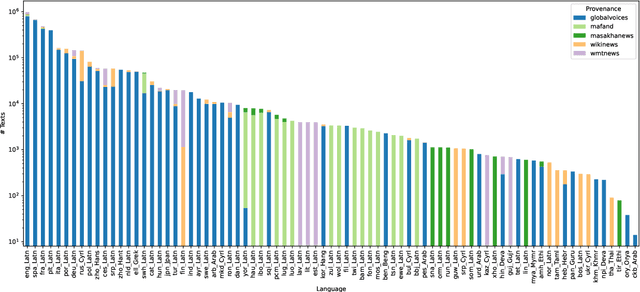


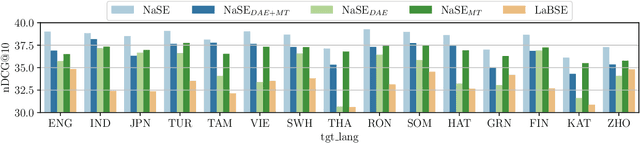
Rapidly growing numbers of multilingual news consumers pose an increasing challenge to news recommender systems in terms of providing customized recommendations. First, existing neural news recommenders, even when powered by multilingual language models (LMs), suffer substantial performance losses in zero-shot cross-lingual transfer (ZS-XLT). Second, the current paradigm of fine-tuning the backbone LM of a neural recommender on task-specific data is computationally expensive and infeasible in few-shot recommendation and cold-start setups, where data is scarce or completely unavailable. In this work, we propose a news-adapted sentence encoder (NaSE), domain-specialized from a pretrained massively multilingual sentence encoder (SE). To this end, we construct and leverage PolyNews and PolyNewsParallel, two multilingual news-specific corpora. With the news-adapted multilingual SE in place, we test the effectiveness of (i.e., question the need for) supervised fine-tuning for news recommendation, and propose a simple and strong baseline based on (i) frozen NaSE embeddings and (ii) late click-behavior fusion. We show that NaSE achieves state-of-the-art performance in ZS-XLT in true cold-start and few-shot news recommendation.

Knowledge Distillation vs. Pretraining from Scratch under a Fixed (Computation) Budget
Apr 30, 2024
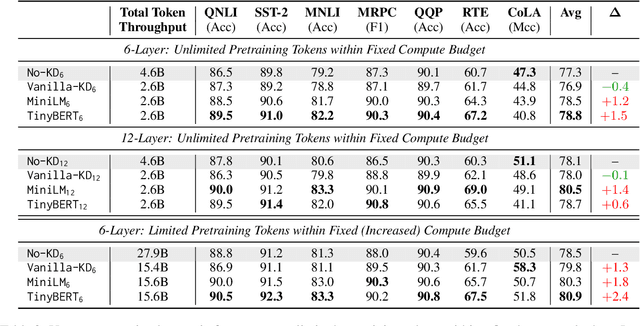
Compared to standard language model (LM) pretraining (i.e., from scratch), Knowledge Distillation (KD) entails an additional forward pass through a teacher model that is typically substantially larger than the target student model. As such, KD in LM pretraining materially slows down throughput of pretraining instances vis-a-vis pretraining from scratch. Scaling laws of LM pretraining suggest that smaller models can close the gap to larger counterparts if trained on more data (i.e., processing more tokens)-and under a fixed computation budget, smaller models are able be process more data than larger models. We thus hypothesize that KD might, in fact, be suboptimal to pretraining from scratch for obtaining smaller LMs, when appropriately accounting for the compute budget. To test this, we compare pretraining from scratch against several KD strategies for masked language modeling (MLM) in a fair experimental setup, with respect to amount of computation as well as pretraining data. Downstream results on GLUE, however, do not confirm our hypothesis: while pretraining from scratch performs comparably to ordinary KD under a fixed computation budget, more sophisticated KD strategies, namely TinyBERT (Jiao et al., 2020) and MiniLM (Wang et al., 2023), outperform it by a notable margin. We further find that KD yields larger gains over pretraining from scratch when the data must be repeated under the fixed computation budget.
MIND Your Language: A Multilingual Dataset for Cross-lingual News Recommendation
Mar 26, 2024


Digital news platforms use news recommenders as the main instrument to cater to the individual information needs of readers. Despite an increasingly language-diverse online community, in which many Internet users consume news in multiple languages, the majority of news recommendation focuses on major, resource-rich languages, and English in particular. Moreover, nearly all news recommendation efforts assume monolingual news consumption, whereas more and more users tend to consume information in at least two languages. Accordingly, the existing body of work on news recommendation suffers from a lack of publicly available multilingual benchmarks that would catalyze development of news recommenders effective in multilingual settings and for low-resource languages. Aiming to fill this gap, we introduce xMIND, an open, multilingual news recommendation dataset derived from the English MIND dataset using machine translation, covering a set of 14 linguistically and geographically diverse languages, with digital footprints of varying sizes. Using xMIND, we systematically benchmark several state-of-the-art content-based neural news recommenders (NNRs) in both zero-shot (ZS-XLT) and few-shot (FS-XLT) cross-lingual transfer scenarios, considering both monolingual and bilingual news consumption patterns. Our findings reveal that (i) current NNRs, even when based on a multilingual language model, suffer from substantial performance losses under ZS-XLT and that (ii) inclusion of target-language data in FS-XLT training has limited benefits, particularly when combined with a bilingual news consumption. Our findings thus warrant a broader research effort in multilingual and cross-lingual news recommendation. The xMIND dataset is available at https://github.com/andreeaiana/xMIND.
IRCoder: Intermediate Representations Make Language Models Robust Multilingual Code Generators
Mar 06, 2024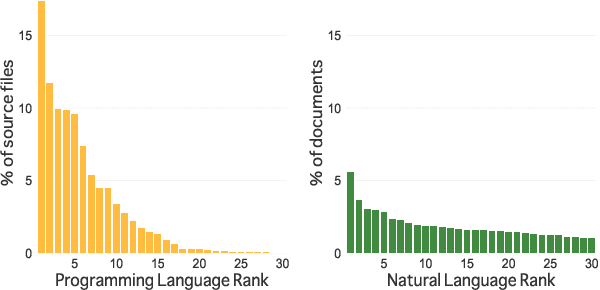
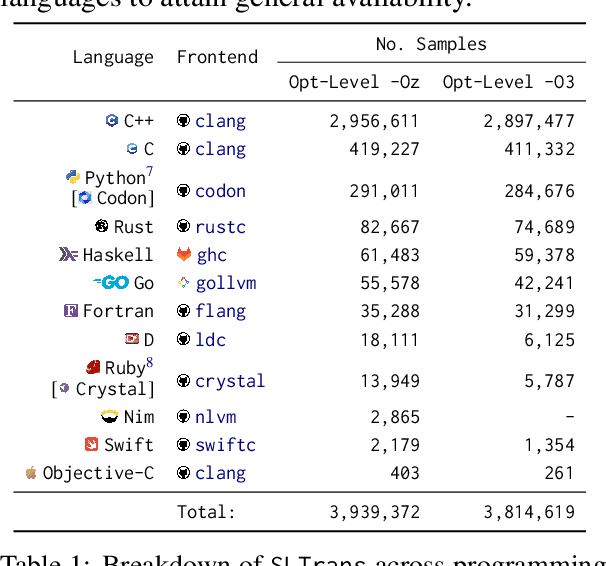
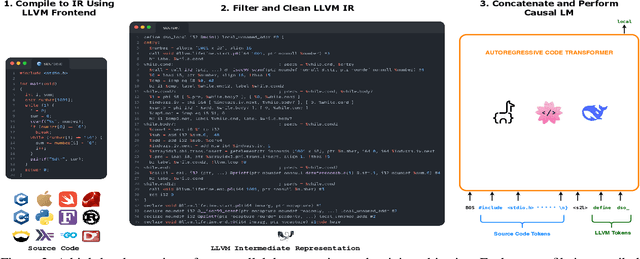

Code understanding and generation have fast become some of the most popular applications of language models (LMs). Nonetheless, research on multilingual aspects of Code-LMs (i.e., LMs for code generation) such as cross-lingual transfer between different programming languages, language-specific data augmentation, and post-hoc LM adaptation, alongside exploitation of data sources other than the original textual content, has been much sparser than for their natural language counterparts. In particular, most mainstream Code-LMs have been pre-trained on source code files alone. In this work, we investigate the prospect of leveraging readily available compiler intermediate representations - shared across programming languages - to improve the multilingual capabilities of Code-LMs and facilitate cross-lingual transfer. To this end, we first compile SLTrans, a parallel dataset consisting of nearly 4M self-contained source code files coupled with respective intermediate representations. Next, starting from various base Code-LMs (ranging in size from 1.1B to 7.3B parameters), we carry out continued causal language modelling training on SLTrans, forcing the Code-LMs to (1) learn the IR language and (2) align the IR constructs with respective constructs of various programming languages. Our resulting models, dubbed IRCoder, display sizeable and consistent gains across a wide variety of code generation tasks and metrics, including prompt robustness, multilingual code completion, code understanding, and instruction following.
On Task Performance and Model Calibration with Supervised and Self-Ensembled In-Context Learning
Dec 22, 2023Following the standard supervised fine-tuning (SFT) paradigm, in-context learning (ICL) has become an efficient approach propelled by the recent advancements in large language models (LLMs), yielding promising performance across various tasks in few-shot data setups. However, both paradigms are prone to suffer from the critical problem of overconfidence (i.e., miscalibration), especially in such limited data setups. In this work, we deliver an in-depth analysis of the behavior across different choices of learning methods from the perspective of both performance and calibration, as well as their interplay. Through extensive controlled experiments, we find that simultaneous gains for both task performance and calibration are difficult to achieve, and the problem of miscalibration exists across all learning methods in low-resource scenarios. To address this challenging trade-off between performance and calibration, we then investigate the potential of self-ensembling techniques applied at different modeling stages (e.g., variations of in-context examples or variations in prompts or different ensembling strategies). We justify the feasibility of self-ensembling on SFT in addition to ICL, to make the predictions more calibrated and have comparable or even better performance. Our work sheds light on which learning paradigm to choose and how to enhance both task performance and calibration of LLMs.
SQATIN: Supervised Instruction Tuning Meets Question Answering for Improved Dialogue NLU
Nov 16, 2023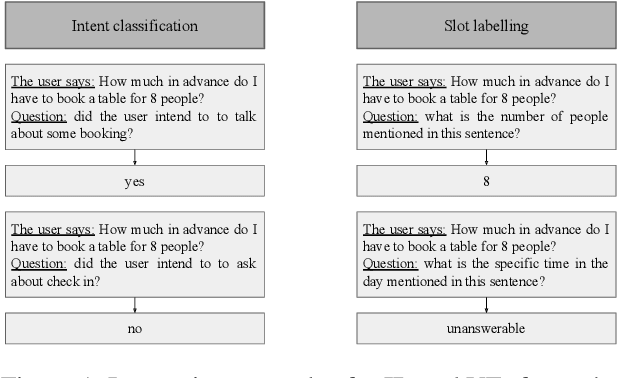
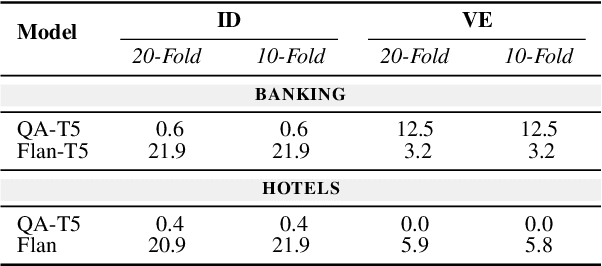
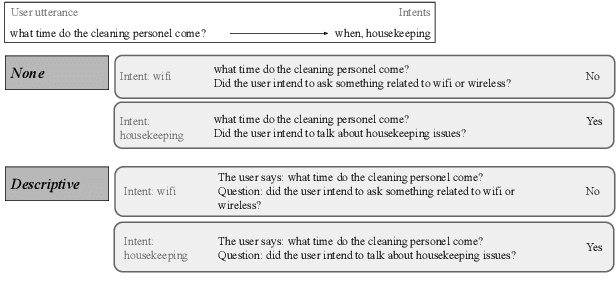
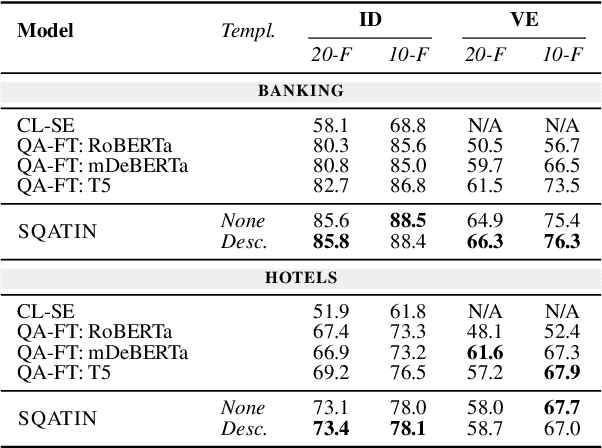
Task-oriented dialogue (ToD) systems help users execute well-defined tasks across a variety of domains (e.g., $\textit{flight booking}$ or $\textit{food ordering}$), with their Natural Language Understanding (NLU) components being dedicated to the analysis of user utterances, predicting users' intents ($\textit{Intent Detection}$, ID) and extracting values for informational slots ($\textit{Value Extraction}$, VE). In most domains, labelled NLU data is scarce, making sample-efficient learning -- enabled with effective transfer paradigms -- paramount. In this work, we introduce SQATIN, a new framework for dialog NLU based on (i) instruction tuning and (ii) question-answering-based formulation of ID and VE tasks. According to the evaluation on established NLU benchmarks, SQATIN sets the new state of the art in dialogue NLU, substantially surpassing the performance of current models based on standard fine-tuning objectives in both in-domain training and cross-domain transfer. SQATIN yields particularly large performance gains in cross-domain transfer, owing to the fact that our QA-based instruction tuning leverages similarities between natural language descriptions of classes (i.e., slots and intents) across domains.
To Translate or Not to Translate: A Systematic Investigation of Translation-Based Cross-Lingual Transfer to Low-Resource Languages
Nov 15, 2023Perfect machine translation (MT) would render cross-lingual transfer (XLT) by means of multilingual language models (LMs) superfluous. Given, on one hand, the large body of work on improving XLT with multilingual LMs and, on the other hand, recent advances in massively multilingual MT, in this work, we systematically evaluate existing and propose new translation-based XLT approaches for transfer to low-resource languages. We show that all translation-based approaches dramatically outperform zero-shot XLT with multilingual LMs, rendering the approach that combines the round-trip translation of the source-language training data with the translation of the target-language test instances the most effective. We next show that one can obtain further empirical gains by adding reliable translations to other high-resource languages to the training data. Moreover, we propose an effective translation-based XLT strategy even for languages not supported by the MT system. Finally, we show that model selection for XLT based on target-language validation data obtained with MT outperforms model selection based on the source-language data. We hope that our findings encourage adoption of more robust translation-based baselines in XLT research.
Vicinal Risk Minimization for Few-Shot Cross-lingual Transfer in Abusive Language Detection
Nov 03, 2023Cross-lingual transfer learning from high-resource to medium and low-resource languages has shown encouraging results. However, the scarcity of resources in target languages remains a challenge. In this work, we resort to data augmentation and continual pre-training for domain adaptation to improve cross-lingual abusive language detection. For data augmentation, we analyze two existing techniques based on vicinal risk minimization and propose MIXAG, a novel data augmentation method which interpolates pairs of instances based on the angle of their representations. Our experiments involve seven languages typologically distinct from English and three different domains. The results reveal that the data augmentation strategies can enhance few-shot cross-lingual abusive language detection. Specifically, we observe that consistently in all target languages, MIXAG improves significantly in multidomain and multilingual environments. Finally, we show through an error analysis how the domain adaptation can favour the class of abusive texts (reducing false negatives), but at the same time, declines the precision of the abusive language detection model.
AdaSent: Efficient Domain-Adapted Sentence Embeddings for Few-Shot Classification
Nov 01, 2023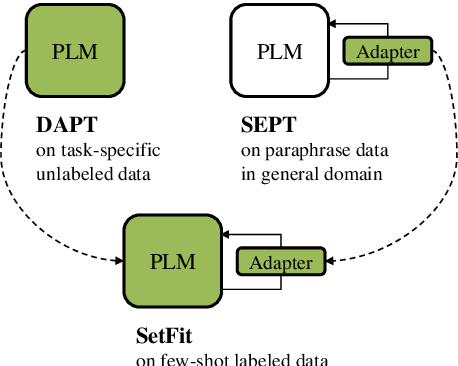

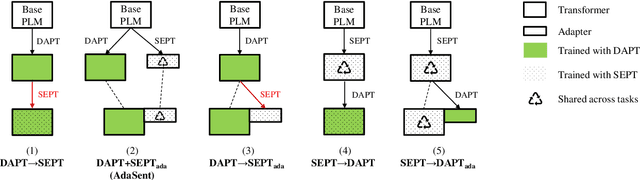
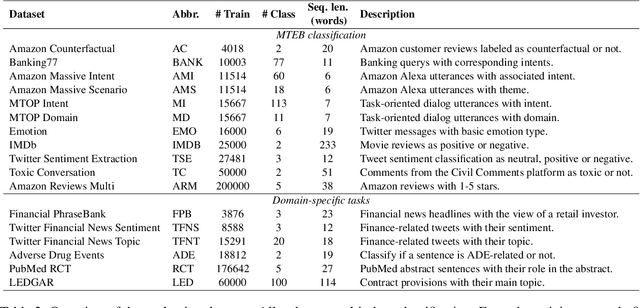
Recent work has found that few-shot sentence classification based on pre-trained Sentence Encoders (SEs) is efficient, robust, and effective. In this work, we investigate strategies for domain-specialization in the context of few-shot sentence classification with SEs. We first establish that unsupervised Domain-Adaptive Pre-Training (DAPT) of a base Pre-trained Language Model (PLM) (i.e., not an SE) substantially improves the accuracy of few-shot sentence classification by up to 8.4 points. However, applying DAPT on SEs, on the one hand, disrupts the effects of their (general-domain) Sentence Embedding Pre-Training (SEPT). On the other hand, applying general-domain SEPT on top of a domain-adapted base PLM (i.e., after DAPT) is effective but inefficient, since the computationally expensive SEPT needs to be executed on top of a DAPT-ed PLM of each domain. As a solution, we propose AdaSent, which decouples SEPT from DAPT by training a SEPT adapter on the base PLM. The adapter can be inserted into DAPT-ed PLMs from any domain. We demonstrate AdaSent's effectiveness in extensive experiments on 17 different few-shot sentence classification datasets. AdaSent matches or surpasses the performance of full SEPT on DAPT-ed PLM, while substantially reducing the training costs. The code for AdaSent is available.
Linking Surface Facts to Large-Scale Knowledge Graphs
Oct 23, 2023


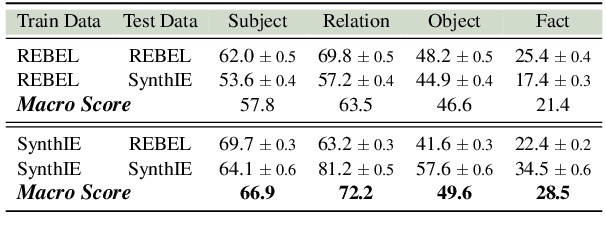
Open Information Extraction (OIE) methods extract facts from natural language text in the form of ("subject"; "relation"; "object") triples. These facts are, however, merely surface forms, the ambiguity of which impedes their downstream usage; e.g., the surface phrase "Michael Jordan" may refer to either the former basketball player or the university professor. Knowledge Graphs (KGs), on the other hand, contain facts in a canonical (i.e., unambiguous) form, but their coverage is limited by a static schema (i.e., a fixed set of entities and predicates). To bridge this gap, we need the best of both worlds: (i) high coverage of free-text OIEs, and (ii) semantic precision (i.e., monosemy) of KGs. In order to achieve this goal, we propose a new benchmark with novel evaluation protocols that can, for example, measure fact linking performance on a granular triple slot level, while also measuring if a system has the ability to recognize that a surface form has no match in the existing KG. Our extensive evaluation of several baselines show that detection of out-of-KG entities and predicates is more difficult than accurate linking to existing ones, thus calling for more research efforts on this difficult task. We publicly release all resources (data, benchmark and code) on https://github.com/nec-research/fact-linking.