 Add to Chrome
 Add to Firefox
 Add to Edge
Deployment-Ready UWB Localization for Industrial Ground Robots with Automatic Anchor Calibration and Terrain-Aware Fusion
Jul 17, 2026
Ultra-Wideband (UWB) ranging has become a viable option for industrial Autonomous Mobile Robot (AMR) localization due to improved accuracy and low cost. However, real-world deployments remain limited by two recurring challenges: calibrating static anchors can be time-consuming and error-prone, and integrating UWB with existing onboard sensors requires careful design to ensure robust and consistent pose estimation. Addressing these challenges, this paper presents an end-to-end pipeline that combines automatic anchor calibration with a generic multi-sensor estimator tailored to surface-bound vehicle motion. It targets existing AMR stacks in scenarios where robot pose priors are available for initialization. The calibration stage estimates anchor positions and range biases, while the localization stage fuses UWB with proprioceptive sensing in a bias-aware Extended Kalman Filter to improve consistency without extensive parameter tuning. Experiments on a commercial logistics AMR in a warehouse setting demonstrate accurate positioning indoors and across outdoor transitions, with improved consistency compared to an earlier estimator formulation. Evaluation on an independent forklift dataset further indicates transferability to other platforms. The method remains effective in test cases with limited line-of-sight and sparse anchor coverage. These results show that UWB localization can be deployed with substantially reduced manual effort while preserving the accuracy required for industrial AMRs. The collected warehouse dataset is made publicly available.

Galilean State Estimation for Inertial Navigation Systems with Unknown Time Delay
May 13, 2026Many Inertial Navigation Systems (INS) use Global Navigation Satellite System (GNSS) position as the primary measurement to drive filter performance and bound error growth. However, commercial-grade GNSS receivers introduce unknown measurement delays ranging from 50 ms to 300 ms depending on sensor quality and operating mode. Such time delays can significantly degrade INS performance unless they are explicitly compensated for. Existing algorithms commonly estimate this delay offline, run the filter concurrently with GNSS measurements using buffered Inertial Measurement Unit (IMU) data, and predict the current state by forward-integrating buffered inertial measurements via IMU preintegration. The state-of-the-art online method is an Extended Kalman Filter (EKF) that explicitly models the time delay as a state parameter, which defines the preintegration duration. This paper introduces a novel geometric framework for modeling time-delayed INS, in which Galilean symmetry is leveraged to provide a joint representation of space and time for consistent state estimation. An Equivariant Filter (EqF) is derived for the coupled estimation of navigation states and time delay. Validation is performed on two fixed-wing Uncrewed Aerial Vehicles (UAV) with GNSS time lags of 90 ms and 120 ms. The test flights last two to three minutes. Simulations further investigate delays up to 500 ms and provide a statistical comparison against the state-of-the-art EKF. Results show that the EqF preserves accuracy and consistency, while the EKF lacks consistency and its performance degrades significantly with increasing measurement delays.
Equivariant Filter for Radar-Inertial Odometry
Apr 24, 2026Radar-Inertial Odometry (RIO) based on the Extended Kalman Filter (EKF) relies on accurate extrinsic calibration between the radar and the Inertial Measurement Unit (IMU) and is sensitive to disturbances, as large linearization errors can degrade performance or even cause divergence. To address these limitations, this letter proposes an Equivariant Filter (EqF) for RIO based on a Lie group symmetry that geometrically couples navigation states and IMU biases, extending it to incorporate radar-IMU extrinsic calibration and multi-state constraint updates. This equivariant formulation inherently preserves consistency and enhances robustness, enabling reliable state estimation even under poor or completely wrong initialization of calibration states. Real-world experiments on two different Uncrewed Aerial Vehicles (UAVs) show that the proposed EqF-RIO achieves state-of-the-art accuracy under correct extrinsic calibration and offers improved convergence under large calibration errors, where the conventional EKF-RIO fails. Evaluation code is open-sourced.
Reformulating AI-based Multi-Object Relative State Estimation for Aleatoric Uncertainty-based Outlier Rejection of Partial Measurements
Feb 02, 2026Precise localization with respect to a set of objects of interest enables mobile robots to perform various tasks. With the rise of edge devices capable of deploying deep neural networks (DNNs) for real-time inference, it stands to reason to use artificial intelligence (AI) for the extraction of object-specific, semantic information from raw image data, such as the object class and the relative six degrees of freedom (6-DoF) pose. However, fusing such AI-based measurements in an Extended Kalman Filter (EKF) requires quantifying the DNNs' uncertainty and outlier rejection capabilities. This paper presents the benefits of reformulating the measurement equation in AI-based, object-relative state estimation. By deriving an EKF using the direct object-relative pose measurement, we can decouple the position and rotation measurements, thus limiting the influence of erroneous rotation measurements and allowing partial measurement rejection. Furthermore, we investigate the performance and consistency improvements for state estimators provided by replacing the fixed measurement covariance matrix of the 6-DoF object-relative pose measurements with the predicted aleatoric uncertainty of the DNN.
Real-Time Initialization of Unknown Anchors for UWB-aided Navigation
Jun 18, 2025This paper presents a framework for the real-time initialization of unknown Ultra-Wideband (UWB) anchors in UWB-aided navigation systems. The method is designed for localization solutions where UWB modules act as supplementary sensors. Our approach enables the automatic detection and calibration of previously unknown anchors during operation, removing the need for manual setup. By combining an online Positional Dilution of Precision (PDOP) estimation, a lightweight outlier detection method, and an adaptive robust kernel for non-linear optimization, our approach significantly improves robustness and suitability for real-world applications compared to state-of-the-art. In particular, we show that our metric which triggers an initialization decision is more conservative than current ones commonly based on initial linear or non-linear initialization guesses. This allows for better initialization geometry and subsequently lower initialization errors. We demonstrate the proposed approach on two different mobile robots: an autonomous forklift and a quadcopter equipped with a UWB-aided Visual-Inertial Odometry (VIO) framework. The results highlight the effectiveness of the proposed method with robust initialization and low positioning error. We open-source our code in a C++ library including a ROS wrapper.
Equivariant IMU Preintegration with Biases: a Galilean Group Approach
Nov 24, 2024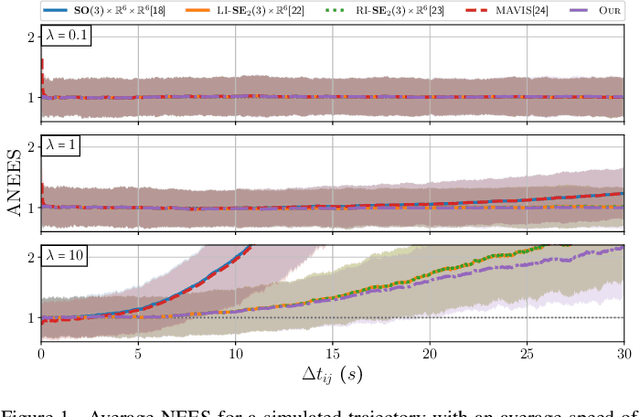
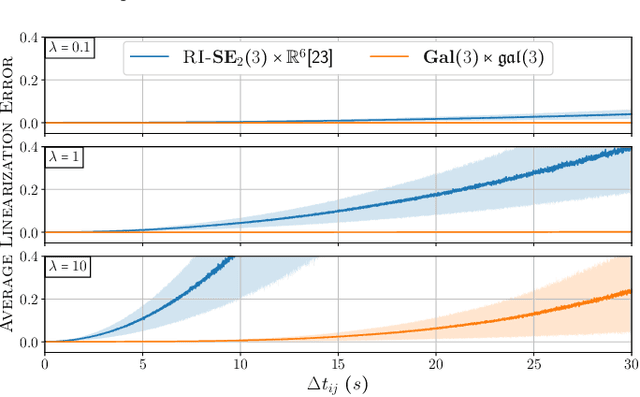
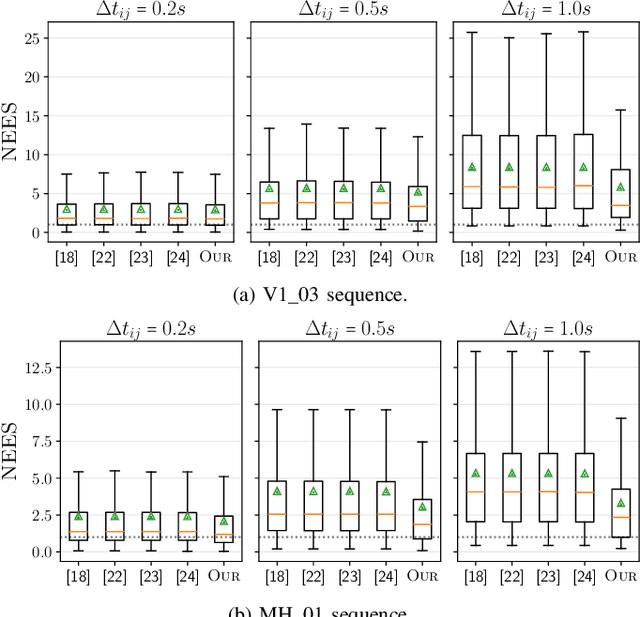

This letter proposes a new approach for Inertial Measurement Unit (IMU) preintegration, a fundamental building block that can be leveraged in different optimization-based Inertial Navigation System (INS) localization solutions. Inspired by recent advances in equivariant theory applied to biased INSs, we derive a discrete-time formulation of the IMU preintegration on ${\mathbf{Gal}(3) \ltimes \mathfrak{gal}(3)}$, the left-trivialization of the tangent group of the Galilean group $\mathbf{Gal}(3)$. We define a novel preintegration error that geometrically couples the navigation states and the bias leading to lower linearization error. Our method improves in consistency compared to existing preintegration approaches which treat IMU biases as a separate state-space. Extensive validation against state-of-the-art methods, both in simulation and with real-world IMU data, implementation in the Lie++ library, and open-source code are provided.
Equivariant IMU Preintegration with Biases: an Inhomogeneous Galilean Group Approach
Nov 08, 2024This letter proposes a new approach for Inertial Measurement Unit (IMU) preintegration, a fundamental building block that can be leveraged in different optimization-based Inertial Navigation System (INS) localization solutions. Inspired by recent advancements in equivariant theory applied to biased INSs, we derive a discrete-time formulation of the IMU preintegration on $\mathbf{G}(3) \ltimes \mathfrak{g}(3)$, the tangent group of the inhomogeneous Galilean group $\mathbf{G}(3)$. We define a novel preintegration error that geometrically couples the navigation states and the bias leading to lower linearization error. Our method improves in consistency compared to existing preintegration approaches which treat IMU biases as a separate state-space. Extensive validation against state-of-the-art methods, both in simulation and with real-world IMU data, implementation in the Lie++ library, and open-sourcing of the code are provided.
UVIO: An UWB-Aided Visual-Inertial Odometry Framework with Bias-Compensated Anchors Initialization
Aug 01, 2023This paper introduces UVIO, a multi-sensor framework that leverages Ultra Wide Band (UWB) technology and Visual-Inertial Odometry (VIO) to provide robust and low-drift localization. In order to include range measurements in state estimation, the position of the UWB anchors must be known. This study proposes a multi-step initialization procedure to map multiple unknown anchors by an Unmanned Aerial Vehicle (UAV), in a fully autonomous fashion. To address the limitations of initializing UWB anchors via a random trajectory, this paper uses the Geometric Dilution of Precision (GDOP) as a measure of optimality in anchor position estimation, to compute a set of optimal waypoints and synthesize a trajectory that minimizes the mapping uncertainty. After the initialization is complete, the range measurements from multiple anchors, including measurement biases, are tightly integrated into the VIO system. While in range of the initialized anchors, the VIO drift in position and heading is eliminated. The effectiveness of UVIO and our initialization procedure has been validated through a series of simulations and real-world experiments.